


Why Navigation Testing Has a Cost Problem
Formal user research for navigation — moderated usability studies, professional A/B testing platforms, recruited participant panels — produces excellent insights but at costs that are impractical for stores under $1M annual revenue. A single moderated usability study with 8 participants costs $3,000–8,000. A/B testing navigation changes requires both a testing platform subscription ($100–500/month) and sufficient traffic to achieve statistical significance (typically 1,000+ visitors per variant per week, meaning months of testing for smaller stores). These are real tools producing real insights — they're just priced for enterprises, not for growing independent stores.
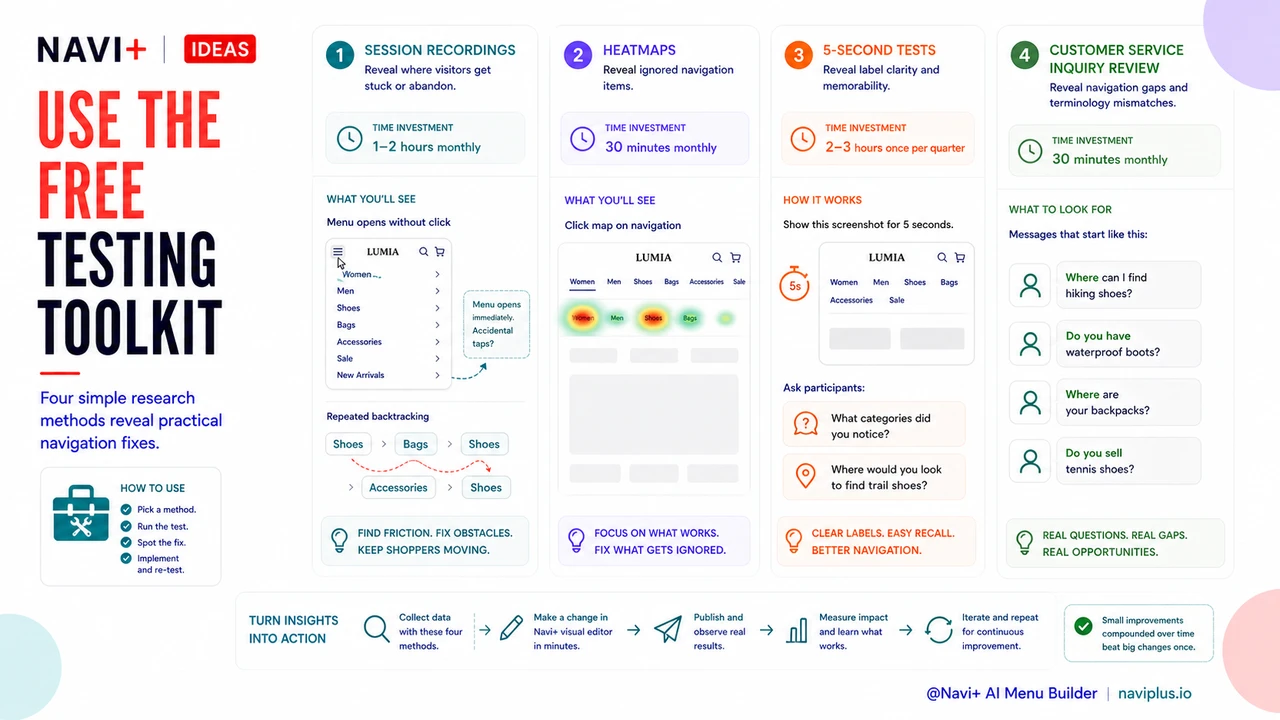
The alternative is free navigation research methods that trade some statistical rigor for near-zero cost. These methods won't produce the p-value certainty of a proper A/B test, but they produce directionally reliable signals about what's working and what isn't — signals that are more than sufficient for making confident navigation improvement decisions without spending thousands of dollars on research infrastructure.
"I discovered our biggest navigation problem entirely for free. Microsoft Clarity (free session recording) showed me that on mobile, visitors were tapping our hamburger menu, the menu would open, and then they'd immediately close it without clicking anything. They were opening the menu, scanning it, finding nothing obvious, and giving up. I watched maybe 15 of these sessions and saw the pattern clearly. The fix was moving our top-selling category to the first Slide Menu item. I didn't need a usability study to see that — I just needed to watch real people use the navigation."
— A Navi+ customer, outdoor gear brand
The Free Navigation Testing Toolkit
Session recording with Microsoft Clarity or Hotjar (free tier). Session recording tools capture anonymized video recordings of real visitor sessions — you can watch how visitors actually navigate your store, including where they click, where they scroll, and where they abandon. Both Microsoft Clarity (fully free, unlimited sessions) and Hotjar (free tier with limited monthly sessions) provide session recordings. For navigation research, filter session recordings by mobile devices and watch 20–30 sessions to identify navigation friction patterns. The most valuable patterns to look for: menu opens without a subsequent click (visitor scanned but found nothing obvious), repeated back-and-forward navigation between categories (visitor can't find the right category), and sessions that end shortly after a navigation interaction (navigation friction leading to abandonment).
Heatmap analysis for navigation click distribution. Heatmaps show which navigation elements receive the most clicks across all visitors, giving a quantitative view of which categories are driving engagement and which are being ignored. Both Clarity and Hotjar provide heatmaps. For navigation, the most useful heatmap view is the click map on your homepage and top-level category pages, showing which navigation links are clicked and which are not. Navigation items that receive zero or near-zero clicks despite being prominent positions are either mislabeled or addressing a need visitors don't have — and are candidates for removal or renaming.
The 5-second test with friends, family, or social followers. The 5-second test is a free method that provides direct feedback on navigation clarity. Show someone your navigation (a screenshot of your open mobile menu is ideal) for exactly 5 seconds, then close it and ask: "What categories did you notice?" and "If you wanted to find [specific product type], where would you look?" Five-second tests with 5–10 people who resemble your target customer — friends, family members, or even a quick social media post asking for volunteers — consistently reveal which navigation labels are memorable and which are overlooked, and which category names visitors recognize versus which ones require translation in their heads. This costs nothing except the time to run it.
Customer service inquiry analysis as passive navigation research. Every customer who emails asking "where can I find [product]?" or "do you carry [type of thing]?" is generating free navigation research. These inquiries identify the navigation gaps — categories that aren't clear enough, products that aren't findable through the existing structure, terminology that customers use that the navigation doesn't match. A monthly review of customer service inquiries for navigation-related questions (any question that starts with "where" or "do you have") provides a continuous, zero-cost stream of navigation improvement ideas from real customers who encountered real problems.
| Free Research Method | What It Reveals | Time Investment |
|---|---|---|
| Session recordings | Where visitors get stuck or abandon | 1–2 hours monthly |
| Heatmaps | Which navigation items are ignored | 30 minutes monthly |
| 5-second tests | Label clarity and memorability | 2–3 hours once per quarter |
| Customer service inquiry review | Navigation gaps and terminology mismatches | 30 minutes monthly |
From Research to Action Without A/B Testing
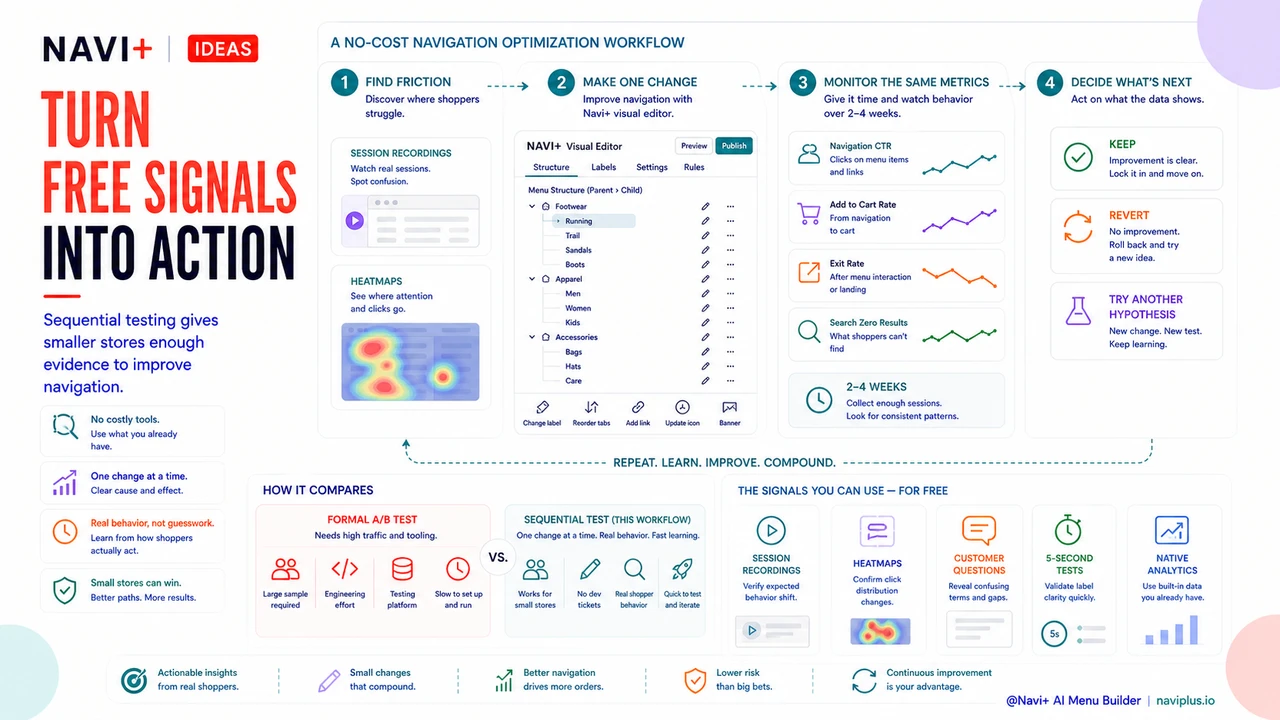
The standard advice for validating navigation changes is to A/B test them. For stores with insufficient traffic for statistical A/B testing, the alternative is sequential testing: make one navigation change at a time, monitor the metrics that change produces over 2–4 weeks, and use the direction of the change (positive or negative) as evidence for the next decision. Sequential testing doesn't produce the same statistical certainty as proper A/B testing, but it's far better than making changes based on intuition alone — and it's far more actionable than waiting for the traffic volumes that would make A/B testing feasible. Combined with session recordings to verify that the change produced the expected behavioral shift, sequential testing provides sufficient signal for navigation optimization in stores below the traffic thresholds where formal A/B testing pays off.
無料で試す — コード不要、開発者不要
Shopify、WordPress、またはあらゆるウェブサイトに数分でインストール。