


The Abandonment Problem Most Stores Are Solving Wrong
Mobile cart abandonment rates across e-commerce average 85–90% — substantially higher than desktop abandonment rates of 70–75%. The conventional response to high cart abandonment is checkout optimization: simplify the form, add saved payment methods, reduce the number of steps, offer express checkout options. These are worthwhile improvements. But they address only the abandonment that happens during checkout — a relatively small fraction of total mobile abandonment.
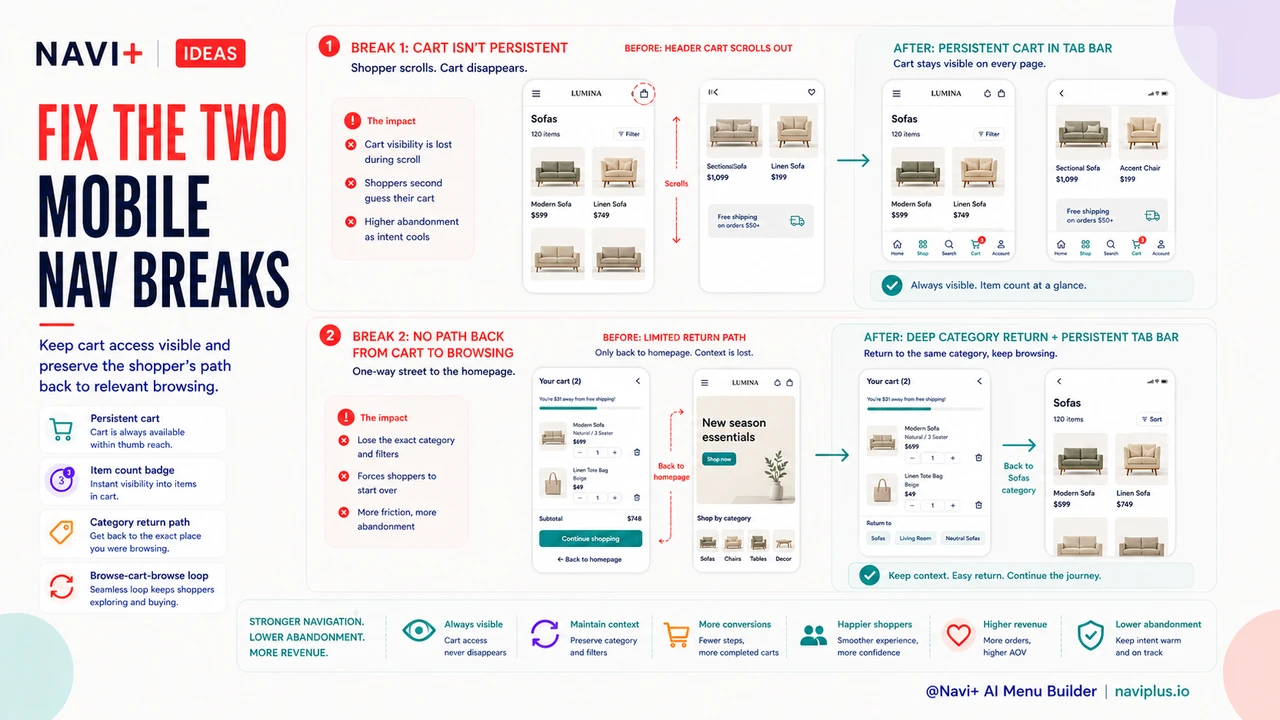
The more significant abandonment event on mobile happens earlier: visitors who added a product to cart, then navigated away from the cart to "keep browsing," then couldn't find their way back efficiently and left. This navigation-after-cart-add abandonment is common on mobile and virtually invisible in most analytics setups because it doesn't register as checkout abandonment — it registers as a session that included a cart add but no purchase, which could be interpreted as a browsing session that never quite reached checkout intent.
The data tells a different story. Heatmap and session recording analysis consistently shows mobile shoppers navigating back from the cart, browsing additional products, and then exiting the store without returning to checkout — not because checkout was hard, but because re-navigation back to the cart after browsing was hard. A mobile navigation system that makes cart access persistent and one-tap from anywhere eliminates this abandonment mode entirely.
"Our session recordings showed a pattern we hadn't noticed in aggregate data: mobile users would add something to cart, navigate to browse more products, and then can't find the cart easily. Some would try a few times. Most would leave. When we added cart access to the Tab Bar — a persistent cart icon with a count badge, visible everywhere — mobile add-to-cart completion rate (the percentage of cart adds that ended in purchase) went up measurably within two weeks. We'd been solving the wrong problem for a year."
— A Navi+ customer, multi-category retail brand
The Two Navigation Patterns That Drive Mobile Abandonment
Two specific mobile navigation failure patterns account for a disproportionate share of mobile abandonment:
No persistent cart access. On most default Shopify themes, the cart is accessible through the header — which scrolls out of view on mobile when a visitor scrolls down a product page or category page. A visitor who scrolls through 12 products and wants to check their cart has to scroll back to the top of the page, or navigate to a new page, to access the cart. This friction is small per instance but cumulative across a browse session. A persistent cart icon in the Tab Bar eliminates this scroll-and-search friction entirely.
No direct path back to browsing from the cart. Visitors who navigate to the cart to review it often want to continue shopping — to add one more item, compare with another product, or check a different size. If the cart page doesn't provide clear, fast navigation back to the relevant category (rather than only a "Continue Shopping" link that goes to the homepage), visitors who check their cart may lose the browsing thread and exit. Deep category navigation accessible from the cart page or persistent in a Tab Bar keeps the browse-to-cart-to-browse loop intact.
The Cost-Benefit of Navigation-Focused Abandonment Reduction
Addressing mobile abandonment through navigation improvement is systematically cheaper than addressing it through checkout optimization:
| Abandonment Reduction Approach | Cost | Addresses Which Abandonment |
|---|---|---|
| Checkout flow redesign | $3,000–$15,000 development cost | Checkout-stage abandonment only (~15% of mobile sessions) |
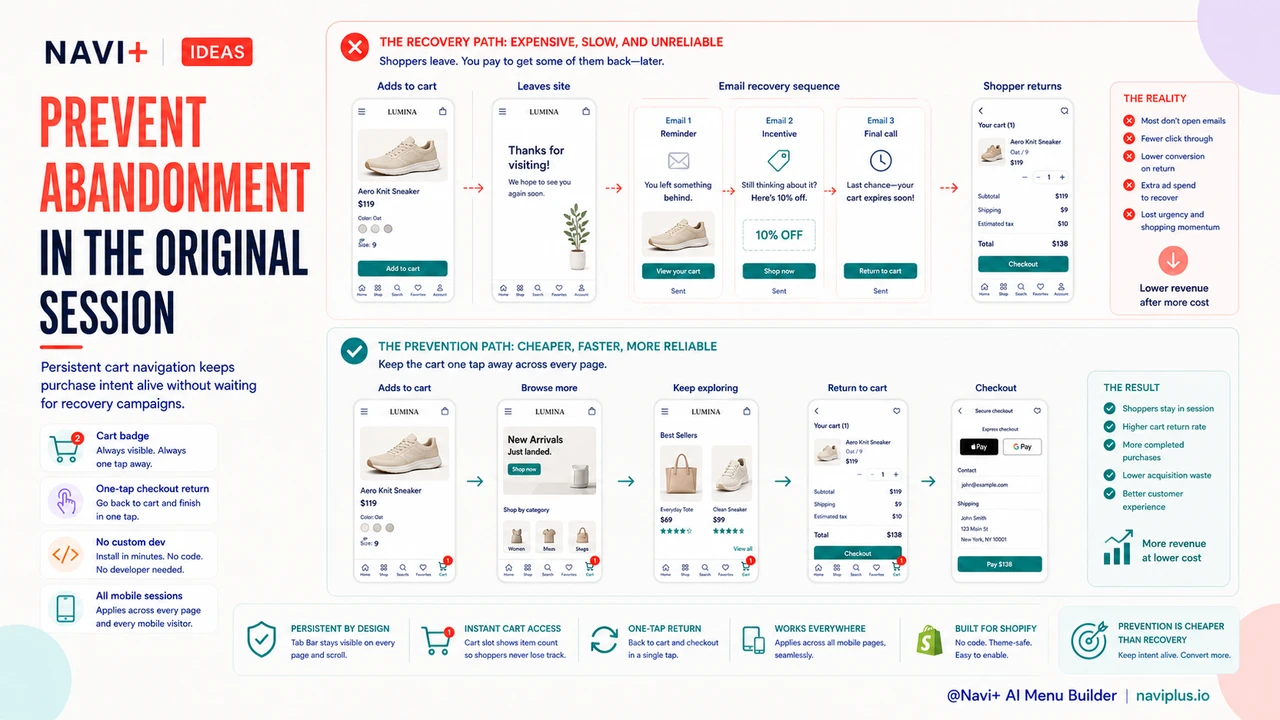
| Cart abandonment email sequence | Ongoing ESP cost + management | Post-session recovery only — doesn't prevent abandonment |
| Persistent cart in Tab Bar (Navi+) | Monthly subscription | Pre-checkout navigation abandonment — prevents loss before it happens |
Preventing abandonment is cheaper than recovering from it. An abandoned cart email sequence that recovers 5% of abandoners at a 10% recovery rate generates a fraction of the revenue of a navigation improvement that prevents 10% of the abandonment events from occurring in the first place. Navigation-based abandonment prevention doesn't require the visitor to return — it keeps them engaged through the original session.
Navi+'s Tab Bar supports a persistent cart slot with item count badge — the same pattern used by native shopping apps that have driven dramatic improvements in mobile commerce completion rates over the last decade. Bringing this pattern to a Shopify store requires no custom development and takes effect across all mobile sessions from the moment it's published.
Try it free — no code, no developer needed
Install in minutes on Shopify, WordPress, or any website.