


The Fundamental Asymmetry Between Ads and Navigation
Advertising is a tap. When you open it, traffic flows. When you close it — or when the budget runs out — the tap shuts off and the flow stops. Every dollar spent on an ad campaign purchases a fixed, finite batch of attention. Once that batch is consumed, the benefit is gone.
Navigation improvement is a multiplier on every session your store will ever receive. A better menu, a more intuitive category structure, or a smarter mobile navigation experience does not expire at the end of a campaign cycle. It works on the next visitor, and the visitor after that, and every visitor who arrives from any channel — paid, organic, email, social, referral — for as long as the improvement exists. The return does not stop accruing when you stop paying. It compounds forward indefinitely.
This is not a subtle difference. It is a structural asymmetry in how the two types of spending generate returns. And yet most e-commerce stores allocate enormous, growing budgets to advertising while the navigation investment budget stays at zero. Understanding why this happens — and why it's backwards — is the first step toward correcting it.
The $100 Math: Ads vs. Navigation Side by Side
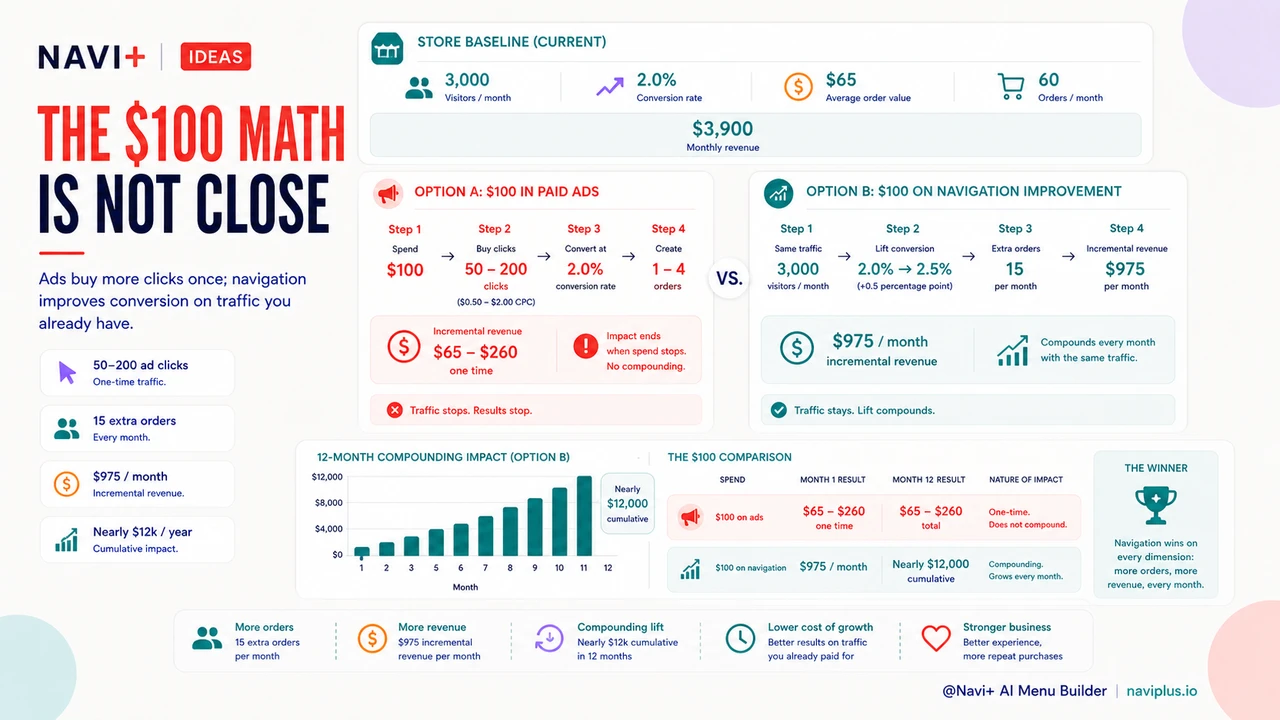
To make the comparison concrete, consider a mid-sized e-commerce store receiving 3,000 visitors per month with a 2.0% conversion rate and an average order value of $65. That store is currently generating 60 orders and $3,900 in monthly revenue.
Now consider two ways that store could spend $100 in a given month.
Option A: $100 in paid advertising. At typical e-commerce cost-per-click rates of $0.50–$2.00, that $100 buys approximately 50 to 200 additional clicks. If those clicks convert at the store's existing 2.0% rate, the store earns 1 to 4 additional orders — between $65 and $260 in incremental revenue. When the campaign ends, the benefit ends with it. Next month's $100 buy the same batch of clicks all over again.
Option B: $100 in navigation improvement. A navigation improvement that raises the store's conversion rate from 2.0% to 2.5% on the existing 3,000 monthly visitors produces 15 additional conversions per month — $975 in additional monthly revenue. Not once. Every month. The improvement persists. Month two delivers the same $975 lift. Month six delivers it again. By month twelve, a single $100 navigation investment has compounded into nearly $12,000 in cumulative incremental revenue, all from traffic the store was already paying to acquire.
The comparison is not close. And notably, the navigation improvement also makes the paid traffic from Option A convert better — which improves the ROI of ad spend too.
Modeling the Comparison Honestly
The right framework for comparing these two investment types uses different formulas for each, because the return profiles are fundamentally different.
For advertising: incremental revenue = new traffic volume × store conversion rate × average order value. This calculation is completed once. The result does not repeat unless you spend again.
For navigation investment: incremental revenue = existing traffic volume × conversion rate delta × average order value × months active. The months active variable is where the compounding happens. A navigation improvement that remains in place for 12 months generates 12× the monthly return. One that persists for 24 months generates 24×. There is no equivalent multiplier in advertising math.
The honest caveat: navigation improvement does not always produce a 0.5 percentage point conversion lift. Stores where navigation is a minor constraint on conversion will see smaller deltas. Stores where navigation is a major friction point — often those with large catalogs, complex category structures, or poorly optimized mobile experiences — can see larger lifts. The calculation above uses conservative, achievable numbers, not ceiling projections.
"We were spending $4,000 a month on retargeting people who bounced. When we fixed the navigation, bounces dropped — and so did the retargeting audience we needed to chase. We saved more on retargeting than we spent on Navi+. The conversion lift was almost secondary."
— A Navi+ customer, home goods brand
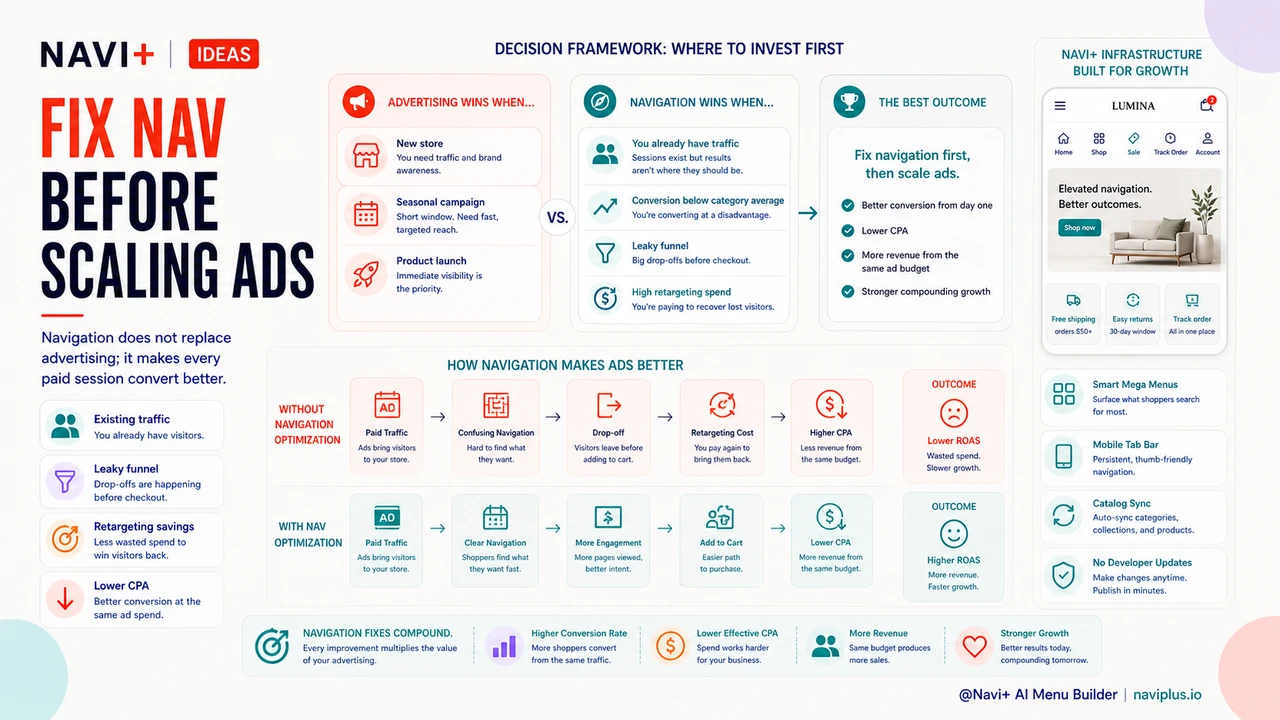
When Advertising Wins
This analysis is not an argument against advertising. There are situations where paid spend is the right tool and navigation investment is not the priority.
A brand new store with no existing traffic has no base to improve navigation on. The conversion rate delta math requires existing visitors. Before traffic exists, advertising is how you build the base. Navigation investment becomes high-leverage once a traffic foundation is in place.
Targeted seasonal campaigns — a holiday sale, a product launch, a flash event — benefit from advertising's speed and precision. If you need 5,000 people to see a specific offer in the next seven days, advertising is the right instrument. Navigation improvement does not deliver immediate, targeted reach on a timeline.
Product launches that need immediate visibility in a specific audience segment are similarly suited to paid. Navigation improvement cannot manufacture reach that does not yet exist.
The general principle: advertising wins when you need to acquire new traffic quickly, precisely, and on a defined timeline. Navigation wins when you already have traffic and need to convert more of it.
When Navigation Investment Wins
Navigation investment has a decisive advantage over advertising in two specific scenarios that affect a large proportion of operating e-commerce stores.
The first is any store with existing traffic converting below its category average. Industry conversion rate benchmarks for e-commerce typically range from 1.5% to 4%, with meaningful variation by category. A store receiving 5,000 monthly visitors and converting at 1.3% in a category where 2.5% is achievable has a structural problem — and that problem is almost never solved by buying more traffic. Adding visitors to a leaky funnel is expensive and inefficient. Fixing the funnel first, then scaling traffic, is the higher-return sequence.
The second scenario is stores running retargeting campaigns. Retargeting is built on the premise that visitors who left without converting can be brought back. But retargeting is expensive — CPMs for retargeting audiences are consistently higher than prospecting, and the return diminishes as audiences saturate. The root cause of retargeting need is visitor departure. Navigation is a primary driver of departure: visitors who cannot find what they are looking for leave, become retargeting audience, and cost money to re-engage. Improving navigation so fewer visitors leave in the first place reduces the retargeting audience that needs to be chased, which directly reduces retargeting cost. The navigation investment pays back through ad savings as well as conversion improvement.
The Neglect Pattern — and Why It Persists
Most e-commerce stores increase their advertising budgets quarterly, responding to pressure to grow revenue. The same stores almost never increase their navigation investment, because navigation investment is not a category most operators think about. Navigation is treated as infrastructure — a cost already sunk at store launch, not an ongoing lever for growth.
This pattern persists for a few reasons. Advertising results are visible and attributable. A $500 campaign that generates $1,800 in revenue shows up clearly in the dashboard. A navigation improvement that raises conversion rate by 0.4 points across all channels looks like organic growth and gets attributed to nothing in particular. The measurement gap makes navigation improvement look like it is doing nothing when it is often doing more than any single campaign.
The neglect pattern also persists because navigation improvement feels like a one-time project rather than an ongoing investment. When operators do think about navigation, they think about rebuilding the menu once and moving on. The reality is that navigation optimization — adapting to catalog changes, testing different structures, improving mobile experience, refining search integration — is continuous work that delivers continuous returns. That's the Navi+ model: infrastructure that keeps improving, not a one-time implementation.
The Compound Benefit: Navigation Makes Ads Better Too
The comparison between navigation investment and advertising spend is not actually an either/or choice. Navigation improvement does not compete with advertising — it multiplies it.
Paid traffic that lands on a store with poor navigation converts poorly, which makes the advertising ROI poor, which leads to increased spend to chase the same revenue targets, which creates a treadmill. Paid traffic that lands on a store with strong navigation converts better, which improves advertising ROI, which means the same budget generates more revenue — or the same revenue can be achieved with less budget.
Stores that optimize navigation first, then scale advertising, consistently outperform stores that scale advertising without fixing navigation. The navigation improvement lowers the effective cost per acquisition across every paid channel simultaneously. It's the highest-leverage preparation for an advertising budget increase.
Ad Spend vs. Navigation Investment: The Comparison
| Factor | Ad Spend ($100/month) | Navigation Investment ($100/month) |
|---|---|---|
| Traffic Generated | 50–200 net-new clicks, one time | No new traffic — works on existing visitors |
| Conversion Impact | Ad traffic converts at existing rate | Raises conversion rate across all traffic sources |
| Duration of Benefit | Ends when budget runs out | Persists indefinitely — every future session benefits |
| Requires Ongoing Spend | Yes — stop paying, stop receiving benefit | No — improvement compounds month over month |
| Affects Retargeting Cost | No direct impact | Reduces bounce, shrinks retargeting audience needed |
| Improves Ad ROI | No | Yes — paid traffic converts better on improved navigation |
What $100/Month in Navigation Infrastructure Looks Like
Navi+ is the navigation investment category for Shopify stores. For a monthly subscription that is a fraction of a single day's typical ad spend, Navi+ replaces the default theme navigation with infrastructure built specifically for conversion: smart mega menus, mobile-optimized navigation experiences, real-time catalog sync, and a management layer that requires no developer involvement to update.
The investment thesis is straightforward. Every session your store receives — paid, organic, email, direct — passes through navigation. An improvement to that layer returns value on every one of those sessions, permanently. That is the definition of leverage in a business: one change that improves the output of everything else running through it.
The question for most stores is not whether navigation improvement is worth $100 a month. It is why they have been spending that $100 — and the $500 and the $5,000 — on channels that reset to zero every 30 days instead.
Try it free — no code, no developer needed
Install in minutes on Shopify, WordPress, or any website.