


The Developer Dependency Tax
For most Shopify stores that were built by a developer or agency, navigation sits inside the theme code — liquid templates, CSS files, and occasionally JavaScript that handles dropdown behavior. This means that every navigation change, however small, requires either a developer to edit the code directly or the store owner to learn enough about the theme structure to make changes without breaking anything. Neither is a good default position for a store that needs to update its navigation for every promotional cycle, product launch, and seasonal campaign.
The cost of this dependency compounds over time. The direct cost is developer fees — even a simple navigation change (adding a new category, updating a label, adding a seasonal promotional link) can take a developer 30–60 minutes at $100–150/hour. Over a year of regular updates, this adds up quickly. But the indirect cost is frequently larger: the updates that don't get made. When updating navigation requires filing a ticket, waiting for developer availability, reviewing the work, and approving a deployment, the friction is high enough that many updates simply don't happen. The store's navigation becomes stale — not reflecting the current product catalog, current promotions, or current marketing strategy — because making it current is too operationally difficult.
"We ran eight promotional campaigns last year. Every single one required a developer ticket to update the navigation. Average turnaround was four days. We missed the launch window on three of those campaigns because the navigation wasn't updated in time. When I calculate what that cost us in revenue versus what Navi+ costs per month, it's not even close."
— A Navi+ customer, beauty brand founder
What Developer Independence Actually Looks Like
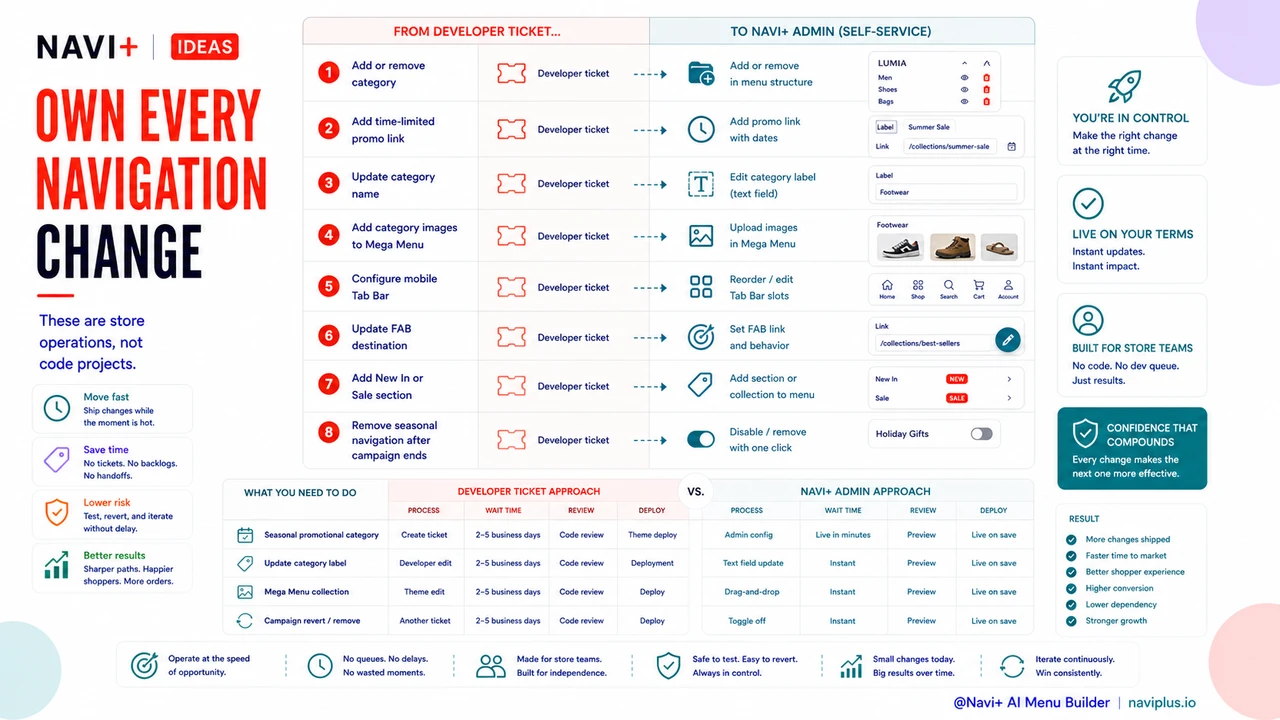
Developer independence for navigation means being able to do all of the following without filing a ticket, waiting for availability, or editing theme code:
- Add or remove a category from the primary navigation
- Add a time-limited promotional link ("Summer Sale" or "Holiday Gift Guide")
- Update a category name to better match how customers search
- Add category images to the Mega Menu for a new product line
- Configure the mobile Tab Bar for a new campaign period
- Update the FAB destination to point to a new collection
- Add a "New In" or "Sale" section at the start of a promotional period
- Remove seasonal navigation elements after a campaign ends
These are operational tasks, not development tasks. They're the equivalent of updating a price tag or rearranging a shelf display — actions that a store owner should be able to take without involving a specialist.
The Compounding Value of Navigation Agility
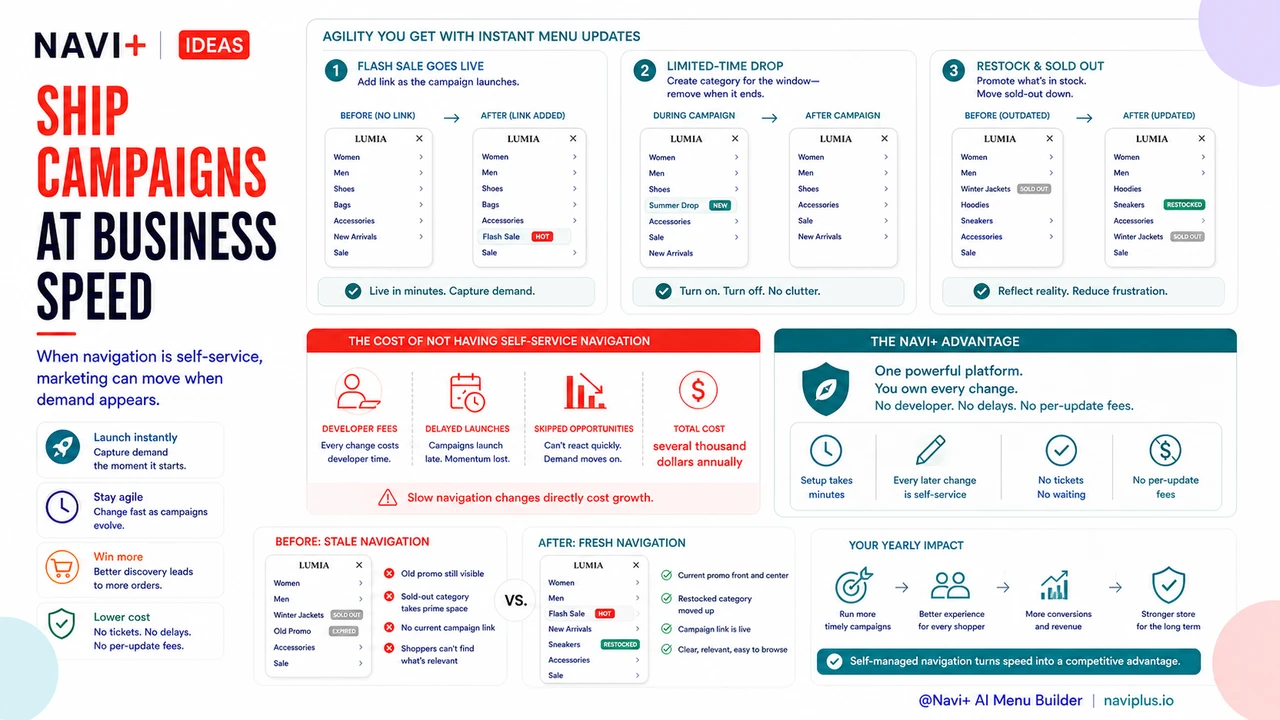
When navigation updates can happen in minutes rather than days, the range of marketing strategies that are practically executable expands significantly. Flash sales with navigation support. Limited-time category additions that appear the moment a campaign launches and disappear when it ends. Rapid testing of different category names to see which drives higher click-through. Immediate response to inventory changes — moving a sold-out category down and promoting a newly restocked one up.
None of these require advanced technical work. All of them require the ability to update navigation without a developer in the loop. Stores that have this capability can execute marketing strategy at the speed business moves. Stores that don't are always a few days behind their own campaigns.
| Navigation Task | With Developer Dependency | With Navi+ Self-Service |
|---|---|---|
| Add seasonal promotional category | Ticket → wait 2–5 days → review → deploy | Admin config → live in minutes |
| Update category label | Developer edit + deployment | Text field update, instant |
| Add new collection to Mega Menu | Theme edit + image upload + deploy | Drag-and-drop in Navi+ admin |
| Revert navigation after campaign ends | Another developer ticket | Toggle off in admin, immediate |
The Real Cost of Developer-Dependent Navigation
When you total the developer fees for navigation changes over a year, add the revenue impact of delayed campaign launches, and factor in the marketing opportunities that were skipped because the friction was too high, the cost of developer-dependent navigation is rarely less than several thousand dollars annually for an active store. For a store running frequent campaigns, it's often significantly more.
Navi+ AI Menu Builder costs a fraction of that and transfers full navigation control to the store owner. Setup takes minutes. Every change from that point forward is a self-service operation — no tickets, no waiting, no fees per update.
Try it free — no code, no developer needed
Install in minutes on Shopify, WordPress, or any website.