


Why Navigation Tests Are High-Leverage
A/B testing in e-commerce is most commonly applied to product pages, email subject lines, ad creative, and checkout flows. Navigation is tested less frequently, despite having a structural advantage over these other surfaces: navigation changes affect every visitor on every page, while product page tests affect only visitors who reach that specific product, and email tests affect only subscribers.
A navigation test that reaches 100% of sessions and produces a 0.2 percentage point conversion lift generates the same revenue increase as a product page test that reaches 40% of sessions and produces a 0.5 percentage point lift — but the navigation test is far easier to implement and has a broader second-order effect on session depth, pages per visit, and repeat purchase rate. The reach advantage of navigation makes it one of the most capital-efficient A/B testing surfaces available.
"Our most statistically significant test of the year was not a product page test or a checkout test — it was a Tab Bar label test. We tested 'Shop All' versus 'All Products' versus 'Browse' in the catch-all Tab Bar slot. 'Browse' won by 18% on navigation engagement and the revenue difference was measurable within 10 days. The test took 30 minutes to set up and required no developer. It's the test I recommend every store run in their first month of Navi+ — labels matter more than most people think."
— A Navi+ customer, specialty food brand
What to Test in Navigation
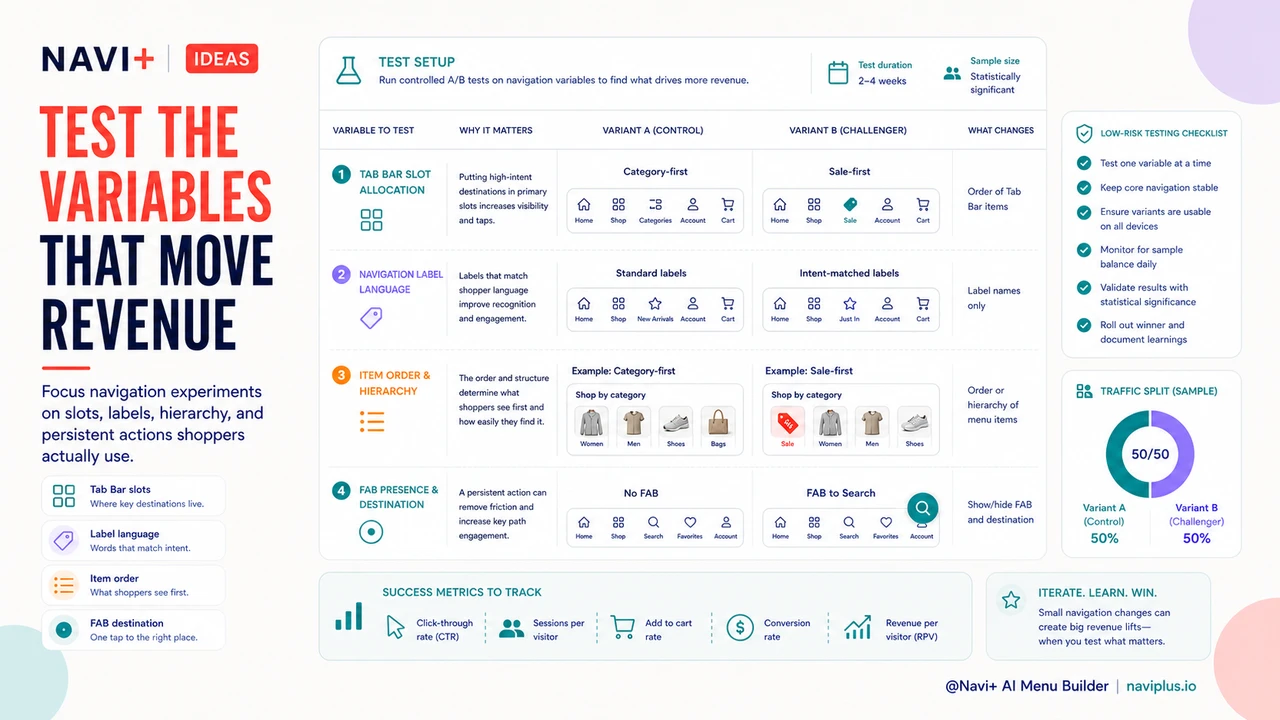
Not all navigation variables are equally testable or equally high-impact. The following variables consistently produce measurable results when tested:
Tab Bar slot allocation. Which five destinations occupy the Tab Bar is a strategic decision that most stores make once and never revisit. A/B testing Tab Bar configurations — swapping one slot for an alternative, comparing category-first versus sale-first configurations, testing a search slot versus a featured category slot — provides direct revenue-attributed data on which Tab Bar configuration serves the store's audience best. This is the highest-leverage navigation variable for most stores.
Navigation label language. "Sale" versus "Deals," "New Arrivals" versus "Just In," "Bestsellers" versus "Most Popular" — label language affects click-through rates in predictable and measurable ways. Testing labels is a low-risk, quick-turnaround experiment that can reveal significant differences in how visitors respond to different terminology. The winning label typically reflects the visitor's own language (from search queries, support emails, and reviews) rather than internal brand terminology.
Navigation item order and hierarchy. The first item in a navigation list receives disproportionate attention and clicks. Testing different orderings within a Mega Menu panel — which category appears first, which subcategory is featured at the top of a column — can meaningfully shift the distribution of traffic within a category, with conversion effects that depend on which categories have higher or lower conversion rates.
FAB presence and destination. Testing whether a FAB is present at all, and if so, which destination it points to, provides data on whether a persistent floating call-to-action adds value for the store's specific audience. Some stores find FABs increase conversion; others find them create distraction. Testing is cheaper than assuming.
How to Measure Navigation Test Results Correctly
Navigation tests are frequently misread because analysts measure the wrong metrics:
| Metric | Good for Navigation Tests? | Why / Why Not |
|---|---|---|
| Navigation click-through rate | Yes — primary engagement signal | Directly measures navigation effectiveness |
| Session conversion rate | Yes — ultimate revenue signal | Requires sufficient sample size (2+ weeks) |
| Bounce rate | Useful early signal | Navigation improvements often reduce bounce quickly |
| Specific page conversion rate | Misleading in isolation | Better navigation may send fewer but more qualified visitors to a page, inflating CVR without revenue gain |
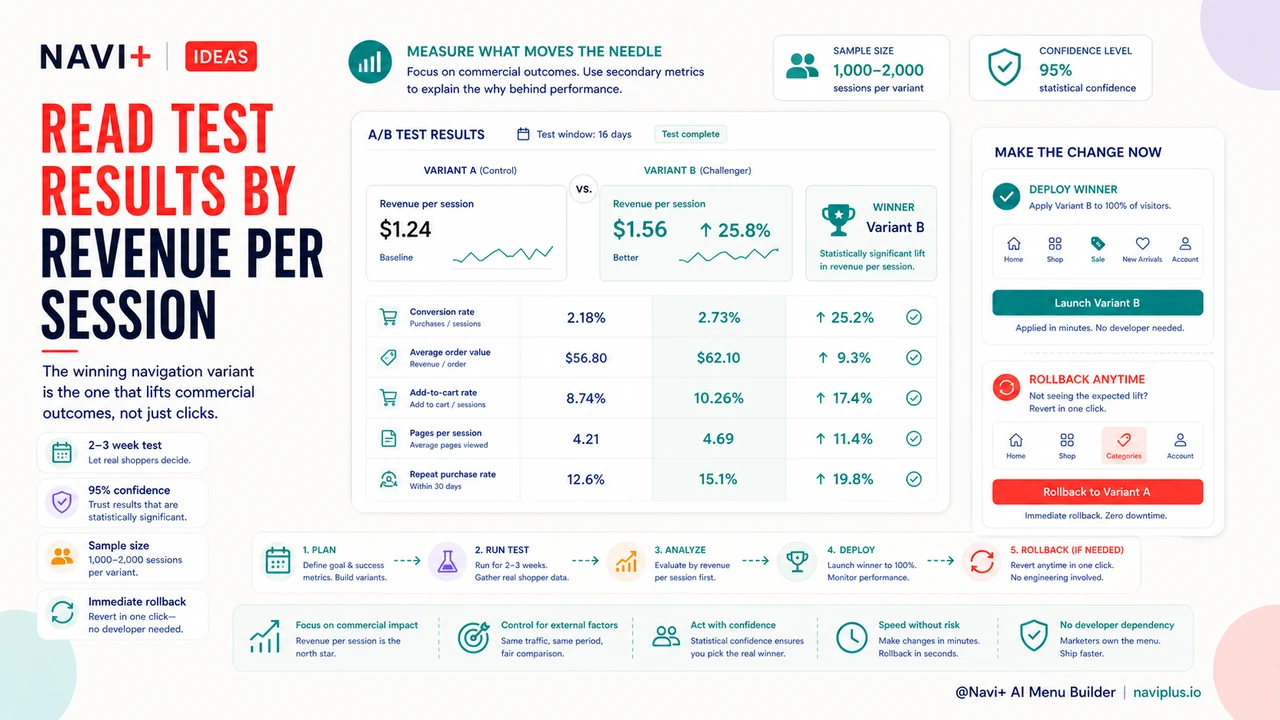
The cleanest navigation test measurement is revenue per session over the test period for each variant. This accounts for both conversion rate and order value effects and is the most direct measure of commercial impact. Statistical significance at the 95% confidence level typically requires 1,000–2,000 sessions per variant for a 0.2 percentage point effect — achievable in 2–3 weeks for stores with moderate traffic.
Navi+'s configuration flexibility makes navigation A/B testing straightforward: change the navigation configuration, run for the required sample size, compare revenue per session across the period. The changes take effect immediately, the rollback is equally immediate, and no developer involvement is required for any stage of the test cycle.
Try it free — no code, no developer needed
Install in minutes on Shopify, WordPress, or any website.