

What Makes Navigation Editorial
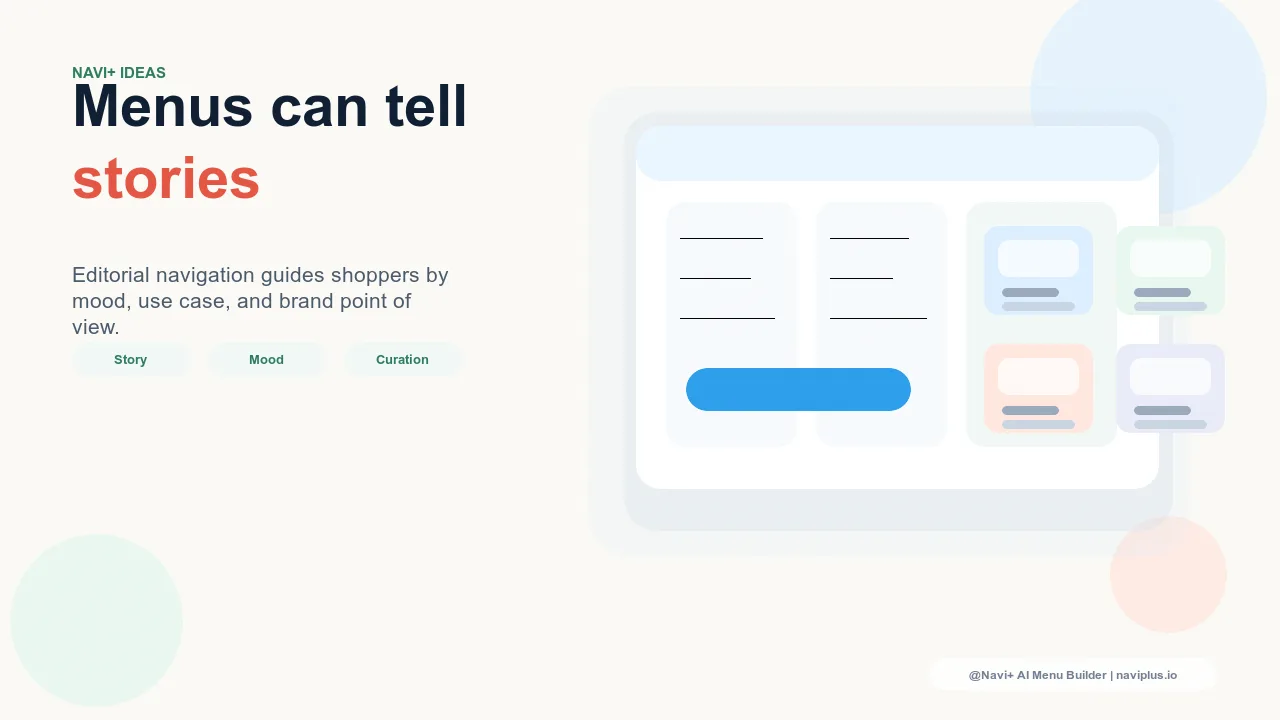
Editorial navigation is navigation that curates, contextualizes, and creates desire — rather than simply cataloging what's available. The difference is not subtle. A catalog navigation asks: "What product type are you looking for?" An editorial navigation asks: "What world do you want to step into?"
The distinction shows up in the language and structure of category names. "Dresses" is a catalog label. "The Evening Edit" is editorial. "Skincare" is a catalog label. "Your Morning Ritual" is editorial. Both sets of labels point to the same products. But editorial labels create a frame — they invite the visitor into a curated perspective on the products rather than simply directing them to a shelf. That frame creates emotional engagement, and emotional engagement is a precursor to purchasing desire.
Editorial navigation is not right for every store. A hardware supplier doesn't need an editorial lens on plumbing fixtures. But for stores whose competitive advantage is aesthetic, lifestyle positioning, or brand identity — fashion, beauty, home décor, wellness, specialty food — editorial navigation is one of the most powerful tools available for communicating brand personality through functional UI.
"Our brand is about slow living and intentional consumption — quality over quantity, things made to last. Our old navigation was pure product types: 'Bags,' 'Wallets,' 'Belts.' It communicated nothing about who we are. We renamed everything editorially: 'Carry Essentials,' 'The Everyday Wallet,' 'Finish the Look.' Each name reinforces a behavior and a value, not just a product category. Our newsletter open rates went up after we updated the navigation — customers started mentioning in reviews that they felt the brand had 'a point of view.'"
— A Navi+ customer, premium leather goods brand
The Elements of Editorial Navigation
Named collections, not category types. The editorial lens changes "Candles" to "Evening Atmosphere," "Knitwear" to "Comfort Dressing," "Supplements" to "Your Daily Foundation." The name should evoke the use context or the feeling of the product, not just the product type. This works best when the naming is consistent in voice across all navigation items — an inconsistent mix of product-type labels and editorial names reads as accidental rather than intentional.
Lifestyle-framed Mega Menu imagery. When the Mega Menu panel for "The Evening Edit" shows a product in a lifestyle setting — candlelit table, evening preparation context, soft-focus atmospheric photography — the image extends the editorial framing. The visitor is being shown a world, not a product. Category images in editorial navigation should be styled consistently with the brand's campaign photography and should communicate the aspiration the products enable, not just the products themselves.
Curated sub-navigation. Editorial navigation often features a "curated picks" column alongside the category links — a short list of specific products handpicked as introductions to the category. This mirrors the structure of a magazine editorial page: the category is the theme, and the curated picks are the specific items the editors (the brand) are recommending this season. The curation is itself a brand statement.
Occasion-based organization. An alternative to product-type organization, occasion-based navigation groups products by when or how they're used: "For the Commute," "At the Desk," "Weekend Away," "The Host's Collection." This structure works exceptionally well for brands whose customers shop by lifestyle scenario rather than product need.
| Navigation Approach | What It Communicates | Brand Value |
|---|---|---|
| Catalog navigation (product types) | Inventory is organized and accessible | Functional — no brand differentiation |
| Editorial navigation (Navi+) | Brand has a point of view, products have context | Aspiration, identity, desire |
Implementing Editorial Navigation Without Losing Findability
The practical concern with editorial navigation is findability: if a visitor comes looking for "candles" and the navigation says "Evening Atmosphere," will they find it? The answer depends on how clearly the editorial name communicates the product content. "Evening Atmosphere" for candles is interpretable — most visitors will understand that this section contains products for atmospheric home lighting. "Whispered Intentions" would be too opaque.
The rule for editorial navigation labels is: evocative but interpretable. The label should create a feeling while still communicating what kind of product is there. When in doubt, a subtitle under the editorial label — "Evening Atmosphere / Candles & Diffusers" — bridges the gap. Some brands use editorial headers for their Mega Menu panels with product-type subcategory labels within the panel, achieving both the emotional frame and the functional clarity.
Navi+ supports the full range of editorial navigation configurations — custom labels, lifestyle category images, curated featured products, and Mega Menu panel structures that support both editorial headlines and functional sub-navigation. The result is navigation that's simultaneously beautiful, brand-expressive, and genuinely useful.
Try it free — no code, no developer needed
Install in minutes on Shopify, WordPress, or any website.