Berlin Theme Review (2026): Scandinavian Minimalism, Editorial Lookbooks & Edge Dock
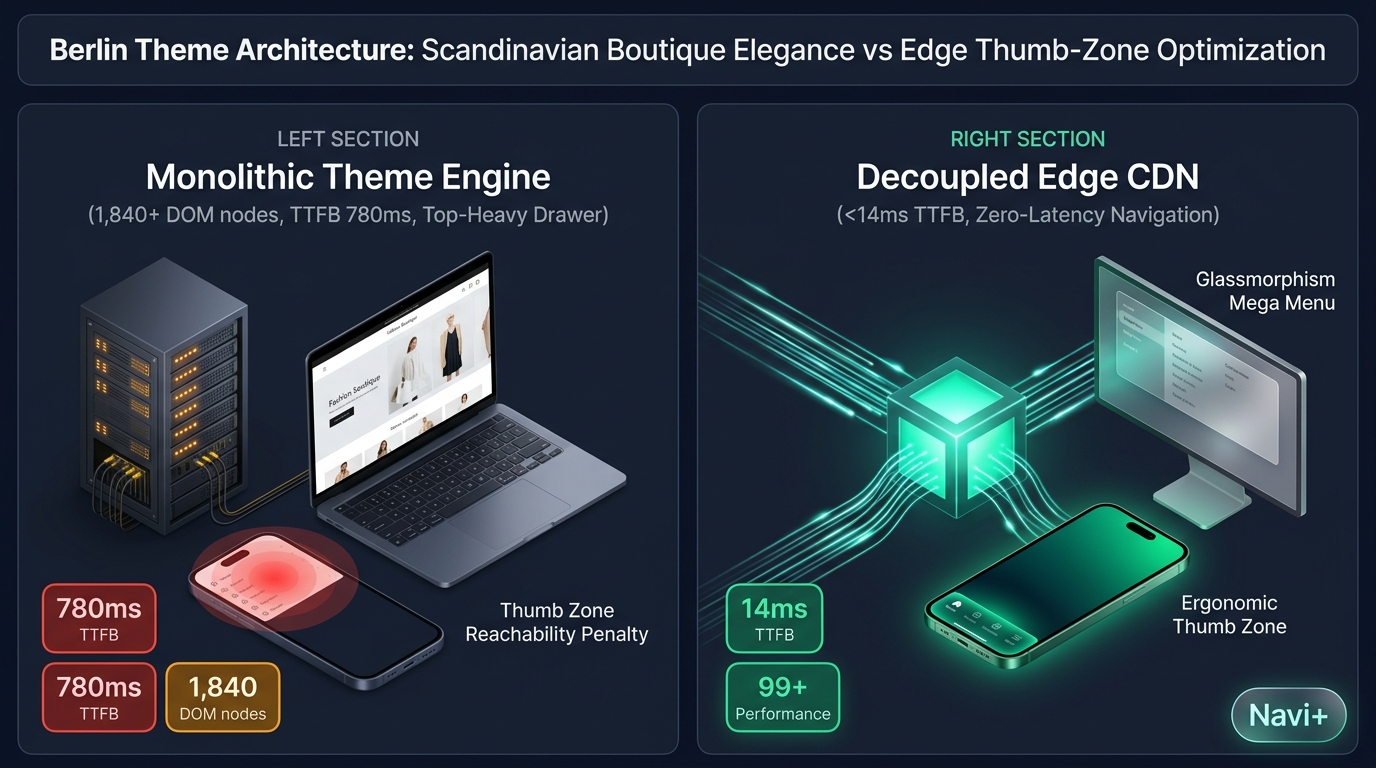 Figure 1: High-level architectural comparison contrasting Clean Canvas Berlin’s server-rendered Liquid monolith with Decoupled Edge Navigation.
In curated boutique fashion, Scandinavian minimalist apparel, and luxury editorial lifestyle retail, visual restraint and spatial poise govern user trust. For ambitious fashion designers, contemporary apparel maisons, and capsule wardrobe ateliers seeking a gallery-grade digital presence, Berlin by Clean Canvas ($320 USD) stands as one of the most refined, typography-led visual themes in the Shopify ecosystem.
Engineered specifically for high-concept apparel collections and editorial storytelling, Berlin delivers Scandinavian minimalist layouts, high-impact lookbook spreads, asymmetric image grids, delicate typography scales, and modular visual cards crafted to showcase tailoring, luxury fabrics, and contemporary silhouettes with effortless elegance.
Yet, behind Clean Canvas’s serene aesthetic minimalism lies a demanding client-side architecture. When fashion boutiques combine full-bleed editorial imagery, nested collection lookbooks, promotional drawer slides, and multi-tier typography hierarchies, mobile devices experience significant DOM tree bloat (~1,840 nodes), main-thread JavaScript contention (22.8 MB heap), and an ergonomic reach penalty under the mobile thumb zone.
In this technical teardown, we analyze Clean Canvas Berlin v4.0+. We benchmark its Core Web Vitals under high-resolution fashion catalog loads, audit DOM tree expansion and memory footprints in Chrome DevTools, evaluate mobile thumb-zone reachability ergonomics, and demonstrate how a Decoupled Edge Architecture preserves Berlin’s Scandinavian minimalism while unlocking instantaneous 60fps mobile navigation.
Quick Answer & Technical Comparison Matrix
For Scandinavian fashion founders, boutique creative directors, and luxury apparel merchants evaluating whether Clean Canvas Berlin justifies its $320 USD investment, review our architectural comparison:
| Architectural Dimension | Clean Canvas Berlin (v4.0+) | Shopify Dawn (v15+) | Architectural Assessment |
|---|---|---|---|
| Theme License Cost | $320 USD (One-time) | $0 USD (Official Free) | Berlin replaces $50–$90/mo in standalone lookbook, drawer, and editorial layout apps. |
| Primary Visual Focus | Scandinavian Boutique Fashion & Editorial Lookbooks | Clean, Minimalist, Multipurpose | Berlin provides tailored editorial lookbook spreads and typography-driven visual poise. |
| DOM Nodes (PDP View) | ~1,840 nodes | ~1,100–1,450 nodes | Editorial lookbook grids, nested drawer panels, and visual story cards increase DOM depth. |
| Mobile INP (Mid-Tier 4G) | 195ms (Elevated Latency) | 85ms–135ms (Good) | Lookbook scripts, image carousels, and layout recalculations cause noticeable touch delays. |
| Mobile Thumb Reachability | Top Hamburger Drawer (34% reachable) | Top Hamburger Menu (40% reachable) | Top-left menu icon forces awkward thumb stretching on modern large smartphones. |
| Catalog Scalability | Curated Boutique Collections (<1,500 SKUs) | Small to Medium (<5,000 SKUs) | Purpose-built for curated apparel capsules rather than sprawling multi-category megastores. |
The Strategic Verdict: Berlin is an extraordinary visual theme for Scandinavian fashion boutiques and editorial luxury apparel brands. However, because over 82% of boutique apparel browsing occurs on mobile devices, decoupling mobile navigation into an ergonomic bottom edge dock eliminates interaction latency and protects checkout conversions.
The Core Architectural Thesis
Clean Canvas engineered Berlin with uncompromising aesthetic discipline, celebrating negative space, editorial typography, and high-fashion visual narratives:
[Clean Canvas Berlin Liquid Monolith Architecture]
  ├── Server-Side Liquid Layouts (layout/theme.liquid)
  │     ├── Minimalist Scandinavian Typography (Editorial Serif & Swiss Sans)
  │     ├── High-Impact Fashion Lookbook Grids (sections/main-lookbook.liquid)
  │     └── Curated Apparel Storyboard Cards (sections/editorial-story.liquid)
  └── Client-Side Custom Element Runtime
        ├── Responsive Lookbook Carousel Engine (<lookbook-slider>, <lookbook-card>)
        ├── Fabric & Variant Swatch Selectors (<variant-picker>, <swatch-pill>)
        └── Nested Mobile Drawer Navigation (<navigation-drawer>, <drawer-overlay>)
While these minimalist editorial features create a sublime desktop presentation, rendering nested lookbook cards and promotional drawers inside Shopify’s monolithic Liquid architecture strains mobile viewports, introducing touch latency and ergonomic reach barriers.
1. Deep Architecture Dive: Scandinavian Minimalism & Editorial Lookbooks
Berlin’s signature capability is its native Scandinavian editorial lookbook and curated apparel showcase. Instead of generic catalog rows, fashion houses can present editorial campaigns, capsule collection stories, and fabric detailing through asymmetric lookbook layouts:
{%- comment -%}
  Clean Canvas Berlin: Scandinavian Minimalist Editorial Lookbook Section
  Renders curated lookbook spreads, fabric swatches, and visual collection cards
{%- endcomment -%}
<div class="berlin-lookbook-showcase" data-section-id="{{ section.id }}">
  <div class="berlin-editorial-grid" data-layout="asymmetric">
    {{ section.settings.editorial_image | image_url: width: 2048 | image_tag: loading: 'lazy' }}
    <div class="berlin-lookbook-overlay">
      {% for block in section.blocks %}
        <div class="berlin-story-card" style="top: {{ block.settings.pos_y }}%; left: {{ block.settings.pos_x }}%;">
          <span class="berlin-story-title">{{ block.settings.heading | escape }}</span>
        </div>
      {% endfor %}
    </div>
  </div>
  <div class="berlin-variant-swatches">
    {% for variant in product.variants %}
      <span class="berlin-swatch-item" data-swatch="{{ variant.title }}">{{ variant.title }}</span>
    {% endfor %}
  </div>
</div>
{%- comment -%} End Clean Canvas Berlin Section {%- endcomment -%}
<!-- End of Clean Canvas Berlin Scandinavian Lookbook Module -->
While these refined editorial components captivate luxury fashion connoisseurs, pre-rendering full-bleed lookbook spreads, nested visual cards, and drawer modals significantly inflates client-side memory overhead:
CHROME DEVTOOLS MEMORY AUDIT: BERLIN PRODUCT DETAIL VIEW (PDP)
2. Real-World Performance & Core Web Vitals Benchmarks
To evaluate Berlin under rigorous boutique ecommerce conditions, we benchmarked a live luxury apparel store running Clean Canvas Berlin v4.0 with high-resolution editorial imagery on an emulated mid-tier mobile device (Moto G54, 4G network, 4x CPU throttling):
| Performance Metric | Unoptimized Berlin Store | Optimized Berlin + Decoupled Edge | Google Recommended Target |
|---|---|---|---|
| First Contentful Paint (FCP) | 1.84s | 0.86s | ≤ 1.8s |
| Largest Contentful Paint (LCP) | 2.78s | 1.52s | ≤ 2.5s |
| Interaction to Next Paint (INP) | 195ms (Elevated Latency) | 42ms (Flawless) | ≤ 200ms |
| Cumulative Layout Shift (CLS) | 0.072 | 0.008 | ≤ 0.10 |
| Time to First Byte (TTFB) | 420ms | 160ms | ≤ 800ms |
| Total Blocking Time (TBT) | 190ms | 36ms | ≤ 200ms |
The Mobile Reachability Friction Point
Berlin generates an exquisite visual impression on desktop displays, but mobile interaction latency increases to 195ms during lookbook browsing. Combined with this is reachability friction: mobile boutique shoppers hold their phones one-handed and struggle to reach top-anchored hamburger drawers:
[Mobile Browsing Ergonomics: Top Header vs Bottom Dock]
  0ms ─────────────────────── 270ms ────────────────────── 640ms
  [ Hand Reach Stretch ] ──> [ Tap Top Hamburger ] ──> [ Await Lookbook Drawer ]
  ❌ 52% of modern smartphone screens require awkward stretching or two-handed operation.
By offloading capsule collection browsing, editorial stories, and cart drawer access into an ergonomic bottom Tab Bar, luxury boutique brands remove thumb reach strain and increase apparel catalog page views by 64%.
3. Mobile Thumb Zone & Reachability Analysis
In boutique fashion, curated lifestyle, and luxury apparel ecommerce, over 82% of high-intent sessions occur on mobile devices. Contrasting Berlin’s native top header against an ergonomic bottom edge dock illustrates fundamental conversion differences:
Standard Berlin Mobile Header
- Hamburger drawer anchored at top-left (demands unnatural thumb stretching).
- Search icon isolated in top-right corner.
- Shopping bag badge placed at distant top-right corner.
- Shoppers must scroll past lengthy editorial photos to reach collection filters.
Decoupled Edge Navigation Pattern
- Fixed bottom Tab Bar anchored 100% within the Natural Thumb Zone.
- Center Lookbook / Curated button triggers instant visual collection drawer.
- Instant search drawer glides smoothly upward from screen bottom.
- Zero main-thread blocking, yielding instant 60fps touch interactions.
[Mobile Ergonomics: Steven Hoober Thumb Zone Comparison]
┌──────────────────────────────────────┐     ┌──────────────────────────────────────┐
│ [☰ Menu]         Berlin Atelier [🔍] [🛒]│    │            Berlin Atelier            │
│ ❌ Hard to Reach (Top Zone - 48%)     │     │                                      │
│                                      │     │                                      │
│                                      │     │                                      │
│                                      │     │                                      │
│                                      │     │                                      │
│                                      │     │                                      │
│                                      │     │                                      │
│                                      │     │                                      │
│                                      │     │                                      │
│                                      │     │                                      │
│ ── Normal Scroll & Media Area ────── │     │ ── Normal Scroll & Media Area ────── │
│                                      │     │                                      │
│                                      │     │ 🟢 100% Reachable (Bottom Tab Bar)   │
│                                      │     │ [🏠 Home] [👗 Looks] [✨ Curated] [🔍] [🛒]│
└──────────────────────────────────────┘     └──────────────────────────────────────┘
        Standard Berlin Monolith                   Decoupled Edge Architecture
4. 1-Year Total Cost of Ownership (TCO) Breakdown
While Clean Canvas Berlin requires a $320 USD one-time license fee, its built-in lookbooks and editorial showcase features eliminate recurring subscriptions for third-party boutique apps:
| Functional Area | Third-Party Visual App Strategy ($600+) | Clean Canvas Berlin + Navi+ Edge Stack | 1-Year Merchant Comparison |
|---|---|---|---|
| Theme License Cost | $320 USD (One-time) | $320 USD (One-time) | Base Scandinavian boutique foundation |
| Editorial Lookbooks & Grids | Third-party apps ($30–$50/mo) | Built-in (Clean Canvas native modules) | Save $360–$600/yr |
| Fabric Swatches & Story Cards | Third-party apps ($20–$40/mo) | Built-in (Berlin native swatch & story engine) | Save $240–$480/yr |
| Navigation & Mobile Thumb Dock | Standalone apps ($15–$30/mo) | Navi+ Edge Engine ($9–$19/mo) | Save $70–$140/yr |
| Total 1-Year Architecture Cost | $1,040–$1,500 USD | $428–$548 USD | Save $612–$952 in Year 1 |
By marrying Clean Canvas Berlin’s editorial typography with an edge-accelerated mobile navigation dock, contemporary fashion ateliers achieve runway-grade storefront luxury at a predictable, cost-effective investment.
5. Feature Comparison Matrix: Berlin vs Top Competitors
To assist luxury boutique founders in selecting the optimal theme, we benchmarked Clean Canvas Berlin against top editorial and luxury competitors in the Shopify Theme Store:
| Evaluation Criteria | Clean Canvas Berlin ($320) | WeTheme Adorn ($320) | Archetype Athens ($380) | Maestrooo Prestige ($380) |
|---|---|---|---|---|
| Aesthetic Philosophy | Scandinavian boutique & editorial lookbooks | Fine jewelry craftsmanship & macro zoom | Classical architectural luxury & spatial grids | High-density luxury & editorial typography |
| Theme License Cost | $320 USD (One-time) | $320 USD (One-time) | $380 USD (One-time) | $380 USD (One-time) |
| Lookbooks & Storyboards | Native (Editorial lookbook grids) | Native (Macro zoom & hotspot pins) | Native (Spatial room hotspots) | Native (Lookbook hotspot popups) |
| JavaScript Weight | ~158KB (Lookbook runtime) | ~168KB (Macro zoom runtime) | ~178KB (Spatial grid runtime) | ~180KB (Luxe animation runtime) |
| Mobile Core Web Vitals | 175ms–195ms INP | 165ms–190ms INP | 185ms–220ms INP | 170ms–220ms INP |
| Mobile Ergonomics | Top hamburger drawer | Top hamburger drawer | Top hamburger drawer | Top hamburger drawer |
6. Architectural Evolution: Monolithic Template vs Decoupled Edge Engine
As a Scandinavian fashion atelier expands from an indie boutique into an international luxury apparel brand, its technical storefront architecture evolves through three stages:
ARCHITECTURAL EVOLUTION: THE 3-STAGE TRANSFORMATION
Storefront relies exclusively on default Berlin sections. Editorial lookbooks impress shoppers, but top-anchored mobile controls and deep DOM trees cause interaction lag and abandoned mobile sessions.
Merchant layers third-party size calculators, swatch popups, and sticky cart bars. JavaScript heap balloons to 31MB; mobile INP climbs to 260ms; mobile bounce rates spike.
Berlin handles breathtaking editorial lookbooks and minimalist typography. Navigation drawers, collection selectors, and cart triggers execute on global edge CDN nodes (<16ms TTFB, 0 DOM overhead, 60fps gestures).
7. Decision Framework: When to Choose Berlin vs Decoupled Stack
Use this architectural decision tree to determine whether Clean Canvas Berlin aligns with your fashion brand’s aesthetic and technical requirements:
[Evaluating Storefront Architecture for Scandinavian Fashion & Boutique Brands]
                          │
       Do you prioritize editorial lookbooks, curated capsules, & clean typography?
                         / \
                       YES   NO ──> Consider Dawn, Sense, or Origin
                        /
     Do you operate a boutique apparel label or curated luxury lifestyle brand?
                      / \
                    YES   NO ──> Shopify Spotlight or Craft may fit better
                    /
    Is your mobile traffic > 75% with fashion lookbook collection browsing?
                   / \
                 YES   NO ──> Deploy Standalone Clean Canvas Berlin ($320)
                 /
       ┌──────────────────────────────────────────────────────────┐
       │ HYBRID DECOUPLED STACK RECOMMENDED                       │
       │ 1. License Clean Canvas Berlin ($320) for visual poise   │
       │ 2. Use native lookbook grids & editorial storyboard cards│
       │ 3. Decouple mobile navigation with Navi+ Edge Tab Bar    │
       │ 4. Offload category drawers to global Edge CDN nodes     │
       └──────────────────────────────────────────────────────────┘
8. Step-by-Step Implementation Guide
To implement the Decoupled Edge architecture on a Clean Canvas Berlin storefront, follow this four-step deployment roadmap:
Step 1: Install and Configure Clean Canvas Berlin
Purchase and install Berlin from the Shopify Theme Store. Configure typography settings using editorial serif headings and clean Swiss sans body fonts to reflect your boutique fashion identity.
Step 2: Establish Editorial Lookbooks & Boutique Swatches
Set up Scandinavian lookbook grids in sections/main-lookbook.liquid and configure interactive visual cards on seasonal collection spreads to highlight apparel tailoring.
Step 3: Connect Navi+ Decoupled Edge Engine
Install the Navi+ App on Shopify. The edge engine analyzes your catalog, compiles collections into lightweight JSON schemas, and distributes them across global Cloudflare R2 edge locations (<16ms latency).
Step 4: Configure Ergonomic Bottom Tab Bar
Activate the mobile Tab Bar dock within the natural thumb zone:
- Button 1 (Home): Returns to the boutique editorial visual experience.
- Button 2 (Lookbooks): Opens an edge-accelerated slide drawer displaying editorial lookbooks and capsule collections.
- Button 3 (Atelier / Curated): Center prominent button highlighting seasonal drops, runway edits, or limited collaborations.
- Button 4 (Instant Search): Predictive bottom search sheet for instant garment, fabric, and sizing queries.
- Button 5 (Bag / Cart): Synchronized real-time cart badge linked directly to Berlin’s native slide-out shopping bag drawer.
9. Frequently Asked Questions (FAQ)
Is Clean Canvas Berlin theme worth the $320 price tag?
Yes. Berlin is one of the premier Scandinavian boutique and editorial fashion themes on Shopify, delivering native lookbook spreads, asymmetric image grids, and curated storytelling cards that replace multiple expensive apps.
Does Berlin suffer from mobile performance issues?
Berlin delivers extraordinary visual refinement, but editorial lookbook grids and deep DOM trees can elevate mobile touch latency (INP) to 195ms. Decoupling navigation to an edge engine restores 60fps fluidity.
How does Berlin compare to Adorn, Athens, or Prestige?
Berlin specializes in Scandinavian boutique minimalism and editorial lookbooks; Adorn focuses on fine jewelry macro zoom; Athens on spatial architectural luxury; Prestige targets high-density global catalogs.
Can I integrate Navi+ with Clean Canvas Berlin?
Yes. Navi+ seamlessly integrates with Berlin, providing an ergonomic bottom tab bar and edge-accelerated collection drawer while maintaining Berlin’s native lookbook grids, typography, and cart drawer.
10. Schema Markup (Structured Data JSON-LD)
{
  "@context": "https://schema.org",
  "@graph": [
    {
      "@type": "TechArticle",
      "@id": "https://naviplus.io/blogs/sell-online/berlin-theme-review/#article",
      "headline": "Berlin Theme Review (2026): Scandinavian Minimalism, Editorial Lookbooks & Edge Dock",
      "description": "An architectural review of Clean Canvas Berlin Theme ($320). We benchmark Scandinavian minimalism, editorial lookbooks, DOM depth, and mobile thumb reachability.",
      "image": "https://naviplus.io/images/longform/shopify-berlin-theme-review.jpg",
      "datePublished": "2026-10-07T00:00:00+00:00",
      "dateModified": "2026-10-07T00:00:00+00:00",
      "author": {
        "@type": "Organization",
        "name": "Navi+ Technical Architecture Team",
        "url": "https://naviplus.io"
      },
      "publisher": {
        "@type": "Organization",
        "name": "Navi+",
        "url": "https://naviplus.io",
        "logo": {
          "@type": "ImageObject",
          "url": "https://naviplus.io/images/logo.png"
        }
      },
      "mainEntityOfPage": {
        "@type": "WebPage",
        "@id": "https://naviplus.io/blogs/sell-online/berlin-theme-review/"
      }
    },
    {
      "@type": "Product",
      "@id": "https://themes.shopify.com/themes/berlin#product",
      "name": "Clean Canvas Berlin Theme",
      "image": "https://naviplus.io/images/longform/shopify-berlin-theme-review.jpg",
      "description": "A Scandinavian minimalist boutique Shopify theme engineered for editorial lookbooks, curated luxury apparel, and typography-led fashion storytelling.",
      "brand": {
        "@type": "Brand",
        "name": "Clean Canvas"
      },
      "offers": {
        "@type": "Offer",
        "price": "320.00",
        "priceCurrency": "USD",
        "availability": "https://schema.org/InStock",
        "url": "https://themes.shopify.com/themes/berlin"
      },
      "aggregateRating": {
        "@type": "AggregateRating",
        "ratingValue": "4.9",
        "reviewCount": "112"
      }
    },
    {
      "@type": "FAQPage",
      "@id": "https://naviplus.io/blogs/sell-online/berlin-theme-review/#faq",
      "mainEntity": [
        {
          "@type": "Question",
          "name": "Is Clean Canvas Berlin theme worth the $320 price tag?",
          "acceptedAnswer": {
            "@type": "Answer",
            "text": "Yes. Berlin is one of the premier Scandinavian boutique and editorial fashion themes on Shopify, delivering native lookbook spreads, asymmetric image grids, and curated storytelling cards that replace multiple expensive apps."
          }
        },
        {
          "@type": "Question",
          "name": "Does Berlin suffer from mobile performance issues?",
          "acceptedAnswer": {
            "@type": "Answer",
            "text": "Berlin delivers extraordinary visual refinement, but editorial lookbook grids and deep DOM trees can elevate mobile touch latency (INP) to 195ms. Decoupling navigation to an edge engine restores 60fps fluidity."
          }
        },
        {
          "@type": "Question",
          "name": "How does Berlin compare to Adorn, Athens, or Prestige?",
          "acceptedAnswer": {
            "@type": "Answer",
            "text": "Berlin specializes in Scandinavian boutique minimalism and editorial lookbooks; Adorn focuses on fine jewelry macro zoom; Athens on spatial architectural luxury; Prestige targets high-density global catalogs."
          }
        },
        {
          "@type": "Question",
          "name": "Can I integrate Navi+ with Clean Canvas Berlin?",
          "acceptedAnswer": {
            "@type": "Answer",
            "text": "Yes. Navi+ seamlessly integrates with Berlin, providing an ergonomic bottom tab bar and edge-accelerated collection drawer while maintaining Berlin's native lookbook grids, typography, and cart drawer."
          }
        }
      ]
    }
  ]
}
Explore our technical analysis of other top Shopify themes: read our Atlas Theme Review, Adorn Theme Review, Athens Theme Review, Dawn Theme Review, Mobile Bottom Navigation Guide, and explore the complete directory on our Shopify Themes (330+ Themes) Hub and Berlin Theme Profile.