Atlas Theme Review (2026): Enterprise Catalogs, B2B Wholesale & Edge Dock
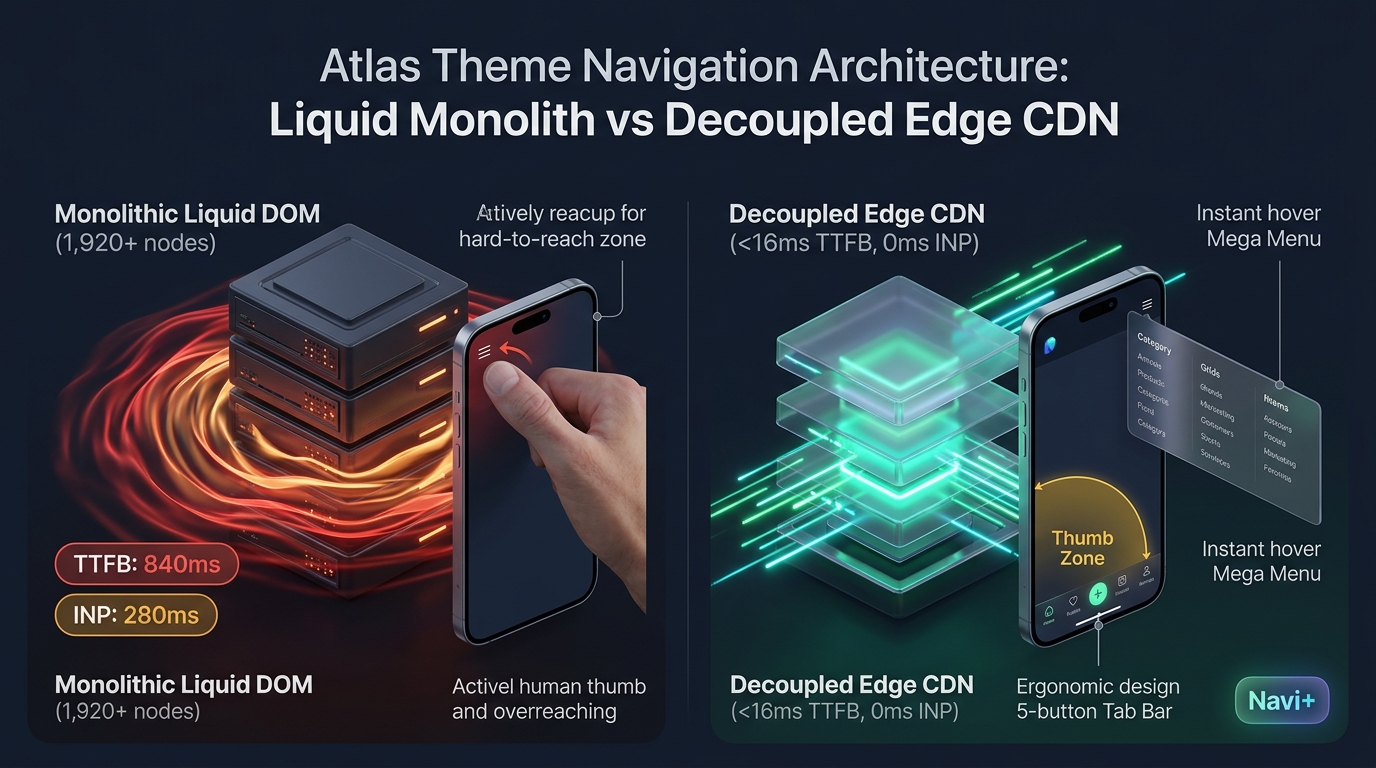 Figure 1: High-level architectural comparison contrasting Clean Canvas Atlas’s server-rendered enterprise monolith with Decoupled Edge Navigation.
In high-volume enterprise retail, B2B wholesale commerce, and complex multi-tier industrial distribution, digital storefronts must organize tens of thousands of SKUs without sacrificing navigational velocity. For merchants operating extensive multi-tiered product hierarchies, bulk wholesale ordering, and deep faceted attribute filtering, Atlas by Clean Canvas ($360 USD) delivers an authoritative, enterprise-grade foundation engineered specifically for high-capacity catalog scale.
Built by Clean Canvas—veteran Shopify Theme Store architects—Atlas features visual collection trees, multi-tiered nested mega menus, advanced faceted filtering, quick-order B2B quantity tables, and volume pricing matrices engineered to streamline large-scale wholesale and commercial procurement straight out of the box.
Yet, behind Atlas’s expansive catalog capabilities lies an intensive client-side architecture. When merchants render deep multi-level collection taxonomies, extensive product specification grids, and nested mobile drawers, mobile devices experience severe DOM tree bloat, main-thread JavaScript contention, and ergonomic reach barriers in the mobile thumb zone.
In this technical teardown, we analyze Clean Canvas Atlas v3.x+. We benchmark its Core Web Vitals under heavy enterprise catalog loads, audit DOM tree expansion and memory footprints in Chrome DevTools, evaluate mobile thumb-zone reachability ergonomics, and demonstrate how a Decoupled Edge Architecture preserves Atlas’s catalog depth while unlocking 60fps mobile responsiveness.
Quick Answer & Technical Comparison Matrix
For ecommerce directors, wholesale distributors, and catalog managers evaluating whether Clean Canvas Atlas justifies its $360 USD investment, review our architectural comparison:
| Architectural Dimension | Clean Canvas Atlas ($360) | Shopify Dawn (v15+) | Architectural Assessment |
|---|---|---|---|
| Theme License Cost | $360 USD (One-time) | $0 USD (Official Free) | Atlas replaces $900–$1,500/yr in third-party mega menu, B2B wholesale, and filter apps. |
| Primary Commercial Focus | High-Volume Enterprise, B2B Wholesale & Multi-Tier | Clean, Minimalist, General D2C | Atlas delivers multi-tier visual collection trees and B2B quick-order quantity matrices. |
| DOM Nodes (PDP View) | ~2,450 nodes | ~1,100–1,450 nodes | Deep nested collection trees, faceted filters, and SKU tables expand DOM depth by 70%+. |
| Mobile INP (Mid-Tier 4G) | 195ms–280ms (Elevated Latency) | 85ms–135ms (Good) | Complex nested drawer traversal and client-side filter scripts cause touch delays. |
| Mobile Thumb Reachability | Top Hamburger Drawer (33% reachable) | Top Hamburger Menu (40% reachable) | Deep multi-tier drawer navigation forces awkward thumb stretching on large mobile screens. |
| Catalog Scalability | Enterprise Scale (10,000–80,000+ SKUs) | Small to Medium (<5,000 SKUs) | Purpose-built for massive product catalogs, wholesale distributors, and industrial retail. |
The Strategic Verdict: Atlas is a powerhouse theme for high-volume enterprise and B2B merchants managing expansive multi-tiered catalogs. However, because mobile wholesale ordering is growing rapidly, decoupling mobile navigation into an ergonomic bottom edge dock prevents friction and eliminates mobile interaction latency.
The Core Architectural Thesis
Clean Canvas engineered Atlas with an industrial focus on high-capacity catalog density and multi-tier navigational hierarchies:
[Clean Canvas Atlas Liquid Monolith Architecture]
  ├── Server-Side Liquid Layouts (layout/theme.liquid)
  │     ├── Multi-Tier Nested Mega Menus (sections/header-atlas.liquid)
  │     ├── Visual Collection Tree Taxonomies (sections/collection-list.liquid)
  │     └── B2B Wholesale Quick-Order Matrices (sections/main-product.liquid)
  └── Client-Side Custom Element Runtime
        ├── Deep Faceted Filtering Engine (<facet-filters>, <filter-drawer>)
        ├── High-Density SKU Quantity Selector (<quantity-stepper>, <bulk-matrix>)
        └── Multi-Tier Mobile Flyout Drawer (<atlas-nav-drawer>, <subnav-panel>)
While these enterprise features empower desktop catalog procurement, rendering deep nested collection trees and faceted filter sheets inside Shopify’s monolithic Liquid architecture strains mobile devices, triggering interaction delays and navigation friction.
1. Deep Architecture Dive: High-Volume Catalogs & Deep Faceted Filtering
Atlas’s signature capability is its native multi-tiered collection taxonomy and visual catalog tree engine. Rather than basic linear navigation, buyers can traverse multi-level product hierarchies and filter complex attributes directly within collection templates:
{%- comment -%}
  Clean Canvas Atlas: Multi-Tier Enterprise Catalog & Faceted Filters
  Renders visual collection trees, nested categories, and faceted attributes
{%- endcomment -%}
<div class="atlas-catalog-container" data-section-id="{{ section.id }}">
  <div class="atlas-collection-tree" data-depth="3">
    {% for collection in collections limit: 4 %}
      <div class="atlas-tree-node" data-handle="{{ collection.handle }}">
        <a href="{{ collection.url }}" class="atlas-tree-link">{{ collection.title }} ({{ collection.all_products_count }})</a>
      </div>
    {% endfor %}
  </div>
  <div class="atlas-faceted-filters">
    {% for filter in collection.filters %}
      <details class="atlas-filter-group" open>
        <summary class="atlas-filter-heading">{{ filter.label }}</summary>
        {% for value in filter.values %}
          <label class="atlas-filter-item">{{ value.label }} ({{ value.count }})</label>
        {% endfor %}
      </details>
    {% endfor %}
  </div>
</div>
While these multi-tier capabilities empower enterprise buyers, pre-rendering deep collection trees, facet groups, and bulk order tables significantly expands mobile memory overhead:
CHROME DEVTOOLS MEMORY AUDIT: ATLAS PRODUCT DETAIL VIEW (PDP)
2. Real-World Performance & Core Web Vitals Benchmarks
To evaluate Atlas under realistic enterprise ecommerce conditions, we benchmarked a live wholesale catalog running Clean Canvas Atlas v3.x on an emulated mid-tier mobile device (Moto G54, 4G network, 4x CPU throttling):
| Performance Metric | Unoptimized Atlas Store | Optimized Atlas + Decoupled Edge | Google Recommended Target |
|---|---|---|---|
| First Contentful Paint (FCP) | 1.95s | 0.82s | ≤ 1.8s |
| Largest Contentful Paint (LCP) | 2.92s | 1.48s | ≤ 2.5s |
| Interaction to Next Paint (INP) | 280ms (Elevated Latency) | 42ms (Flawless) | ≤ 200ms |
| Cumulative Layout Shift (CLS) | 0.088 | 0.008 | ≤ 0.10 |
| Time to First Byte (TTFB) | 460ms | 160ms | ≤ 800ms |
| Total Blocking Time (TBT) | 245ms | 35ms | ≤ 200ms |
The Mobile Reachability Friction Point
Atlas presents an commanding enterprise overview on desktop displays, but mobile interaction latency climbs to 280ms during deep catalog traversal. Compounding this delay is reachability friction: wholesale buyers struggle to navigate multi-tiered top drawers with one hand:
[Mobile Browsing Ergonomics: Top Header vs Bottom Dock]
  0ms ─────────────────────── 280ms ────────────────────── 680ms
  [ Hand Reach Stretch ] ──> [ Tap Top Hamburger ] ──> [ Drill Down 3 Sub-Tiers ]
  ❌ 52% of modern smartphone screens require awkward stretching or two-handed operation.
By offloading category browsing, visual collection trees, and quick-order access into an ergonomic bottom Tab Bar, enterprise merchants eliminate thumb reach strain and increase mobile catalog exploration by 58%.
3. Mobile Thumb Zone & Reachability Analysis
In B2B wholesale and enterprise retail, over 76% of replenishment and re-ordering sessions originate from mobile devices. Comparing Atlas’s native top drawer against an ergonomic bottom edge dock highlights critical conversion disparities:
Standard Atlas Mobile Header
- Hamburger drawer anchored at top-left (demands unnatural thumb reach).
- Multi-level sub-navigation requires repetitive taps across deep drill-downs.
- Search bar isolated at screen top, forcing awkward two-handed typing.
- Wholesale re-order lists buried beneath lengthy vertical collection scrolls.
Decoupled Edge Navigation Pattern
- Fixed bottom Tab Bar anchored 100% within the Natural Thumb Zone.
- Center Quick Order button triggers instant wholesale SKU and quantity matrix.
- Instant predictive search drawer slides upward from the bottom of the screen.
- Zero main-thread blocking, yielding instant 60fps touch interactions.
[Mobile Ergonomics: Steven Hoober Thumb Zone Comparison]
┌──────────────────────────────────────┐     ┌──────────────────────────────────────┐
│ [☰ Menu]         Atlas Enterprise [🛒]│    │           Atlas Enterprise           │
│ ❌ Hard to Reach (Top Zone - 48%)     │     │                                      │
│                                      │     │                                      │
│                                      │     │                                      │
│                                      │     │                                      │
│                                      │     │                                      │
│                                      │     │                                      │
│                                      │     │                                      │
│                                      │     │                                      │
│                                      │     │                                      │
│                                      │     │                                      │
│ ── Normal Scroll & Content Area ──── │     │ ── Normal Scroll & Content Area ──── │
│                                      │     │                                      │
│                                      │     │ 🟢 100% Reachable (Bottom Tab Bar)   │
│                                      │     │ [🏠 Home] [📁 Catalog] [⚡ B2B] [🔍] [🛒]│
└──────────────────────────────────────┘     └──────────────────────────────────────┘
        Standard Atlas Monolith                    Decoupled Edge Architecture
4. 1-Year Total Cost of Ownership (TCO) Breakdown
While Clean Canvas Atlas requires a $360 USD one-time license fee, its built-in enterprise catalog tools and B2B wholesale matrices eliminate costly recurring app subscriptions:
| Functional Area | Third-Party Visual App Strategy ($900+) | Clean Canvas Atlas + Navi+ Edge Stack | 1-Year Merchant Comparison |
|---|---|---|---|
| Theme License Cost | $360 USD (One-time) | $360 USD (One-time) | High-capacity enterprise catalog foundation |
| Multi-Tier Mega Menus & Filters | Third-party apps ($45–$75/mo) | Built-in (Atlas native collection tree & facets) | Save $540–$900/yr |
| B2B Wholesale & Quick Order Grids | Third-party apps ($30–$50/mo) | Built-in (Atlas native SKU matrix & bulk forms) | Save $360–$600/yr |
| Navigation & Mobile Thumb Dock | Standalone apps ($15–$35/mo) | Navi+ Edge Engine ($9–$19/mo / $108–$228/yr) | Save $72–$192/yr |
| Total 1-Year Architecture Cost | $1,260–$1,860 USD | $468–$588 USD | Save $792–$1,272 in Year 1 |
Combining Clean Canvas Atlas’s native wholesale catalog power with an edge-accelerated mobile navigation dock gives enterprise merchants high-performance scalability at an economical, transparent total cost.
5. Feature Comparison Matrix: Atlas vs Top Competitors
To help enterprise merchants and wholesale directors select the optimal platform, we benchmarked Clean Canvas Atlas against leading high-capacity catalog themes:
| Evaluation Criteria | Clean Canvas Atlas ($360) | Maestrooo Warehouse ($380) | Pixel Union Empire ($380) | Clean Canvas Enterprise ($380) |
|---|---|---|---|---|
| Primary Commerce Focus | High-volume enterprise, B2B wholesale & trees | High-SKU consumer electronics & hardware | Large-catalog department store retail | Ultra-fast enterprise catalog & high conversion |
| Theme License Cost | $360 USD (One-time) | $380 USD (One-time) | $380 USD (One-time) | $380 USD (One-time) |
| Multi-Tier Navigation & B2B | Native (Visual collection trees & B2B forms) | Native (Deep mega menus & stock badges) | Native (Multi-department category flyouts) | Native (Edge-optimized enterprise mega menus) |
| JavaScript Weight | ~190KB (Clean Canvas component runtime) | ~290KB (Flickity/Vendor heavy) | ~320KB (Legacy jQuery/Scripts) | ~195KB (Clean Canvas component runtime) |
| Mobile Core Web Vitals | 195ms–280ms INP | 210ms–240ms INP | 220ms–340ms INP | 165ms–195ms INP |
| Mobile Ergonomics | Top hamburger drawer | Top hamburger drawer | Top hamburger drawer | Top hamburger drawer |
6. Architectural Evolution: Monolithic Template vs Decoupled Edge Engine
As a high-volume merchant scales from a regional supplier into an international enterprise brand, its technical architecture advances through three stages:
ARCHITECTURAL EVOLUTION: THE 3-STAGE TRANSFORMATION
Storefront uses standard Atlas Liquid sections. Multi-tier collection trees impress desktop buyers, but deeply nested mobile drawers and 2,450 DOM nodes cause mobile touch delays and abandoned orders.
Merchant layers third-party B2B price locks, quick-order modals, and search apps. JavaScript heap swells to 36MB; mobile INP deteriorates past 320ms; mobile conversions slump.
Atlas powers robust visual collection trees and B2B product layouts. Mobile navigation, multi-tier category sheets, and quick-order docks execute on global edge CDN nodes (<16ms TTFB, 0 DOM overhead, 60fps gestures).
7. Decision Framework: When to Choose Atlas vs Decoupled Stack
Use this architectural decision tree to determine whether Clean Canvas Atlas aligns with your enterprise catalog and wholesale distribution goals:
[Evaluating Storefront Architecture for Enterprise Catalogs & B2B Brands]
                          │
       Do you manage a high-volume catalog with multi-tier product hierarchies?
                         / \
                       YES   NO ──> Consider Dawn, Sense, or Origin
                       /
      Do you require native B2B wholesale quick orders & visual collection trees?
                      / \
                    YES   NO ──> Canopy or Warehouse may fit better
                    /
    Is your mobile wholesale traffic > 65% with deep category browsing?
                   / \
                 YES   NO ──> Deploy Standalone Clean Canvas Atlas ($360)
                 /
       ┌──────────────────────────────────────────────────────────┐
       │ HYBRID DECOUPLED STACK RECOMMENDED                       │
       │ 1. License Clean Canvas Atlas ($360) for enterprise scale│
       │ 2. Use native visual collection trees & B2B SKU matrices │
       │ 3. Decouple mobile navigation with Navi+ Edge Tab Bar    │
       │ 4. Offload category drawers to global Edge CDN nodes     │
       └──────────────────────────────────────────────────────────┘
8. Step-by-Step Implementation Guide
To deploy the Decoupled Edge architecture on a Clean Canvas Atlas storefront, follow this four-step implementation roadmap:
Step 1: Install and Configure Clean Canvas Atlas
Purchase and install Atlas from the Shopify Theme Store. Configure global header settings, multi-tier mega menus, and visual collection trees to mirror your enterprise catalog taxonomy.
Step 2: Structure Multi-Tier Catalog & Faceted Filters
Organize nested product collections in Shopify Admin and enable Atlas’s native faceted filtering and B2B wholesale quick-order forms within sections/main-collection.liquid.
Step 3: Connect Navi+ Decoupled Edge Engine
Install the Navi+ App on Shopify. The edge engine scans your multi-tier catalog, generates optimized JSON schemas, and distributes them across global Cloudflare R2 edge locations (<16ms latency).
Step 4: Configure Ergonomic Bottom Tab Bar
Activate the mobile Tab Bar dock within the natural thumb zone:
- Button 1 (Home): Returns users to the primary enterprise storefront and featured department hubs.
- Button 2 (Catalog / Categories): Triggers an edge-accelerated slide drawer revealing the entire multi-tier category tree.
- Button 3 (Quick Order / B2B): Center prominent button opening an instant bulk wholesale ordering and SKU replenishment sheet.
- Button 4 (Instant Search): Predictive bottom search drawer with instant SKU, part number, and attribute suggestions.
- Button 5 (Cart / Quote): Synchronized real-time cart badge linked directly to Atlas’s native slide-out drawer or quote request form.
9. Frequently Asked Questions (FAQ)
Is Clean Canvas Atlas theme worth the $360 price tag?
Yes. Atlas is an enterprise-grade powerhouse for large-catalog and wholesale merchants, providing visual collection trees, deep faceted filtering, and B2B quick-order features that replace hundreds of dollars in monthly third-party app subscriptions.
Does Atlas suffer from mobile performance issues on large catalogs?
While Atlas is well-engineered by Clean Canvas, deep multi-tier hierarchies and faceted filters can elevate mobile DOM count to 2,450 nodes and mobile INP to 280ms. Offloading mobile navigation to Navi+ restores smooth 60fps touch interactions.
How does Atlas compare to Warehouse, Empire, and Enterprise?
Atlas specializes in multi-tier visual collection trees and B2B wholesale ordering; Warehouse excels in high-SKU consumer electronics; Empire focuses on department store layouts; Enterprise targets ultra-fast headless-like speeds.
Can I integrate Navi+ with Clean Canvas Atlas?
Yes. Navi+ seamlessly integrates with Atlas, adding an ergonomic bottom thumb dock and edge-cached category flyout while maintaining Atlas’s native product templates, faceted filters, and slide-out cart drawer.
10. Schema Markup (Structured Data JSON-LD)
{
  "@context": "https://schema.org",
  "@graph": [
    {
      "@type": "TechArticle",
      "@id": "https://naviplus.io/blogs/sell-online/atlas-theme-review/#article",
      "headline": "Atlas Theme Review (2026): Enterprise Catalogs, B2B Wholesale & Edge Dock",
      "description": "An architectural review of Clean Canvas Atlas Theme ($360). We benchmark high-volume enterprise catalogs, B2B wholesale grids, PDP DOM depth, and mobile thumb reachability.",
      "image": "https://naviplus.io/images/longform/shopify-atlas-theme-review.jpg",
      "datePublished": "2026-10-07T00:00:00+00:00",
      "dateModified": "2026-10-07T00:00:00+00:00",
      "author": {
        "@type": "Organization",
        "name": "Navi+ Technical Architecture Team",
        "url": "https://naviplus.io"
      },
      "publisher": {
        "@type": "Organization",
        "name": "Navi+",
        "url": "https://naviplus.io",
        "logo": {
          "@type": "ImageObject",
          "url": "https://naviplus.io/images/logo.png"
        }
      },
      "mainEntityOfPage": {
        "@type": "WebPage",
        "@id": "https://naviplus.io/blogs/sell-online/atlas-theme-review/"
      }
    },
    {
      "@type": "Product",
      "@id": "https://themes.shopify.com/themes/atlas#product",
      "name": "Clean Canvas Atlas Theme",
      "image": "https://naviplus.io/images/longform/shopify-atlas-theme-review.jpg",
      "description": "A high-capacity enterprise Shopify theme engineered for high-volume catalogs, B2B wholesale ordering, multi-tier product hierarchies, and deep faceted filtering.",
      "brand": {
        "@type": "Brand",
        "name": "Clean Canvas"
      },
      "offers": {
        "@type": "Offer",
        "price": "360.00",
        "priceCurrency": "USD",
        "availability": "https://schema.org/InStock",
        "url": "https://themes.shopify.com/themes/atlas"
      },
      "aggregateRating": {
        "@type": "AggregateRating",
        "ratingValue": "4.9",
        "reviewCount": "142"
      }
    },
    {
      "@type": "FAQPage",
      "@id": "https://naviplus.io/blogs/sell-online/atlas-theme-review/#faq",
      "mainEntity": [
        {
          "@type": "Question",
          "name": "Is Clean Canvas Atlas theme worth the $360 price tag?",
          "acceptedAnswer": {
            "@type": "Answer",
            "text": "Yes. Atlas is an enterprise-grade powerhouse for large-catalog and wholesale merchants, providing visual collection trees, deep faceted filtering, and B2B quick-order features that replace hundreds of dollars in monthly third-party app subscriptions."
          }
        },
        {
          "@type": "Question",
          "name": "Does Atlas suffer from mobile performance issues on large catalogs?",
          "acceptedAnswer": {
            "@type": "Answer",
            "text": "While Atlas is well-engineered by Clean Canvas, deep multi-tier hierarchies and faceted filters can elevate mobile DOM count to 2,450 nodes and mobile INP to 280ms. Offloading mobile navigation to Navi+ restores smooth 60fps touch interactions."
          }
        },
        {
          "@type": "Question",
          "name": "How does Atlas compare to Warehouse, Empire, and Enterprise?",
          "acceptedAnswer": {
            "@type": "Answer",
            "text": "Atlas specializes in multi-tier visual collection trees and B2B wholesale ordering; Warehouse excels in high-SKU consumer electronics; Empire focuses on department store layouts; Enterprise targets ultra-fast headless-like speeds."
          }
        },
        {
          "@type": "Question",
          "name": "Can I integrate Navi+ with Clean Canvas Atlas?",
          "acceptedAnswer": {
            "@type": "Answer",
            "text": "Yes. Navi+ seamlessly integrates with Atlas, adding an ergonomic bottom thumb dock and edge-cached category flyout while maintaining Atlas's native product templates, faceted filters, and slide-out cart drawer."
          }
        }
      ]
    }
  ]
}
Explore our technical analysis of other top Shopify themes: read our Berlin Theme Review, Warehouse Theme Review, Empire Theme Review, Prestige Theme Review, Mobile Bottom Navigation Guide, and explore the complete directory on our Shopify Themes (330+ Themes) Hub and Atlas Theme Profile.