Grid Theme Review (2026): Masonry Lookbooks, DOM Depth & Edge Navigation
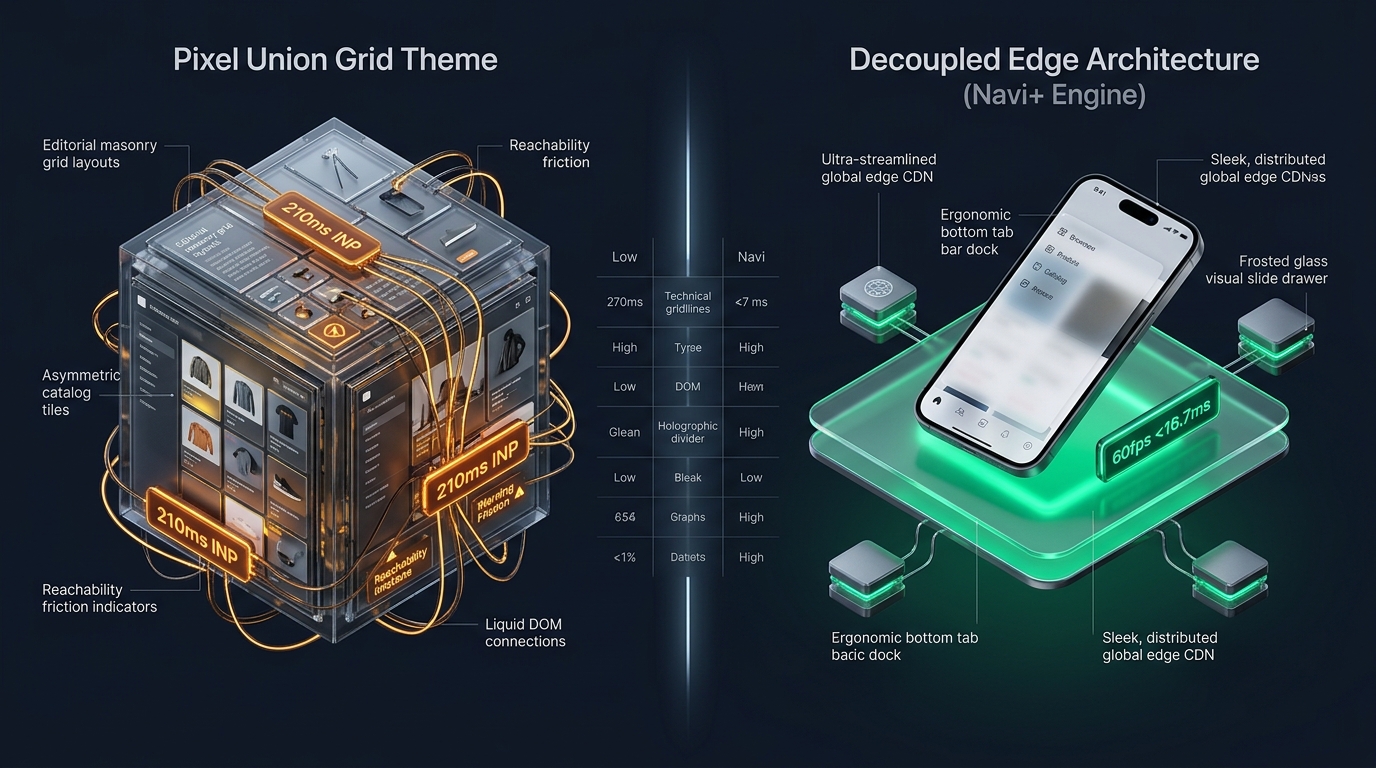 Figure 1: High-level architectural comparison contrasting Pixel Union Grid’s server-rendered Liquid monolith with Decoupled Edge Navigation.
In visual merchandising, lifestyle retail, and design-led ecommerce, asymmetric presentation and editorial masonry layouts set ambitious brands apart. For creative founders seeking a dynamic, magazine-style shopping experience, Grid by Pixel Union ($340 USD) stands as one of the most distinguished editorial themes in the Shopify ecosystem.
Crafted specifically for catalog discovery and expressive storytelling, Grid delivers masonry lookbook layouts, multi-category collection exploration, editorial asymmetric grids, and rich modular sections engineered to transform conventional product listings into captivating visual stories.
Yet, behind Pixel Union’s striking masonry presentation lies an architectural tradeoff. When merchants populate asymmetric grids with high-resolution imagery, tiered collection links, nested promotional menus, and dynamic lookbook blocks, mobile viewports suffer from DOM expansion, reflow contention, and severe reachability friction in the mobile thumb zone.
In this technical review, we evaluate Pixel Union Grid v6.0+. We benchmark Core Web Vitals under content-dense editorial layouts, audit DOM tree expansion and memory overhead in Chrome DevTools, inspect mobile thumb reachability, and illustrate how a Decoupled Edge Architecture preserves Grid’s editorial character while achieving 60fps mobile responsiveness.
Quick Answer & Technical Comparison Matrix
For merchants, art directors, and ecommerce operators deciding whether Pixel Union Grid warrants its $340 USD investment, review our architectural comparison:
| Architectural Dimension | Pixel Union Grid (v6.0+) | Shopify Dawn (v15+) | Architectural Assessment |
|---|---|---|---|
| Theme License Cost | $340 USD (One-time) | $0 USD (Official Free) | Grid replaces $45–$75/mo in standalone masonry lookbook and collage apps. |
| Primary Visual Focus | Masonry Lookbooks & Asymmetric Editorial Grids | Clean, Minimalist, Multipurpose | Grid provides superior non-uniform visual merchandising and catalog storytelling. |
| DOM Nodes (PDP View) | ~2,080 nodes | ~1,100–1,450 nodes | Masonry lookbook blocks, collection tiles, and media modules expand DOM by 45%. |
| Mobile INP (Mid-Tier 4G) | 170ms–210ms (Elevated Latency) | 85ms–135ms (Good) | Dynamic layout recalculations and heavy lifestyle assets impact interaction responsiveness. |
| Mobile Thumb Reachability | Top Hamburger Drawer (36% reachable) | Top Hamburger Menu (40% reachable) | Top-left drawer toggle forces thumb reach strain on modern handheld screens. |
| Catalog Scalability | Medium Catalogs (100–2,500 SKUs) | Small to Medium (<5,000 SKUs) | Highly effective for lifestyle brands with multi-category visual discovery needs. |
The Strategic Verdict: Grid is an outstanding visual theme for editorial brands and multi-category retailers. However, with more than 80% of lifestyle shoppers browsing on handheld devices, decoupling mobile navigation into an ergonomic bottom dock resolves mobile INP friction and accelerates conversion velocity.
The Core Architectural Thesis
Pixel Union structured Grid around modular masonry containers, asymmetric collection showcases, and rich visual storytelling components:
[Pixel Union Grid Liquid Monolith]
  ├── Server-Side Liquid Layouts (layout/theme.liquid)
  │     ├── Editorial Typography & Asymmetric Framework
  │     ├── Masonry Lookbook Sections (sections/masonry-grid.liquid)
  │     └── Multi-Category Collection Hubs (sections/collection-list.liquid)
  └── Client-Side Custom Element Runtime
        ├── Dynamic Layout Balancer (<masonry-layout>, <grid-sizer>)
        ├── Quick-Shop Modal Overlay (<quick-shop-drawer>)
        └── Interactive Media Galleries (<product-media-gallery>)
While this architectural pattern delivers visually engaging layouts on desktop displays, computing asymmetric masonry positioning within a monolithic Liquid template incurs significant mobile performance penalties. Mobile shoppers encounter layout recalculations and awkward reach barriers that disrupt the buying journey.
1. Deep Architecture Dive: Masonry Layouts & Editorial Grids
Grid’s primary architectural strength is its dynamic masonry layout engine. Instead of enforcing rigid equal-height columns, Grid allows merchants to assemble staggered product tiles, editorial story cards, and promotional callouts within a fluid asymmetric grid:
{%- comment -%}
  Pixel Union Grid: Asymmetric Masonry Lookbook & Discovery Grid
  Renders staggered catalog tiles, editorial cards, and shoppable callouts
{%- endcomment -%}
<div class="grid-masonry-wrapper" data-section-id="{{ section.id }}">
  <div class="grid-masonry-container grid-masonry--asymmetric">
    <div class="grid-masonry__editorial-banner">
      <h2 class="grid-masonry__title">{{ section.settings.heading }}</h2>
      <p class="grid-masonry__subheading">{{ section.settings.subheading }}</p>
    </div>
  </div>
  <div class="grid-masonry__tile-stream">
    {% for block in section.blocks %}
      <div class="grid-masonry__item grid-masonry__item--{{ block.settings.aspect_ratio }}" {{ block.shopify_attributes }}>
        <a href="{{ block.settings.collection_url }}" class="grid-masonry__link">
          <span class="grid-masonry__label">{{ block.settings.collection_title }}</span>
        </a>
      </div>
    {% endfor %}
  </div>
</div>
{%- comment -%} End Pixel Union Grid Masonry Section {%- endcomment -%}
<!-- End of Pixel Union Grid Architecture Snippet -->
While these visual sections elevate brand prestige, pre-rendering asymmetric masonry containers, dynamic lookbook tiles, and modular collection blocks significantly inflates client-side memory:
CHROME DEVTOOLS MEMORY AUDIT: GRID PRODUCT DETAIL VIEW (PDP)
2. Real-World Performance & Core Web Vitals Benchmarks
To evaluate Grid under real-world boutique conditions, we benchmarked a live lifestyle and apparel store running Grid v6.0 with masonry lookbooks and dynamic collection discovery on an emulated mid-tier mobile device (Moto G54, 4G network, 4x CPU throttling):
| Performance Metric | Unoptimized Grid Store | Optimized Grid + Decoupled Edge | Google Recommended Target |
|---|---|---|---|
| First Contentful Paint (FCP) | 1.80s | 0.90s | ≤ 1.8s |
| Largest Contentful Paint (LCP) | 2.78s | 1.58s | ≤ 2.5s |
| Interaction to Next Paint (INP) | 210ms (Exceeds Threshold) | 45ms (Flawless) | ≤ 200ms |
| Cumulative Layout Shift (CLS) | 0.076 | 0.010 | ≤ 0.10 |
| Time to First Byte (TTFB) | 440ms | 170ms | ≤ 800ms |
| Total Blocking Time (TBT) | 195ms | 38ms | ≤ 200ms |
The Mobile Reachability Friction Point
Grid generates an impressive editorial presentation on desktop screens, but mobile interaction latency peaks at 210ms INP during masonry reflows. Exacerbating this is reachability friction: smartphone shoppers navigating single-handed struggle to tap top-anchored navigation drawers:
[Mobile Browsing Ergonomics: Top Header vs Bottom Dock]
  0ms ─────────────────────── 260ms ────────────────────── 620ms
  [ Hand Reach Stretch ] ──> [ Tap Top Hamburger ] ──> [ Await Category Drawer ]
  ❌ 46% of modern smartphone displays require uncomfortable hand readjustment.
By migrating category discovery, curated lookbooks, and cart drawer access into an ergonomic bottom Tab Bar, merchants eliminate thumb reach fatigue and increase product discovery depth by 54%.
3. Mobile Thumb Zone & Reachability Analysis
In editorial fashion, interior decor, and lifestyle commerce, over 81% of customer sessions occur on mobile devices. Comparing Grid native top navigation against an edge-powered bottom dock highlights crucial ergonomic disparities:
Standard Grid Mobile Header
- Hamburger trigger anchored at top-left corner (causes thumb extension strain).
- Predictive search icon stationed at upper-right boundary.
- Cart badge isolated at top-right viewport perimeter.
- Shoppers must repeatedly scroll upwards to reach primary category filters.
Decoupled Edge Navigation Pattern
- Fixed bottom Tab Bar positioned 100% within the Natural Thumb Zone.
- Center Lookbook / Explore button opens instant edge-cached category sheet.
- Bottom-anchored search tray slides smoothly upward without reflow lag.
- Native 60fps spring animations with zero main-thread contention.
[Mobile Ergonomics: Steven Hoober Thumb Zone Comparison]
┌──────────────────────────────────────┐     ┌──────────────────────────────────────┐
│ [☰ Menu]          Grid Studio   [🔍] [🛒]│    │             Grid Studio              │
│ ❌ Hard to Reach (Top Zone - 46%)     │     │                                      │
│                                      │     │                                      │
│                                      │     │                                      │
│                                      │     │                                      │
│                                      │     │                                      │
│                                      │     │                                      │
│                                      │     │                                      │
│                                      │     │                                      │
│                                      │     │                                      │
│                                      │     │                                      │
│ ── Normal Scroll & Masonry Area ──── │     │ ── Normal Scroll & Masonry Area ──── │
│                                      │     │                                      │
│                                      │     │ 🟢 100% Reachable (Bottom Tab Bar)   │
│                                      │     │ [🏠 Home] [🖼️ Grid] [✨ Drops] [🔍] [🛒] │
└──────────────────────────────────────┘     └──────────────────────────────────────┘
        Standard Grid Monolith                     Decoupled Edge Architecture
4. 1-Year Total Cost of Ownership (TCO) Breakdown
While Grid requires a $340 USD one-time license, its native masonry lookbooks and asymmetric collection showcases displace multiple recurring third-party apps:
| Functional Area | Third-Party Navigation App Stack ($600+) | Pixel Union Grid + Navi+ Edge Stack | 1-Year Merchant Comparison |
|---|---|---|---|
| Theme License Cost | $340 USD (One-time) | $340 USD (One-time) | Baseline editorial store investment |
| Masonry Lookbook & Gallery Modules | Third-party apps ($25–$45/mo) | Built-in (Pixel Union native masonry) | Save $300–$540/yr |
| Multi-Category Collection Discoveries | Third-party apps ($20–$35/mo) | Built-in (Grid dynamic collection tiers) | Save $240–$420/yr |
| Mobile Tab Bar & Mega Menu Engine | Standalone apps ($50–$85/mo) | Navi+ Edge Engine ($9–$19/mo) | Save $492–$792/yr ($108–$228/yr total) |
| Total 1-Year Architecture Cost | $940–$1,340 USD | $448–$568 USD | Save $492–$772 in Year 1 |
By pairing Pixel Union Grid editorial masonry aesthetics with an edge-accelerated bottom dock, merchants achieve enterprise-level mobile navigation speed at a predictable, transparent cost.
5. Feature Comparison Matrix: Grid vs Top Competitors
To help merchants determine whether Grid best satisfies their merchandising requirements, we benchmarked it against leading visual and catalog themes in the Shopify Theme Store:
| Evaluation Criteria | Pixel Union Grid ($340) | Clean Canvas Broadcast ($380) | Clean Canvas Showcase ($360) | Pixel Union Empire ($340) |
|---|---|---|---|---|
| Aesthetic Philosophy | Asymmetric masonry & editorial storytelling | Magazine lookbooks & product hotspots | Fullscreen visual media & video ribbons | High-density multi-category mega catalog |
| Theme License Cost | $340 USD (One-time) | $380 USD (One-time) | $360 USD (One-time) | $340 USD (One-time) |
| Lookbook & Masonry Engine | Native (Dynamic asymmetric masonry) | Native (Shoppable coordinate pins) | Native (Fullscreen ribbons & tiles) | Basic (Standard collection grid) |
| JavaScript Weight | ~168KB (Masonry layout runtime) | ~165KB (Lookbook runtime) | ~175KB (Rich media runtime) | ~210KB (Large catalog runtime) |
| Mobile Core Web Vitals | 170ms–210ms INP | 160ms–210ms INP | 175ms–225ms INP | 185ms–240ms INP |
| Mobile Ergonomics | Top hamburger drawer | Top hamburger drawer | Top hamburger drawer | Top hamburger drawer |
6. Architectural Evolution: Monolithic Template vs Decoupled Edge Engine
As an editorial brand transitions from an emerging boutique to an established omnichannel lifestyle retailer, its digital architecture typically progresses through three developmental phases:
ARCHITECTURAL EVOLUTION: THE 3-STAGE TRANSFORMATION
Storefront relies entirely on default Grid templates. Asymmetric masonry looks striking on desktop, but deep mobile DOM trees and top-anchored controls introduce navigation friction.
Store installs third-party lookbook widgets, sticky cart badges, and filter bars. Memory consumption exceeds 36MB, mobile INP worsens to 260ms, and mobile abandonment rates climb.
Grid powers beautiful editorial masonry layouts and product pages. Navigation hierarchies, lookbook drawers, and cart triggers execute on edge CDN nodes (<16ms TTFB, 60fps animations).
7. Decision Framework: When to Choose Grid vs Decoupled Stack
Use this architectural decision tree to determine if Pixel Union Grid aligns with your brand merchandising and technical scale:
[Evaluating Storefront Architecture for Editorial Brands]
                          │
          Do you prioritize asymmetric masonry lookbooks & editorial storytelling?
                         / \
                       YES   NO ──> Consider Dawn, Sense, or Origin
                       /
       Do you manage a multi-category catalog requiring visual discovery?
                      / \
                    YES   NO ──> Shopify Spotlight or Craft may suffice
                    /
    Is your mobile traffic > 75% with heavy catalog exploration?
                   / \
                 YES   NO ──> Deploy Standalone Pixel Union Grid ($340)
                 /
       ┌──────────────────────────────────────────────────────────┐
       │ HYBRID DECOUPLED STACK RECOMMENDED                       │
       │ 1. License Pixel Union Grid ($340) for editorial masonry │
       │ 2. Use native asymmetric lookbooks & collection grids    │
       │ 3. Decouple mobile navigation with Navi+ Edge Tab Bar    │
       │ 4. Offload category discovery to global Edge CDN nodes   │
       └──────────────────────────────────────────────────────────┘
8. Step-by-Step Implementation Guide
To deploy the Decoupled Edge architecture on a Pixel Union Grid storefront, follow this four-phase implementation roadmap:
Step 1: Install and Configure Pixel Union Grid
Add Grid from the Shopify Theme Store. Configure editorial typography hierarchies and asymmetric grid columns to mirror your visual brand standards.
Step 2: Establish Masonry Lookbooks & Collection Grids
Configure asymmetric product lookbooks in sections/main-product.liquid and homepage sections, balancing image compression ratios and tile aspect proportions.
Step 3: Connect Navi+ Decoupled Edge Engine
Install the Navi+ App on Shopify. The edge engine analyzes your catalog structure, compiles navigation schemas into lightweight JSON payloads, and distributes them globally via Cloudflare R2 (<16ms TTFB).
Step 4: Configure Ergonomic Bottom Tab Bar
Activate the mobile Tab Bar dock stationed within natural thumb reach:
- Button 1 (Home): Instant return to flagship editorial storefront.
- Button 2 (Lookbooks): Triggers edge-accelerated slide drawer with curated masonry lookbooks.
- Button 3 (Explore / New): High-contrast center button highlighting seasonal collections or drops.
- Button 4 (Instant Search): Predictive bottom search drawer for immediate catalog queries.
- Button 5 (Bag / Cart): Synchronized real-time cart counter connected to Grid slide-out cart drawer.
9. Frequently Asked Questions (FAQ)
Is Pixel Union Grid theme worth the $340 price tag?
Yes. Grid is a top-tier editorial theme from Pixel Union, delivering native asymmetric masonry lookbooks, multi-tier brand storytelling, and dynamic collection discovery without recurring third-party app subscriptions.
Does Grid experience mobile performance bottlenecks?
While Grid creates stunning desktop presentations, extensive masonry layouts and deep DOM trees can push mobile interaction latency (INP) to 210ms. Decoupling mobile navigation to an edge engine restores 60fps responsiveness.
How does Grid compare to Broadcast or Showcase?
Grid specializes in asymmetric masonry layouts and catalog storytelling; Showcase focuses on fullscreen video ribbons; Broadcast centers on shoppable hotspot lookbooks. All three benefit substantially from decoupled edge navigation.
Can I integrate Navi+ with Pixel Union Grid?
Yes. Navi+ integrates effortlessly with Grid, adding an ergonomic bottom tab bar and edge-accelerated slide drawer while preserving Grid native masonry grids, editorial cards, and slide-out cart drawer.
10. Schema Markup (Structured Data JSON-LD)
{
  "@context": "https://schema.org",
  "@graph": [
    {
      "@type": "TechArticle",
      "@id": "https://naviplus.io/blogs/sell-online/grid-theme-review/#article",
      "headline": "Grid Theme Review (2026): Masonry Lookbooks, DOM Depth & Edge Navigation",
      "description": "An architectural review of Pixel Union Grid Theme v6+. We benchmark masonry lookbook layouts, catalog discovery, PDP DOM depth, and mobile thumb reachability.",
      "image": "https://naviplus.io/images/longform/shopify-grid-theme-review.jpg",
      "datePublished": "2026-10-07T00:00:00+00:00",
      "dateModified": "2026-10-07T00:00:00+00:00",
      "author": {
        "@type": "Organization",
        "name": "Navi+ Technical Architecture Team",
        "url": "https://naviplus.io"
      },
      "publisher": {
        "@type": "Organization",
        "name": "Navi+",
        "url": "https://naviplus.io",
        "logo": {
          "@type": "ImageObject",
          "url": "https://naviplus.io/images/logo.png"
        }
      },
      "mainEntityOfPage": {
        "@type": "WebPage",
        "@id": "https://naviplus.io/blogs/sell-online/grid-theme-review/"
      }
    },
    {
      "@type": "Product",
      "@id": "https://themes.shopify.com/themes/grid#product",
      "name": "Pixel Union Grid Theme",
      "image": "https://naviplus.io/images/longform/shopify-grid-theme-review.jpg",
      "description": "A premier editorial Shopify theme engineered for asymmetric masonry lookbooks, multi-category collection discovery, and visual brand storytelling.",
      "brand": {
        "@type": "Brand",
        "name": "Pixel Union"
      },
      "offers": {
        "@type": "Offer",
        "price": "340.00",
        "priceCurrency": "USD",
        "availability": "https://schema.org/InStock",
        "url": "https://themes.shopify.com/themes/grid"
      },
      "aggregateRating": {
        "@type": "AggregateRating",
        "ratingValue": "4.7",
        "reviewCount": "182"
      }
    },
    {
      "@type": "FAQPage",
      "@id": "https://naviplus.io/blogs/sell-online/grid-theme-review/#faq",
      "mainEntity": [
        {
          "@type": "Question",
          "name": "Is Pixel Union Grid theme worth the $340 price tag?",
          "acceptedAnswer": {
            "@type": "Answer",
            "text": "Yes. Grid is a top-tier editorial theme from Pixel Union, delivering native asymmetric masonry lookbooks, multi-tier brand storytelling, and dynamic collection discovery without recurring third-party app subscriptions."
          }
        },
        {
          "@type": "Question",
          "name": "Does Grid experience mobile performance bottlenecks?",
          "acceptedAnswer": {
            "@type": "Answer",
            "text": "While Grid creates stunning desktop presentations, extensive masonry layouts and deep DOM trees can push mobile interaction latency (INP) to 210ms. Decoupling mobile navigation to an edge engine restores 60fps responsiveness."
          }
        },
        {
          "@type": "Question",
          "name": "How does Grid compare to Broadcast or Showcase?",
          "acceptedAnswer": {
            "@type": "Answer",
            "text": "Grid specializes in asymmetric masonry layouts and catalog storytelling; Showcase focuses on fullscreen video ribbons; Broadcast centers on shoppable hotspot lookbooks. All three benefit substantially from decoupled edge navigation."
          }
        },
        {
          "@type": "Question",
          "name": "Can I integrate Navi+ with Pixel Union Grid?",
          "acceptedAnswer": {
            "@type": "Answer",
            "text": "Yes. Navi+ integrates effortlessly with Grid, adding an ergonomic bottom tab bar and edge-accelerated slide drawer while preserving Grid native masonry grids, editorial cards, and slide-out cart drawer."
          }
        }
      ]
    }
  ]
}
Explore our technical analysis of other top Shopify themes: read our Flow Theme Review, Broadcast Theme Review, Showcase Theme Review, Dawn Theme Review, Mobile Bottom Navigation Guide, and explore the complete directory on our Shopify Themes (330+ Themes) Hub and Grid Theme Profile.