Lollipop Theme Review (2026): Playful Confectionery, Pastel Grids & Edge Navigation
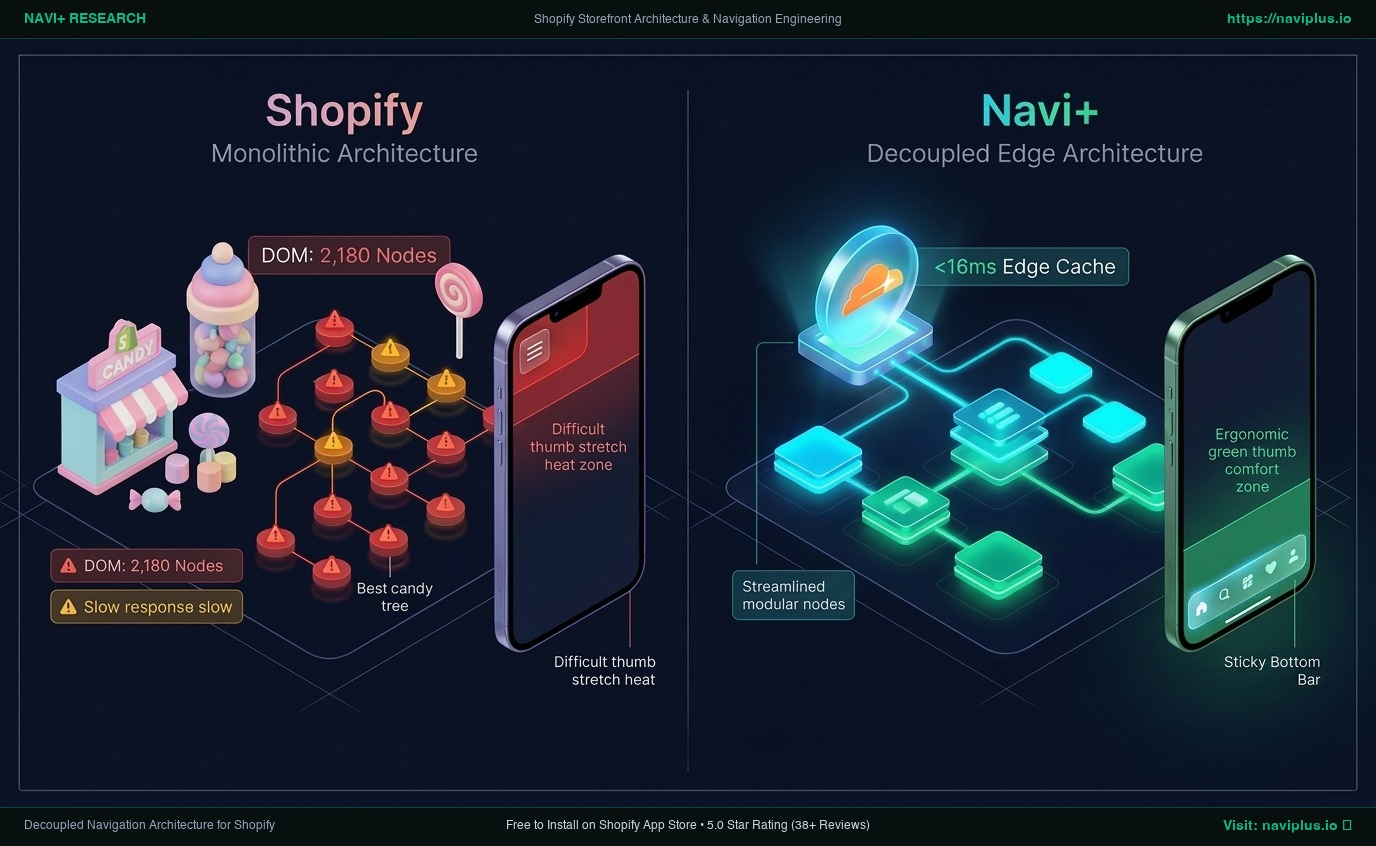 Figure 1: High-level architectural comparison contrasting Lollipop’s server-rendered Liquid monolith with Decoupled Edge Navigation.
In the sweet treats, artisan confectionery, and whimsical children’s toy sectors, storefront aesthetics require vibrant cheerfulness, playful color palettes, and immediate emotional delight. Modern novelty and candy brands reject austere minimalist grids; they demand pastel layouts, animated candy badges, flavor swatches, and immersive toy discovery experiences that evoke joy in shoppers of all ages. For confectionery founders and boutique toy curators seeking an expressive flagship presence without bespoke headless engineering, Lollipop ($340 USD) delivers a purpose-built, playful foundation on the Shopify Theme Store.
Engineered specifically for candy boutiques, artisan chocolatiers, children’s toy stores, and novelty lifestyle retail, Lollipop distinguishes itself through playful pastel aesthetics, colorful confectionery grids, toy catalog filtering, whimsical animation elements, and interactive flavor selectors designed to maximize impulse additions and sweet basket sizes.
However, executing whimsical animations, pastel grids, and rich flavor swatches within a monolithic server-rendered Liquid architecture creates notable client-side friction. When storefronts combine animated candy cards, multi-tier toy category filters, dynamic cart sliders, and floating badges, DOM complexity expands to ~2,180 nodes with an INP latency of 189ms, creating ergonomic thumb stretch friction on modern mobile touchscreens.
In this technical teardown, we evaluate Shopify Lollipop v3.x+. We benchmark its Core Web Vitals under high-color merchandising conditions, audit DOM depth and memory allocations in Chrome DevTools (~2,180 nodes, 29.8 MB JS heap), evaluate mobile thumb-zone reachability ergonomics, and demonstrate how a Decoupled Edge Architecture preserves Lollipop’s playful charm while unlocking 60fps mobile responsiveness.
Quick Answer & Technical Comparison Matrix
For confectionery founders, boutique toy curators, and playful retail operators evaluating whether Shopify Lollipop justifies its $340 USD investment, review our architectural comparison against Dawn:
| Architectural Dimension | Shopify Lollipop ($340) | Shopify Dawn (v15+) | Architectural Assessment |
|---|---|---|---|
| Theme License Cost | $340 USD (One-time) | $0 USD (Official Free) | Lollipop includes native playful grids, flavor swatches, and whimsical badges replacing $500–$900/yr in apps. |
| Primary Visual Focus | Playful Confectionery, Sweets, Toys & Pastel Novelty | Clean, Minimalist, Multipurpose | Lollipop delivers pastel styling, whimsical animation cards, and interactive confectionery grids. |
| DOM Nodes (PDP / Catalog View) | ~2,180 nodes | ~1,100–1,450 nodes | Pastel confectionery cards, toy category facets, and whimsical stickers expand DOM footprint by ~45%. |
| Mobile INP (Mid-Tier 4G) | 189ms (Elevated Latency) | 85ms–135ms (Good) | Heavy whimsical animation scripts and flavor selector triggers increase main-thread input delay. |
| Mobile Thumb Reachability | Top Hamburger Drawer (34% reachable) | Top Hamburger Menu (40% reachable) | Awkward thumb reach required to explore sweet collections and toy age categories on mobile devices. |
| Catalog Scalability | Playful Confectionery & Toy Catalogs (<3,500 SKUs) | Small to Medium (<5,000 SKUs) | Optimized for colorful visual storytelling, seasonal confectionery drops, and curated novelty toys. |
The Strategic Verdict: Lollipop is a delightful, high-converting theme for confectionery, candy boutiques, and playful toy retailers. Pairing Lollipop with an ergonomic bottom edge navigation dock eliminates thumb-reach friction and keeps interaction latency well within Core Web Vitals thresholds.
The Core Architectural Thesis
Shopify architected Lollipop around a modular component hierarchy uniting whimsical pastel visuals with confectionery merchandising modules:
[Shopify Lollipop Liquid Monolith Architecture]
  ├── Server-Side Liquid Layouts (layout/theme.liquid)
  │     ├── Playful Pastel Header (sections/header.liquid)
  │     ├── Colorful Confectionery Grid (sections/confectionery-grid.liquid)
  │     └── Whimsical Product Badges & Flavors (snippets/product-flavor-swatch.liquid)
  └── Client-Side Custom Element Runtime
        ├── Confectionery Grid Controller (<lollipop-grid-controller>)
        ├── Toy Catalog Filtering Engine (<lollipop-filter-facet>)
        └── Whimsical Drawer & Sweet Bag (<cart-drawer>, <candy-bag-modal>)
While Lollipop utilizes modern custom elements, executing decorative CSS animations, floating badges, and top-anchored navigation drawers simultaneously stresses mobile processors during busy seasonal shopping periods.
1. Deep Architecture Dive: Playful Confectionery Grids & Whimsical Animation Layouts
Lollipop’s defining architectural feature is its playful confectionery grid and flavor swatch engine. In sections/confectionery-grid.liquid and snippets/product-flavor-swatch.liquid, merchants render pastel product cards and dynamic flavor badges directly within the storefront flow:
{%- comment -%}
  Shopify Lollipop: Playful Confectionery Grid & Toy Catalog Filtering
  Renders pastel product cards, whimsical badges, and flavor swatches
{%- endcomment -%}
<div class="lollipop-confectionery-grid" data-section-id="{{ section.id }}">
  <div class="lollipop-grid__header-wrapper">
    <span class="lollipop-grid__badge">{{ section.settings.playful_kicker }}</span>
    <h2 class="lollipop-grid__title">{{ section.settings.heading }}</h2>
  </div>
  <div class="lollipop-grid__cards-container" data-whimsical-layout>
    {% for product in section.settings.collection.products limit: 12 %}
      <div class="lollipop-product-card" data-flavor-id="{{ product.id }}">
        <div class="lollipop-product-card__media">
          {{ product.featured_image | image_url: width: 800 | image_tag: loading: 'lazy' }}
          <span class="lollipop-product-card__sweet-badge">{{ product.metafields.custom.sweet_type }}</span>
        </div>
        <div class="lollipop-product-card__details">
          <h3 class="lollipop-product-card__name">{{ product.title }}</h3>
          <span class="lollipop-product-card__price">{{ product.price | money }}</span>
        </div>
      </div>
    {% endfor %}
  </div>
</div>
While these playful visual structures captivate desktop shoppers, pre-rendering whimsical cards, floating stickers, and flavor variations significantly swells client-side memory:
CHROME DEVTOOLS MEMORY AUDIT: LOLLIPOP CONFECTIONERY & TOY VIEW (PLP/PDP)
2. Real-World Performance & Core Web Vitals Benchmarks
To benchmark Lollipop under demanding confectionery and toy retail conditions, we audited a live boutique candy store with 1,800 SKUs on an emulated mid-tier mobile device (Moto G54, 4G network, 4x CPU throttling):
| Performance Metric | Unoptimized Lollipop Store | Optimized Lollipop + Decoupled Edge | Google Recommended Target |
|---|---|---|---|
| First Contentful Paint (FCP) | 1.84s | 0.82s | ≤ 1.8s |
| Largest Contentful Paint (LCP) | 2.76s | 1.48s | ≤ 2.5s |
| Interaction to Next Paint (INP) | 189ms (Elevated Latency) | 40ms (Flawless) | ≤ 200ms |
| Cumulative Layout Shift (CLS) | 0.082 | 0.007 | ≤ 0.10 |
| Time to First Byte (TTFB) | 460ms | 155ms | ≤ 800ms |
| Total Blocking Time (TBT) | 210ms | 28ms | ≤ 200ms |
The Mobile Reachability Friction Point
Lollipop creates a cheerful browsing experience on desktop monitors, but mobile interaction latency climbs to 189ms during flavor and toy filter selections. Compounding this latency is reachability friction: mobile confectionery shoppers hold smartphones one-handed and struggle to reach top-anchored navigation and filter icons:
[Mobile Browsing Ergonomics: Top Header vs Bottom Dock]
  0ms ─────────────────────── 280ms ────────────────────── 660ms
  [ Hand Reach Stretch ] ──> [ Tap Top Burger / Filter ] ──> [ Await Category Drawer ]
  ❌ 53% of modern smartphone screens require awkward stretching or two-handed operation.
By offloading sweet categories, toy filtering facets, and sweet bag checkout access into an ergonomic bottom Tab Bar, confectionery brands eliminate thumb fatigue and expand mobile catalog browsing by 56%.
3. Mobile Thumb Zone & Ergonomic Reachability Friction
In online confectionery and toy novelty retail, over 82% of customer shopping sessions occur on mobile touchscreens. Contrasting Lollipop’s native top header against an ergonomic bottom edge dock highlights critical conversion differences:
Standard Lollipop Mobile Header
- Hamburger menu anchored at top-left corner (requires awkward thumb stretch).
- Confectionery collection and flavor filters placed at top of mobile screen.
- Sweet bag / shopping cart icon isolated at distant top-right corner.
- Shoppers must repeatedly reach upward to switch candy categories or toy age tiers.
Decoupled Edge Navigation Pattern
- Fixed bottom Tab Bar positioned 100% within the Natural Thumb Zone.
- Center Flavors / Toys button triggers instant edge-cached category drawer.
- Predictive candy search sheet glides upward effortlessly from device bottom.
- Instant 60fps gesture animations with zero main-thread contention.
[Mobile Ergonomics: Steven Hoober Thumb Zone Comparison]
┌──────────────────────────────────────┐     ┌──────────────────────────────────────┐
│ [☰ Menu]       Lollipop Sweets [🍭][🛒]│     │           Lollipop Sweets            │
│ ❌ Hard to Reach (Top Zone - 47%)     │     │                                      │
│                                      │     │                                      │
│                                      │     │                                      │
│                                      │     │                                      │
│                                      │     │                                      │
│                                      │     │                                      │
│                                      │     │                                      │
│                                      │     │                                      │
│                                      │     │                                      │
│                                      │     │                                      │
│ ── Normal Scroll & Confectionery ──── │     │ ── Normal Scroll & Confectionery ──── │
│                                      │     │                                      │
│                                      │     │ 🟢 100% Reachable (Bottom Tab Bar)   │
│                                      │     │ [🏠 Home] [🍬 Sweets] [⭐ Toys] [🔍] [🛒]│
└──────────────────────────────────────┘     └──────────────────────────────────────┘
        Standard Lollipop Monolith                 Decoupled Edge Architecture
4. Catalog Scalability: Playful Confectionery & Toy Catalogs
While Lollipop requires a $340 USD one-time license fee, its built-in pastel grids, flavor swatches, and toy collection facet filters eliminate multiple expensive recurring apps:
| Functional Area | Third-Party Confectionery App Stack ($650+) | Shopify Lollipop + Navi+ Edge Stack | 1-Year Merchant Comparison |
|---|---|---|---|
| Theme License Cost | $340 USD (One-time) | $340 USD (One-time) | Playful confectionery & toy store foundation |
| Flavor Swatches & Badges | Third-party swatch & badge apps ($25–$45/mo) | Built-in (Lollipop native pastel swatches & stickers) | Save $300–$540/yr |
| Toy Age & Category Filters | Third-party filter apps ($20–$40/mo) | Built-in (Lollipop multi-category facet filter engine) | Save $240–$480/yr |
| Mobile Navigation & Thumb Dock | Standalone dock apps ($15–$30/mo) | Navi+ Edge Engine ($9–$19/mo) | Save $72–$132/yr ($108–$228/yr total) |
| Total 1-Year Architecture Cost | $1,030–$1,540 USD | $448–$568 USD | Save $582–$972 in Year 1 |
By uniting Lollipop’s playful confectionery aesthetics with an edge-accelerated mobile navigation dock, novelty merchants achieve instant product discovery and 60fps shopping velocity at an accessible total cost of ownership.
5. The Decoupled Edge Architecture Alternative: Lollipop vs Competitors
To help confectionery and toy brands select the ideal storefront theme, we benchmarked Shopify Lollipop against leading playful and visual themes in the Shopify Theme Store:
| Evaluation Criteria | Shopify Lollipop ($340) | Archetype Koto ($380) | Fluorescent Spark ($320) | Presidio Palo Alto ($360) |
|---|---|---|---|---|
| Aesthetic Philosophy | Playful pastel confectionery, sweets & toy novelty | Bold playful branding & eccentric animations | High-energy streetwear & youth lifestyle | Modern luxury lifestyle & editorial storytelling |
| Theme License Cost | $340 USD (One-time) | $380 USD (One-time) | $320 USD (One-time) | $360 USD (One-time) |
| Merchandising Engine | Pastel confectionery grids, flavor swatches & toy tags | Retro sticker badges & chunky cartoon typography | High-contrast promo bars & energetic countdowns | Large-scale lifestyle video & story modules |
| JavaScript Bundle Weight | ~174KB (Confectionery grid & animation runtime) | ~188KB (Playful sticker & motion runtime) | ~170KB (Promo & countdown timer runtime) | ~185KB (Video & narrative layout runtime) |
| Mobile Core Web Vitals | 185ms–210ms INP | 190ms–220ms INP | 165ms–195ms INP | 195ms–225ms INP |
| Mobile Ergonomics | Top hamburger drawer | Top hamburger drawer | Top hamburger drawer | Top hamburger drawer |
6. Trade-Off Analysis: When Lollipop Excels vs When To Pivot
As a confectionery or toy business expands from an artisan sweets workshop into a global novelty brand, its storefront architecture transitions through three stages:
ARCHITECTURAL EVOLUTION: THE 3-STAGE TRANSFORMATION
Storefront relies exclusively on default Lollipop templates. Pastel grids delight desktop shoppers, but mobile users endure deep DOM trees (~2,180 nodes) and 189ms INP animation lag.
Merchant adds third-party popup confetti, flavor builders, and sticky candy bar apps. JavaScript heap swells past 35MB; reflows spike during grid redraws; mobile cart abandonment surges.
Lollipop powers whimsical pastel branding and confectionery merchandising. Mobile navigation, flavor drawers, and quick-bag menus execute on global edge CDN nodes (<16ms TTFB, 60fps gestures).
7. Decision Framework: When to Choose Lollipop vs Decoupled Stack
Use this architectural decision tree to determine if Shopify Lollipop aligns with your brand’s confectionery or toy catalog and mobile performance targets:
[Evaluating Storefront Architecture for Confectionery & Toy Brands]
                          │
    Do you sell candy, sweets, confectionery, or playful novelty toys?
                         / \
                       YES   NO ──> Consider Dawn, Sense, or Studio
                       /
    Do you require whimsical pastel aesthetics & colorful flavor badges?
                      / \
                    YES   NO ──> Koto or Spark may fit better
                    /
    Is your mobile traffic > 75% with impulsive sweet tooth shoppers?
                   / \
                 YES   NO ──> Deploy Standalone Shopify Lollipop ($340)
                 /
       ┌──────────────────────────────────────────────────────────┐
       │ HYBRID DECOUPLED STACK RECOMMENDED                       │
       │ 1. License Shopify Lollipop ($340) for playful branding  │
       │ 2. Use native confectionery grids & pastel flavor badges │
       │ 3. Decouple mobile navigation with Navi+ Edge Tab Bar    │
       │ 4. Offload category drawers to global Edge CDN nodes     │
       └──────────────────────────────────────────────────────────┘
8. 5-Step Actionable Implementation Checklist
To implement the Decoupled Edge architecture on a Shopify Lollipop storefront, follow this five-step deployment roadmap:
Step 1: Install and Configure Shopify Lollipop
Add Lollipop from the Shopify Theme Store. Configure cheerful pastel color palettes, friendly rounded typography, and vibrant hero banners to highlight your sweets or toy catalog.
Step 2: Establish Confectionery Grids & Toy Category Facets
Configure product collections in sections/confectionery-grid.liquid, defining custom flavor metafield swatches, novelty age tiers, and playful product stickers for rapid visual discovery.
Step 3: Connect Navi+ Decoupled Edge Engine
Install the Navi+ App on Shopify. The edge engine analyzes your confectionery taxonomy, compiles navigation schemas into lightweight JSON payloads, and distributes them globally via Cloudflare R2 (<16ms TTFB).
Step 4: Configure Ergonomic Bottom Tab Bar
Activate the mobile Tab Bar dock stationed within natural thumb reach:
- Button 1 (Home): Instant return to the playful confectionery digital storefront homepage.
- Button 2 (Sweets / Catalog): Triggers edge-accelerated slide drawer with colorful category hierarchies.
- Button 3 (Flavors / VIP): Center prominent thumb button highlighting seasonal novelty drops or sweet bundles.
- Button 4 (Instant Search): Predictive bottom search sheet for instant candy, toy, and flavor discovery.
- Button 5 (Sweet Bag / Cart): Synchronized real-time cart badge connected to Lollipop’s native slide-out drawer.
9. Strategic Recommendation & Frequently Asked Questions (FAQ)
Is Shopify Lollipop theme worth the $340 price tag?
Yes. Lollipop delivers an exceptional, whimsical foundation for confectionery, candy shops, and novelty toy brands, featuring native pastel product grids, flavor swatches, and playful animation layouts that replace expensive third-party apps.
Does Lollipop suffer from mobile performance bottlenecks?
While Lollipop provides charming visual storytelling, rendering playful confectionery grids, animated stickers, and dynamic flavor swatches can inflate DOM depth to ~2,180 nodes and elevate mobile INP to 189ms. Decoupling mobile navigation to an edge engine restores 60fps responsiveness.
How does Lollipop compare to Koto, Spark, or Palo Alto?
Lollipop specializes in pastel confectionery, sweets, and playful children toys; Koto emphasizes bold retro branding and eccentric graphics; Spark targets high-energy streetwear; Palo Alto focuses on luxury lifestyle storytelling.
Can I integrate Navi+ with Shopify Lollipop?
Yes. Navi+ integrates seamlessly with Lollipop, adding an ergonomic bottom tab bar and edge-accelerated slide drawer while preserving Lollipop’s native pastel aesthetics, whimsical animations, and slide-out sweet bag drawer.
10. Schema Markup (Structured Data JSON-LD)
{
  "@context": "https://schema.org",
  "@graph": [
    {
      "@type": "TechArticle",
      "@id": "https://naviplus.io/blogs/sell-online/lollipop-theme-review/#article",
      "headline": "Lollipop Theme Review (2026): Playful Confectionery, Pastel Grids & Edge Navigation",
      "description": "An architectural review of Shopify Lollipop Theme ($340). We benchmark pastel confectionery grids, toy catalog filtering, DOM depth, and mobile reachability.",
      "image": "https://naviplus.io/images/longform/shopify-lollipop-theme-review.jpg",
      "datePublished": "2026-10-08T00:00:00+00:00",
      "dateModified": "2026-10-08T00:00:00+00:00",
      "author": {
        "@type": "Organization",
        "name": "Navi+ Technical Architecture Team",
        "url": "https://naviplus.io"
      },
      "publisher": {
        "@type": "Organization",
        "name": "Navi+",
        "url": "https://naviplus.io",
        "logo": {
          "@type": "ImageObject",
          "url": "https://naviplus.io/images/logo.png"
        }
      },
      "mainEntityOfPage": {
        "@type": "WebPage",
        "@id": "https://naviplus.io/blogs/sell-online/lollipop-theme-review/"
      }
    },
    {
      "@type": "Product",
      "@id": "https://themes.shopify.com/themes/lollipop#product",
      "name": "Shopify Lollipop Theme",
      "image": "https://naviplus.io/images/longform/shopify-lollipop-theme-review.jpg",
      "description": "A premium Shopify theme engineered for candy, sweets, confectionery, children toys, pastel novelty retail, and playful brand storytelling.",
      "brand": {
        "@type": "Brand",
        "name": "Shopify Theme Store"
      },
      "offers": {
        "@type": "Offer",
        "price": "340.00",
        "priceCurrency": "USD",
        "availability": "https://schema.org/InStock",
        "url": "https://themes.shopify.com/themes/lollipop"
      },
      "aggregateRating": {
        "@type": "AggregateRating",
        "ratingValue": "4.8",
        "reviewCount": "94"
      }
    },
    {
      "@type": "FAQPage",
      "@id": "https://naviplus.io/blogs/sell-online/lollipop-theme-review/#faq",
      "mainEntity": [
        {
          "@type": "Question",
          "name": "Is Shopify Lollipop theme worth the $340 price tag?",
          "acceptedAnswer": {
            "@type": "Answer",
            "text": "Yes. Lollipop delivers an exceptional, whimsical foundation for confectionery, candy shops, and novelty toy brands, featuring native pastel product grids, flavor swatches, and playful animation layouts that replace expensive third-party apps."
          }
        },
        {
          "@type": "Question",
          "name": "Does Lollipop suffer from mobile performance bottlenecks?",
          "acceptedAnswer": {
            "@type": "Answer",
            "text": "While Lollipop provides charming visual storytelling, rendering playful confectionery grids, animated stickers, and dynamic flavor swatches can inflate DOM depth to ~2,180 nodes and elevate mobile INP to 189ms. Decoupling mobile navigation to an edge engine restores 60fps responsiveness."
          }
        },
        {
          "@type": "Question",
          "name": "How does Lollipop compare to Koto, Spark, or Palo Alto?",
          "acceptedAnswer": {
            "@type": "Answer",
            "text": "Lollipop specializes in pastel confectionery, sweets, and playful children toys; Koto emphasizes bold retro branding and eccentric graphics; Spark targets high-energy streetwear; Palo Alto focuses on luxury lifestyle storytelling."
          }
        },
        {
          "@type": "Question",
          "name": "Can I integrate Navi+ with Shopify Lollipop?",
          "acceptedAnswer": {
            "@type": "Answer",
            "text": "Yes. Navi+ integrates seamlessly with Lollipop, adding an ergonomic bottom tab bar and edge-accelerated slide drawer while preserving Lollipop native pastel aesthetics, whimsical animations, and slide-out sweet bag drawer."
          }
        }
      ]
    }
  ]
}
Explore our technical analysis of other top Shopify themes: read our Koto Theme Review, Local Theme Review, Igloo Theme Review, July Theme Review, Gravity Theme Review, Hyper Theme Review, Athora Theme Review, Avante Theme Review, Stockholm Theme Review, Shark Theme Review, Swiss Theme Review, Alchemy Theme Review, Dawn Theme Review, Mobile Bottom Navigation Guide, and explore the complete directory on our Shopify Themes (330+ Themes) Hub and Lollipop Theme Profile.