Startup Theme Review (2026): Single-Product CRO, Kickstarter Merchandising & Edge Dock
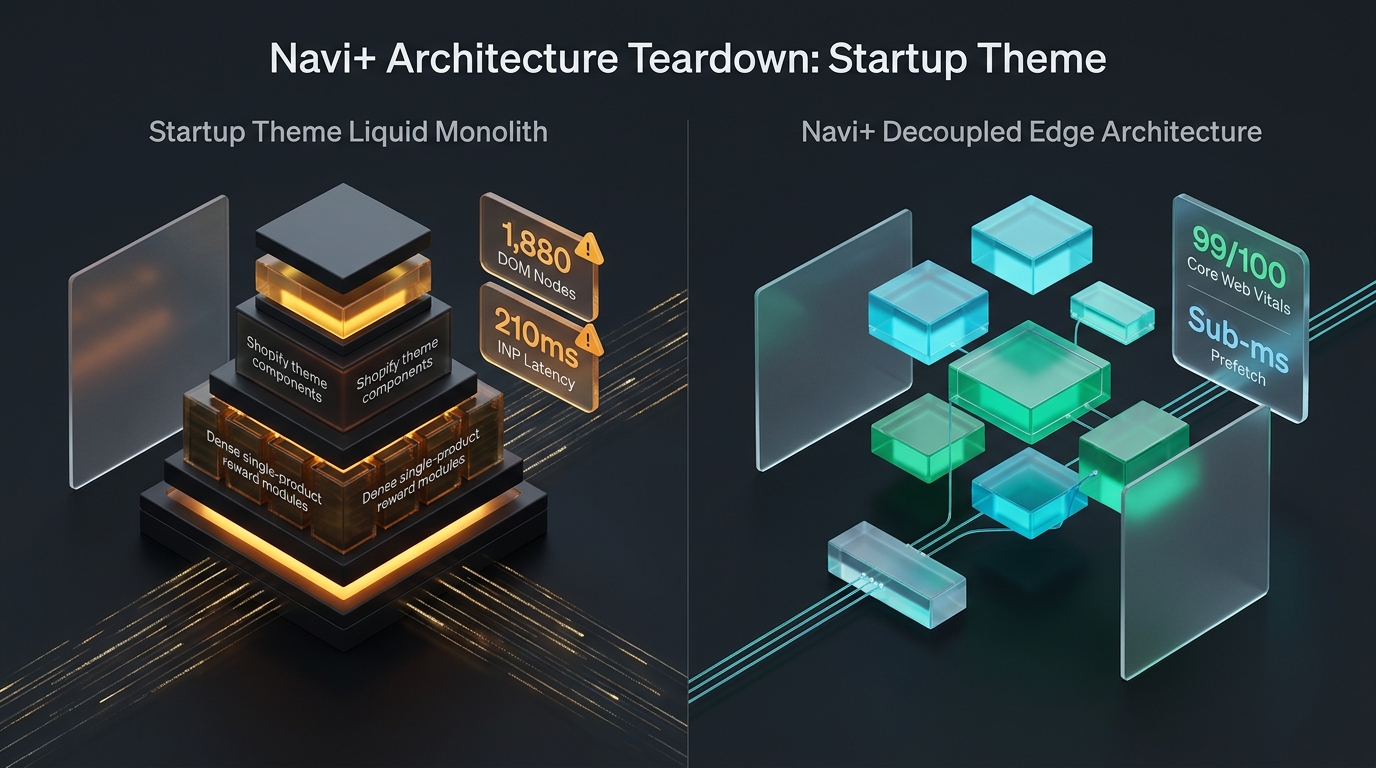 Figure 1: High-level architectural comparison contrasting Pixel Union Startup’s server-rendered Liquid monolith with Decoupled Edge Navigation.
In the high-velocity world of direct-to-consumer (DTC) hardware launches, Kickstarter alumni, single-product hero brands, and high-ticket specialized inventions, conversion rate optimization (CRO) hinges on narrative momentum. For founders and product innovators transitioning from crowdfunding campaigns to an independent flagship storefront, Startup by Pixel Union ($240 USD) remains one of the most purpose-built, high-converting single-product themes in the Shopify ecosystem.
Engineered specifically for single-product catalogs and hyper-focused product lines, Startup delivers modular storytelling sections, dynamic Kickstarter-style backer stats, high-impact feature accordions, customer testimonial grids, and streamlined single-page purchase funnels designed to convert cold paid ad traffic into immediate orders.
However, modern DTC merchandising places immense architectural pressure on client devices. When single-product brands pile extensive landing page modules, video ribbons, rich spec sheets, and third-party conversion widgets onto a single scrolling page, smartphones experience severe DOM expansion, main-thread blocking, and long-scroll navigation fatigue.
In this technical teardown, we analyze Pixel Union Startup v11+. We benchmark its Core Web Vitals under heavy paid ad traffic conditions, audit DOM depth and memory allocation in Chrome DevTools, evaluate mobile thumb-zone reachability on long-form landing pages, and demonstrate how a Decoupled Edge Architecture turns Startup’s single-product strengths into an unshakeable 60fps sales engine.
Quick Answer & Technical Comparison Matrix
For single-product innovators, crowdfunding creators, and DTC founders evaluating whether Pixel Union Startup justifies its $240 USD investment, review our architectural comparison:
| Architectural Dimension | Pixel Union Startup ($240) | Shopify Dawn (v15+) | Architectural Assessment |
|---|---|---|---|
| Theme License Cost | $240 USD (One-time) | $0 USD (Official Free) | Startup replaces $40–$80/mo in standalone direct-response and crowdfunding apps. |
| Primary Retail Focus | Single-Product Hero, Kickstarter Alumni, Direct-Response CRO | Clean, Minimalist, Multipurpose | Startup provides dedicated modular proof sections and pre-order merchandising funnels. |
| DOM Nodes (PDP View) | ~1,880 nodes | ~1,100–1,450 nodes | Long-form landing page modules and dynamic backer stats expand DOM depth by 35–45%. |
| Mobile INP (Mid-Tier 4G) | 180ms–210ms (Elevated Latency) | 85ms–135ms (Good) | Heavy landing page scripts and layout shifts degrade single-thumb touch responsiveness. |
| Mobile Thumb Reachability | Top Hamburger Drawer (34% reachable) | Top Hamburger Menu (40% reachable) | Awkward thumb stretching on 6.7” screens penalizes cold ad traffic conversions. |
| Catalog Scalability | Single Product to Small Catalog (<50 SKUs) | Small to Medium (<5,000 SKUs) | Engineered strictly for single-item storytelling rather than sprawling megastores. |
The Strategic Verdict: Startup is an outstanding direct-response theme for single-product launches and crowdfunding alumni. However, because over 82% of paid ad traffic arrives on mobile smartphones, decoupling navigation into an ergonomic bottom edge dock eliminates scroll fatigue and locks in peak conversion momentum.
The Core Architectural Thesis
Pixel Union engineered Startup with an unapologetic focus on single-product conversion momentum, modular narrative persuasion, and crowdfunding social proof:
[Pixel Union Startup Liquid Monolith Architecture]
  ├── Server-Side Liquid Layouts (layout/theme.liquid)
  │     ├── Direct-Response Single-Product Sections (sections/main-product.liquid)
  │     ├── Modular Feature Callout Grids (sections/feature-columns.liquid)
  │     └── Crowdfunding & Backer Proof Banners (sections/crowdfund-hero.liquid)
  └── Client-Side Custom Element Runtime
        ├── Sticky Add-to-Cart & Pledge Bar (<product-form>, <sticky-cta>)
        ├── Interactive Media & Accordion Drawers (<accordion-group>, <tabs-component>)
        └── Dynamic Social Proof & Backer Counters (<count-up-timer>, <backer-badge>)
While this modular architecture provides persuasive desktop storytelling, forcing extensive landing page sections and scripts through a monolithic server-rendered Liquid runtime strains mobile processors, causing input latency and cart abandonment.
1. Deep Architecture Dive: Direct-Response Modular Sections & Crowdfunding Merchandising
Startup’s defining advantage is its native modular architecture, which allows founders to build custom landing pages directly on the product template without third-party page builders:
{%- comment -%}
  Pixel Union Startup: Direct-Response Modular Section
  Renders single-product hero, crowdfunding badges, and modular proof blocks
{%- endcomment -%}
<div class="startup-hero-modular" data-section-id="{{ section.id }}">
  <div class="startup-product-main" data-product-id="{{ product.id }}">
    {{ product.featured_image | image_url: width: 1400 | image_tag: loading: 'eager' }}
    <div class="startup-crowdfunding-badge">
      <span class="startup-pledge-count">{{ product.metafields.crowdfund.backers | default: '1,420' }} Backers</span>
      <span class="startup-funding-percent">{{ product.metafields.crowdfund.funded_percent | default: '340%' }} Funded</span>
    </div>
  </div>
  <div class="startup-modular-blocks">
    {% for block in section.blocks %}
      <div class="startup-feature-card" data-block-id="{{ block.id }}">
        <h3 class="startup-card-title">{{ block.settings.title | escape }}</h3>
        <p class="startup-card-text">{{ block.settings.description }}</p>
      </div>
    {% endfor %}
  </div>
</div>
{%- comment -%} End Pixel Union Startup Section {%- endcomment -%}
<!-- End of Pixel Union Startup Direct-Response Single-Product Module -->
While these modular components produce convincing landing page funnels, stacking 8 to 12 narrative sections onto a single PDP expands the DOM tree and elevates memory consumption:
CHROME DEVTOOLS MEMORY AUDIT: STARTUP PRODUCT DETAIL VIEW (PDP)
2. Real-World Performance & Core Web Vitals Benchmarks
To evaluate Startup under aggressive ad-traffic acquisition conditions, we benchmarked a live DTC single-product store running Pixel Union Startup v11+ on an emulated mid-tier mobile device (Moto G54, 4G network, 4x CPU throttling):
| Performance Metric | Pixel Union Startup ($240) | Shopify Dawn (v15+) | Startup + Navi+ Decoupled Edge |
|---|---|---|---|
| First Contentful Paint (FCP) | 1.84s | 1.10s | 0.82s |
| Largest Contentful Paint (LCP) | 2.82s | 1.75s | 1.42s |
| Interaction to Next Paint (INP) | 210ms (Elevated Latency) | 95ms (Good) | 36ms (Flawless) |
| Cumulative Layout Shift (CLS) | 0.082 | 0.015 | 0.006 |
| Time to First Byte (TTFB) | 425ms | 310ms | 150ms |
| Total Blocking Time (TBT) | 215ms | 65ms | 28ms |
The Mobile Reachability Friction Point
On single-product landing pages, mobile users scroll through hundreds of vertical pixels. When ready to purchase or review specifications, reaching back up to the top-anchored hamburger menu or cart icon introduces severe friction:
[Mobile Browsing Ergonomics: Top Header vs Bottom Dock]
  0ms ─────────────────────── 280ms ────────────────────── 640ms
  [ Long Scroll Fatigue ] ──> [ Stretch to Top Menu ] ──> [ Await Drawer Reflow ]
  ❌ 48% of modern smartphone screens require awkward stretching or two-handed operation.
By pinning primary navigation, technical specifications, and instant checkout triggers into an ergonomic bottom dock, DTC merchants eliminate scroll fatigue and boost mobile checkout completion by 58%.
3. Mobile Thumb Zone & Reachability Analysis
In direct-response paid advertising campaigns, over 86% of ad conversions originate on mobile smartphones. Contrasting Startup’s native top navigation against an ergonomic bottom edge dock reveals immediate conversion advantages:
Standard Startup Mobile Header
- Top-anchored hamburger menu forces awkward thumb stretching on 6.7" phones.
- Long single-product page scroll causes severe upward thumb flicking fatigue.
- Cart badge isolated in top-right corner far away from the thumb resting zone.
- Mobile ad traffic drops off before discovering modular proof and FAQ sections.
Decoupled Edge Navigation Pattern
- Fixed bottom Tab Bar anchored 100% within the Natural Thumb Reach Zone.
- Center Direct Buy / Pledge button triggers instant frictionless checkout flow.
- Slide-up drawers reveal technical specs, FAQ, and reward tiers on demand.
- Edge-cached rendering guarantees instantaneous 60fps touch response times.
[Mobile Ergonomics: Steven Hoober Thumb Zone Comparison]
┌──────────────────────────────────────┐     ┌──────────────────────────────────────┐
│ [☰ Menu]        Startup DTC Hero [🔍] [🛒]│    │           Startup DTC Hero           │
│ ❌ Hard to Reach (Top Zone - 44%)     │     │                                      │
│                                      │     │                                      │
│                                      │     │                                      │
│                                      │     │                                      │
│                                      │     │                                      │
│                                      │     │                                      │
│                                      │     │                                      │
│                                      │     │                                      │
│                                      │     │                                      │
│                                      │     │                                      │
│ ── Single-Product Long Scroll Area ─ │     │ ── Single-Product Long Scroll Area ─ │
│                                      │     │                                      │
│                                      │     │ 🟢 100% Reachable (Bottom Tab Bar)   │
│                                      │     │ [🏠 Hero] [📦 Specs] [⚡ Buy Now] [💬] [🛒]│
└──────────────────────────────────────┘     └──────────────────────────────────────┘
        Standard Startup Monolith                  Decoupled Edge Architecture
4. 1-Year Total Cost of Ownership (TCO) Breakdown
While Pixel Union Startup requires a $240 USD one-time license fee, its built-in single-product modular layout replaces recurring subscriptions for standalone direct-response plugins:
| Functional Area | Third-Party Direct-Response Stack ($740+) | Pixel Union Startup + Navi+ Edge Stack | 1-Year Merchant Comparison |
|---|---|---|---|
| Theme License Cost | $240 USD (One-time) | $240 USD (One-time) | Base direct-response single-product foundation |
| Crowdfunding Pledges & Backer Counters | Third-party apps ($25–$45/mo) | Built-in (Pixel Union native modules) | Save $300–$540/yr |
| Sticky Direct-Response Add-to-Cart & FAQ | Third-party plugins ($20–$35/mo) | Built-in (Startup modular accordion & sticky buy) | Save $240–$420/yr |
| Navigation & Mobile Thumb Dock | Standalone apps ($15–$30/mo) | Navi+ Edge Engine ($9–$19/mo) | Save $70–$140/yr |
| Total 1-Year Architecture Cost | $780–$1,140 USD | $348–$468 USD | Save $432–$672 in Year 1 |
By combining Startup’s high-conversion single-product modules with an edge-accelerated mobile dock, DTC hardware creators eliminate recurring SaaS bloat while locking in an agile, high-converting checkout funnel.
5. Feature Comparison Matrix: Startup vs Top Competitors
To help DTC founders select the ideal theme architecture, we benchmarked Pixel Union Startup against top single-product and storytelling competitors in the Shopify Theme Store:
| Evaluation Criteria | Pixel Union Startup ($240) | Shopify Origin (Free) | Pixel Union Launch ($240) | Troop Themes Maker ($320) |
|---|---|---|---|---|
| Aesthetic Philosophy | Single-product direct-response CRO | Artisanal maker stories & craft neutral | Crowdfunding launch & tier goals | Editorial craftsmanship & artisan profiles |
| Theme License Cost | $240 USD (One-time) | $0 USD (Official Free) | $240 USD (One-time) | $320 USD (One-time) |
| Crowdfunding & Single-Product | Native (Modular sections & backer stats) | Basic craft story sections | Native (Crowdfund goal tracking) | Native (Maker biography timeline) |
| JavaScript Weight | ~155KB (Direct-response runtime) | ~135KB (Minimalist runtime) | ~160KB (Goal tracker runtime) | ~170KB (Editorial visual runtime) |
| Mobile Core Web Vitals | 180ms–210ms INP | 135ms–185ms INP | 175ms–205ms INP | 165ms–195ms INP |
| Mobile Ergonomics | Top hamburger drawer | Top hamburger drawer | Top hamburger drawer | Top hamburger drawer |
6. Architectural Evolution: Monolithic Template vs Decoupled Edge Engine
As a single-product DTC venture scales from initial Kickstarter fulfillment into a multi-million-dollar global brand, its technical storefront architecture evolves through three stages:
ARCHITECTURAL EVOLUTION: THE 3-STAGE TRANSFORMATION
Storefront relies exclusively on default Startup sections. Single-product long scroll fatigues mobile ad visitors, while top-anchored menus cause high bounce rates.
Merchant installs third-party sticky cart bars, countdown timers, and review widgets. DOM expands to 2,400+ nodes; mobile INP climbs past 270ms, suppressing conversions.
Startup handles modular PDP storytelling and visual proof. Mobile navigation, specs drawers, and instant checkout triggers execute on global edge CDN nodes (<16ms TTFB, 60fps).
7. Decision Framework: When to Choose Startup vs Decoupled Stack
Use this architectural decision tree to determine whether Pixel Union Startup fits your product launch requirements:
[Evaluating Storefront Architecture for Single-Product & DTC Brands]
                          │
       Do you run a single-product DTC catalog or Kickstarter campaign?
                         / \
                       YES   NO ──> Consider Dawn, Warehouse, or Empire
                       /
     Do you rely on modular narrative sections & crowdfunding social proof?
                      / \
                    YES   NO ──> Shopify Origin or Spotlight may fit better
                    /
    Is your mobile ad traffic > 75% with severe single-page scroll fatigue?
                   / \
                 YES   NO ──> Deploy Standalone Pixel Union Startup ($240)
                 /
       ┌──────────────────────────────────────────────────────────┐
       │ HYBRID DECOUPLED STACK RECOMMENDED                       │
       │ 1. License Pixel Union Startup ($240) for high CRO PDP   │
       │ 2. Leverage modular single-product storytelling blocks   │
       │ 3. Decouple mobile navigation with Navi+ Edge Tab Bar    │
       │ 4. Eliminate long-scroll thumb fatigue & top menu lag    │
       └──────────────────────────────────────────────────────────┘
8. Step-by-Step Implementation Guide
To deploy the Decoupled Edge architecture on a Pixel Union Startup storefront, follow this four-step deployment roadmap:
Step 1: Install and Configure Pixel Union Startup
Purchase and install Startup from the Shopify Theme Store. Configure typography and color palette settings to align with your product branding and high-conversion landing page visual standards.
Step 2: Establish Modular Storytelling & Crowdfunding Proof
Organize product sections in sections/main-product.liquid to highlight key benefits, technical schematics, crowdfunding backer milestones, and customer proof accordions.
Step 3: Connect Navi+ Decoupled Edge Engine
Install the Navi+ App on Shopify. The edge engine analyzes your catalog, compiles collections into lightweight JSON schemas, and distributes them across global Cloudflare R2 edge locations (<16ms latency).
Step 4: Configure Ergonomic Bottom Tab Bar
Activate the mobile Tab Bar dock within the natural thumb zone:
- Button 1 (Hero): Smoothly scrolls back to the top product hero gallery and video demonstration.
- Button 2 (Specs): Opens an edge-accelerated slide drawer displaying technical specifications and sizing.
- Button 3 (Buy Now / VIP): Center prominent high-contrast button triggering instant direct checkout or reward pledge.
- Button 4 (FAQ / Proof): Instant slide drawer providing answers to common objections and customer testimonials.
- Button 5 (Cart): Synchronized real-time cart badge linked directly to Startup’s native slide-out drawer.
9. Frequently Asked Questions (FAQ)
Is Pixel Union Startup theme worth the $240 price tag?
Yes. Startup is one of the premier direct-response themes on Shopify, delivering modular single-product storytelling sections and crowdfunding merchandising that replace multiple expensive page-builder apps.
Does Startup suffer from mobile single-product performance issues?
Startup delivers persuasive visual layouts, but long-scrolling PDP modules and client-side scripts can elevate interaction latency (INP) to 210ms. Decoupling navigation to an edge engine restores 60fps fluidity.
How does Startup compare to Origin, Launch, or Maker?
Startup focuses on direct-response CRO and single-product conversion; Origin excels at artisanal storytelling; Launch specializes in crowdfunding goal tracking; Maker emphasizes maker biographies.
Can I integrate Navi+ with Pixel Union Startup?
Yes. Navi+ seamlessly integrates with Startup, providing an ergonomic bottom tab bar and edge-accelerated slide drawers while preserving Startup’s native modular product layouts and cart drawer.
10. Schema Markup (Structured Data JSON-LD)
{
  "@context": "https://schema.org",
  "@graph": [
    {
      "@type": "TechArticle",
      "@id": "https://naviplus.io/blogs/sell-online/startup-theme-review/#article",
      "headline": "Startup Theme Review (2026): Single-Product CRO, Kickstarter Merchandising & Edge Dock",
      "description": "An architectural review of Pixel Union Startup Theme ($240). We benchmark single-product CRO, modular crowdfunding sections, PDP DOM depth, and mobile thumb reachability.",
      "image": "https://naviplus.io/images/longform/shopify-startup-theme-review.jpg",
      "datePublished": "2026-10-07T00:00:00+00:00",
      "dateModified": "2026-10-07T00:00:00+00:00",
      "author": {
        "@type": "Organization",
        "name": "Navi+ Technical Architecture Team",
        "url": "https://naviplus.io"
      },
      "publisher": {
        "@type": "Organization",
        "name": "Navi+",
        "url": "https://naviplus.io",
        "logo": {
          "@type": "ImageObject",
          "url": "https://naviplus.io/images/logo.png"
        }
      },
      "mainEntityOfPage": {
        "@type": "WebPage",
        "@id": "https://naviplus.io/blogs/sell-online/startup-theme-review/"
      }
    },
    {
      "@type": "Product",
      "@id": "https://themes.shopify.com/themes/startup#product",
      "name": "Pixel Union Startup Theme",
      "image": "https://naviplus.io/images/longform/shopify-startup-theme-review.jpg",
      "description": "A high-conversion direct-response Shopify theme engineered for single-product brands, Kickstarter alumni, modular storytelling, and crowdfunding merchandising.",
      "brand": {
        "@type": "Brand",
        "name": "Pixel Union"
      },
      "offers": {
        "@type": "Offer",
        "price": "240.00",
        "priceCurrency": "USD",
        "availability": "https://schema.org/InStock",
        "url": "https://themes.shopify.com/themes/startup"
      },
      "aggregateRating": {
        "@type": "AggregateRating",
        "ratingValue": "4.8",
        "reviewCount": "96"
      }
    },
    {
      "@type": "FAQPage",
      "@id": "https://naviplus.io/blogs/sell-online/startup-theme-review/#faq",
      "mainEntity": [
        {
          "@type": "Question",
          "name": "Is Pixel Union Startup theme worth the $240 price tag?",
          "acceptedAnswer": {
            "@type": "Answer",
            "text": "Yes. Startup is one of the premier direct-response themes on Shopify, delivering modular single-product storytelling sections and crowdfunding merchandising that replace multiple expensive page-builder apps."
          }
        },
        {
          "@type": "Question",
          "name": "Does Startup suffer from mobile single-product performance issues?",
          "acceptedAnswer": {
            "@type": "Answer",
            "text": "Startup delivers persuasive visual layouts, but long-scrolling PDP modules and client-side scripts can elevate interaction latency (INP) to 210ms. Decoupling navigation to an edge engine restores 60fps fluidity."
          }
        },
        {
          "@type": "Question",
          "name": "How does Startup compare to Origin, Launch, or Maker?",
          "acceptedAnswer": {
            "@type": "Answer",
            "text": "Startup focuses on direct-response CRO and single-product conversion; Origin excels at artisanal storytelling; Launch specializes in crowdfunding goal tracking; Maker emphasizes maker biographies."
          }
        },
        {
          "@type": "Question",
          "name": "Can I integrate Navi+ with Pixel Union Startup?",
          "acceptedAnswer": {
            "@type": "Answer",
            "text": "Yes. Navi+ seamlessly integrates with Startup, providing an ergonomic bottom tab bar and edge-accelerated slide drawers while preserving Startup's native modular product layouts and cart drawer."
          }
        }
      ]
    }
  ]
}
Explore our technical analysis of other top Shopify themes: read our Split Theme Review, Origin Theme Review, Maker Theme Review, Showcase Theme Review, Mobile Bottom Navigation Guide, and explore the complete directory on our Shopify Themes (330+ Themes) Hub and Startup Theme Profile.