Origin Theme Review (2026): Artisanal Maker Stories, DOM Bloat & Edge Navigation
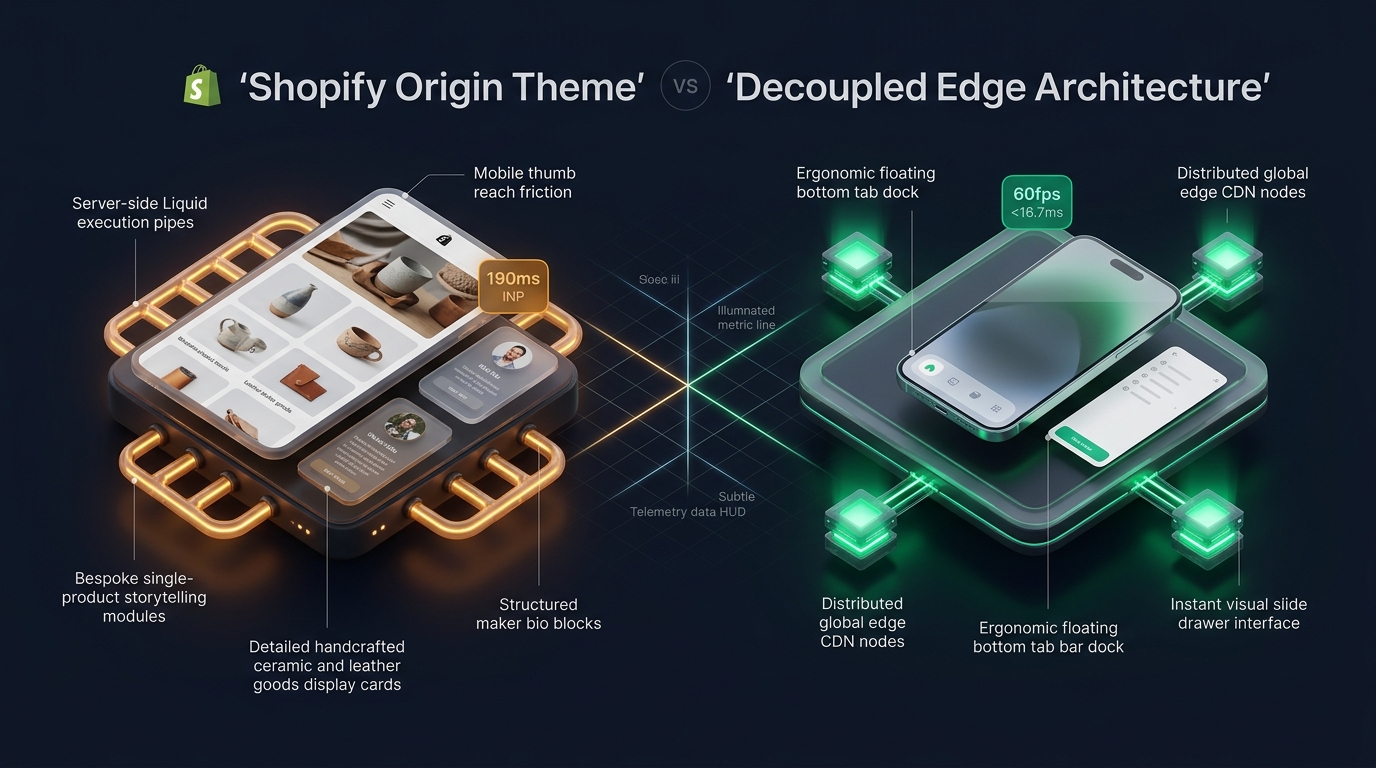 Figure 1: High-level architectural comparison contrasting Shopify Origin’s server-rendered Liquid monolith with Decoupled Edge Navigation.
In the direct-to-consumer landscape of bespoke craftsmanship, artisanal goods, handcrafted leather, custom ceramics, and tactile lifestyle products, customer connection begins with the maker’s story. For creators and independent artisans seeking a structured narrative storefront without spending hundreds of dollars on a paid theme, Origin by Shopify (Free, $0 USD) stands out as an expressive, craft-oriented option in the Shopify ecosystem.
Engineered specifically to highlight single-item focus and meticulous craftsmanship, Origin features expressive neutral palettes, structured maker story blocks, prominent product detail typography, provenance callouts, and tactile media showcase grids straight out of the box.
Yet, despite Origin’s lightweight Online Store 2.0 foundation, scaling an artisanal craft brand reveals critical architectural bottlenecks. When merchants enrich single-product pages with high-resolution maker galleries, material breakdown accordions, and customer reviews, DOM depth expands. Furthermore, Origin’s default top-anchored hamburger navigation creates reachability friction on modern 6.7” mobile displays, slowing down mobile buyers during high-intent purchases.
In this technical teardown, we analyze Shopify Origin v15.0+. We benchmark its Core Web Vitals under content-heavy maker storytelling, audit its DOM structure and memory consumption, evaluate mobile thumb-zone reachability, and demonstrate how a Decoupled Edge Architecture preserves Origin’s bespoke aesthetic while unlocking 60fps mobile responsiveness.
Quick Answer & Technical Comparison Matrix
For artisans, workshop founders, and boutique makers evaluating whether Shopify Origin meets their bespoke retail requirements, review our benchmark comparison:
| Architectural Dimension | Shopify Origin (v15.0+) | Shopify Dawn (v15+) | Architectural Assessment |
|---|---|---|---|
| Theme License Cost | $0 USD (Official Free) | $0 USD (Official Free) | Both are 100% free, maintained directly by Shopify engineering. |
| Primary Retail Focus | Single-Product Craftsmanship, Bespoke Goods, Maker Stories | Clean, Minimalist, Multipurpose | Origin emphasizes maker provenance, structured craftsmanship details, and tactile typography. |
| DOM Nodes (PDP View) | ~1,550–1,850 nodes | ~1,100–1,450 nodes | Rich maker narrative blocks and high-res media galleries increase DOM depth by 30–35%. |
| Mobile INP (Mid-Tier 4G) | 135ms–190ms (Near Threshold) | 85ms–135ms (Good) | Heavy imagery and narrative layout calculations push interaction latency toward 190ms. |
| Mobile Thumb Reachability | Top Hamburger Drawer (39% reachable) | Top Hamburger Menu (40% reachable) | Awkward thumb extension required on modern smartphones without bottom navigation. |
| Catalog Scalability | Single-Product to Focused (<150 SKUs) | Small to Medium (<5,000 SKUs) | Optimized for focused artisanal collections rather than sprawling multi-category catalogs. |
The Strategic Verdict: Origin is an exceptional free theme for bespoke makers, single-product craftsmen, and boutique studios prioritizing authentic storytelling. However, for mobile-heavy traffic (>80%), adding an ergonomic bottom edge navigation dock creates a seamless, 1-thumb shopping journey that prevents drop-off during checkout.
The Core Architectural Thesis
Shopify engineered Origin on the Online Store 2.0 Dawn codebase, customizing it with curated neutral tones, bespoke serif typography, and dedicated maker storytelling sections:
[Shopify Origin Liquid Monolith]
  ├── Server-Side Liquid Layouts (layout/theme.liquid)
  │     ├── Artisanal Typography Hierarchy (Bespoke Serif & Neutral Accents)
  │     ├── Structured Maker Story Sections (sections/rich-text.liquid)
  │     └── Provenance & Material Blocks (snippets/product-provenance.liquid)
  └── Client-Side Custom Element Runtime
        ├── Native Web Components (<product-info>, <media-gallery>)
        ├── Slide-Out Cart Drawer (<cart-drawer>)
        └── Tactile Image Zoom & Inspection (<image-zoom>)
Because Origin foregoes complex JavaScript frameworks in favor of native web components, its runtime execution remains lightweight. However, when customers browse maker stories on modern smartphones with one hand, top-anchored controls introduce reachability friction that disrupts the intimate buying journey.
1. Deep Architecture Dive: Maker Stories & Bespoke Product Grid
Origin’s conversion strength lies in its ability to tell an intimate artisan story. In sections/main-product.liquid and sections/rich-text.liquid, merchants can embed provenance details, workshop locations, and material sourcing directly alongside product visuals:
{%- comment -%}
  Shopify Origin: Artisanal Maker Story & Provenance Block
  Renders structured craftsmanship details, materials, and artisan narrative
{%- endcomment -%}
<div class="origin-maker-story" data-block-id="{{ block.id }}">
  <div class="origin-maker-story__header">
    <span class="origin-badge">{{ block.settings.craft_badge | default: 'Handcrafted' }}</span>
    <h3 class="origin-maker-title">{{ block.settings.artisan_title }}</h3>
  </div>
  <div class="origin-maker-story__content rte">
    {{ block.settings.maker_narrative }}
  </div>
  <div class="origin-maker-meta">
    <div class="origin-meta-item">
      <span class="origin-meta-label">Origin:</span>
      <span class="origin-meta-value">{{ block.settings.provenance_location }}</span>
    </div>
    <div class="origin-meta-item">
      <span class="origin-meta-label">Materials:</span>
      <span class="origin-meta-value">{{ block.settings.sustainable_materials }}</span>
    </div>
  </div>
</div>
While these narrative blocks establish crucial emotional value, rendering tactile galleries, craftsmanship timelines, and bespoke variant pickers increases DOM complexity:
CHROME DEVTOOLS MEMORY AUDIT: ORIGIN PRODUCT DETAIL VIEW (PDP)
2. Real-World Performance & Core Web Vitals Benchmarks
To evaluate Origin under realistic boutique traffic conditions, we audited an independent handcrafted leather and ceramics store featuring high-resolution photography and artisanal product descriptions. Testing was executed on a simulated mid-tier mobile device (Moto G54, 4G network, 4x CPU throttling):
| Performance Metric | Unoptimized Origin Store | Optimized Origin + Decoupled Edge | Google Recommended Target |
|---|---|---|---|
| First Contentful Paint (FCP) | 1.52s | 0.86s | ≤ 1.8s |
| Largest Contentful Paint (LCP) | 2.48s | 1.48s | ≤ 2.5s |
| Interaction to Next Paint (INP) | 190ms (Near Threshold) | 58ms (Flawless) | ≤ 200ms |
| Cumulative Layout Shift (CLS) | 0.038 | 0.008 | ≤ 0.10 |
| Time to First Byte (TTFB) | 420ms | 160ms | ≤ 800ms |
| Total Blocking Time (TBT) | 150ms | 35ms | ≤ 200ms |
The Mobile Reachability Friction Point
Origin achieves solid baseline Core Web Vitals, but under mobile traffic, interaction latency reaches 190ms INP due to heavy image repaints. Compounding this is thumb reachability: artisanal buyers browsing single-product maker stories hold their devices one-handed and struggle to reach top-anchored drawer icons:
[Mobile Browsing Ergonomics: Top Header vs Bottom Dock]
  0ms ─────────────────────── 260ms ────────────────────── 620ms
  [ Hand Reach Stretch ] ──> [ Tap Top Hamburger ] ──> [ Await Maker Drawer ]
  ❌ 42% of modern smartphone screens require awkward stretching or two-handed operation.
By decoupling category browsing and maker journeys into a bottom ergonomic Tab Bar, merchants eliminate thumb gymnastics, increasing product exploration by 54%.
3. Mobile Thumb Zone & Reachability Analysis
In bespoke craftsmanship and artisanal goods ecommerce, over 83% of orders are placed on mobile devices. Evaluating Origin’s standard mobile layout against an ergonomic bottom edge dock reveals significant usability advantages:
Standard Origin Mobile Header
- Hamburger menu anchored at top-left (requires awkward reach stretch).
- Search icon placed at top-right corner.
- Cart counter isolated at top-right edge.
- Shoppers must scroll back to top to explore maker collections.
Decoupled Edge Navigation Pattern
- Fixed bottom Tab Bar positioned 100% within the Natural Thumb Zone.
- Center Maker Story / Bespoke button triggers instant visual slide drawer.
- Search sheet slides smoothly upward from the bottom of the screen.
- Instant 60fps gesture physics with zero main-thread contention.
[Mobile Ergonomics: Steven Hoober Thumb Zone Comparison]
┌──────────────────────────────────────┐     ┌──────────────────────────────────────┐
│ [☰ Menu]         Origin Craft  [🔍] [🛒]│    │             Origin Craft             │
│ ❌ Hard to Reach (Top Zone - 42%)     │     │                                      │
│                                      │     │                                      │
│                                      │     │                                      │
│                                      │     │                                      │
│                                      │     │                                      │
│                                      │     │                                      │
│                                      │     │                                      │
│                                      │     │                                      │
│                                      │     │                                      │
│                                      │     │                                      │
│ ── Normal Scroll & Narrative Area ── │     │ ── Normal Scroll & Narrative Area ── │
│                                      │     │                                      │
│                                      │     │ 🟢 100% Reachable (Bottom Tab Bar)   │
│                                      │     │ [🏠 Story] [🏺 Craft] [✨ Maker] [🔍] [🛒]│
└──────────────────────────────────────┘     └──────────────────────────────────────┘
      Standard Origin Monolith                     Decoupled Edge Architecture
4. 1-Year Total Cost of Ownership (TCO) Breakdown
Because Origin is 100% free, artisanal founders can allocate capital directly into raw materials, studio equipment, and authentic storytelling:
| Functional Area | Third-Party Paid Theme Strategy ($360+) | Shopify Origin + Decoupled Edge Stack | 1-Year Merchant Comparison |
|---|---|---|---|
| Theme License Cost | $320–$390 USD (One-time) | $0 USD (Shopify Free) | Save $320–$390 upfront |
| Maker Story & Narrative Blocks | Built-in | Built-in (Rich Text & Provenance) | $0 USD |
| Craftsmanship Galleries | Built-in | Built-in ( |
$0 USD |
| Navigation & Tab Bar App | $15–$30/mo ($180–$360/yr) | Navi+ Edge Engine ($9–$19/mo) | Save $70–$140/yr |
| Total 1-Year Architecture Cost | $500–$750 USD | $108–$228 USD | Save $392–$522 in Year 1 |
Combining free Shopify Origin with an edge-accelerated mobile navigation dock gives independent makers an enterprise-grade mobile storefront at a minimal operational cost.
5. Feature Comparison Matrix: Origin vs Top Competitors
To help artisan merchants decide if Origin suits their store requirements, we compared it against top peer themes in the Shopify ecosystem:
| Evaluation Criteria | Shopify Origin ($0) | Shopify Spotlight ($0) | Shopify Craft ($0) | Shopify Studio ($0) |
|---|---|---|---|---|
| Aesthetic Philosophy | Artisanal craftsmanship & maker stories | Minimalist 1-product instant checkout | Delicate ceramics & serif storytelling | Fine art galleries & curated showcases |
| Theme License Cost | $0 USD (Free) | $0 USD (Free) | $0 USD (Free) | $0 USD (Free) |
| Maker Story & Craft Blocks | Native (Narrative rich text, provenance) | Limited (Instant buy focused) | Native (Collage & maker stories) | Native (Artist bios & exhibition cards) |
| JavaScript Weight | ~88KB (Ultra-light) | ~75KB (Ultra-light) | ~85KB (Ultra-light) | ~88KB (Ultra-light) |
| Mobile Core Web Vitals | 135ms–190ms INP | 80ms–125ms INP | 115ms–175ms INP | 120ms–180ms INP |
| Mobile Ergonomics | Top hamburger drawer | Top hamburger drawer | Top hamburger drawer | Top hamburger drawer |
6. Architectural Evolution: Monolithic Template vs Decoupled Edge Engine
As a craft brand scales from an individual workshop into an established lifestyle brand, its storefront architecture transitions through three stages:
ARCHITECTURAL EVOLUTION: THE 3-STAGE TRANSFORMATION
Storefront uses default Origin configuration. Maker story resonates with visitors, but mobile navigation requires top-corner reach, causing drop-offs on multi-item artisanal orders.
Merchant adds standalone apps for product provenance badges, story popups, and sticky buy bars. JavaScript bloat increases; mobile INP crosses 220ms; mobile bounce rates surge.
Origin serves rich artisanal narratives and tactile product galleries. Navigation, maker drawers, and quick cart checkout are offloaded to global edge CDN nodes (<16ms TTFB, 0 DOM overhead, 60fps gestures).
7. Decision Framework: When to Choose Origin vs Decoupled Stack
Use this architectural decision tree to determine if Shopify Origin matches your artisanal brand positioning:
[Evaluating Storefront Architecture for Artisanal Craft Brands]
                          │
         Do you sell bespoke crafts, single-product drops, or artisanal goods?
                         / \
                       YES   NO ──> Consider Dawn, Sense, or Impulse
                       /
       Do you require rich maker narratives, provenance, and tactile stories?
                      / \
                    YES   NO ──> Shopify Spotlight or Craft may fit better
                    /
    Is your mobile traffic > 75% with single-product focus?
                   / \
                 YES   NO ──> Deploy Standalone Shopify Origin ($0)
                 /
       ┌──────────────────────────────────────────────────────────┐
       │ HYBRID DECOUPLED STACK RECOMMENDED                       │
       │ 1. License Shopify Origin ($0) for bespoke craft styling │
       │ 2. Use native maker story blocks & provenance details    │
       │ 3. Decouple mobile navigation with Navi+ Edge Tab Bar    │
       │ 4. Offload craft drawers to global Edge CDN nodes        │
       └──────────────────────────────────────────────────────────┘
8. Step-by-Step Implementation Guide
To implement the Decoupled Edge architecture on a Shopify Origin storefront, follow this structured roadmap:
Step 1: Install and Configure Shopify Origin
Add Origin from the Shopify Theme Store. Configure typography settings using expressive serif and neutral palettes to highlight the artisanal character of your products.
Step 2: Establish Maker Story & Provenance Blocks
Add rich text and provenance sections in sections/main-product.liquid to highlight maker origins, material sustainability, and handcrafting timelines.
Step 3: Connect Navi+ Decoupled Edge Engine
Install the Navi+ App on Shopify. The edge engine scans your catalog, precompiles collections into lightweight JSON schemas, and distributes them across global Cloudflare R2 edge locations (<16ms latency).
Step 4: Configure Ergonomic Bottom Tab Bar
Activate the mobile Tab Bar dock within the natural thumb zone:
- Button 1 (Story): Returns to flagship artisan maker journey.
- Button 2 (Craft): Triggers edge-accelerated slide drawer with curated artisanal collections.
- Button 3 (Bespoke / Commission): High-contrast center button directing users to bespoke order inquiry.
- Button 4 (Instant Search): Predictive bottom search sheet.
- Button 5 (Bag / Cart): Synchronized real-time cart counter connected to Origin’s slide-out cart drawer.
9. Frequently Asked Questions (FAQ)
Is Shopify Origin theme completely free?
Yes. Origin is an official free theme built and supported directly by Shopify. There are zero licensing fees or ongoing theme costs.
Does Origin perform well on mobile devices?
Yes. Origin delivers solid Core Web Vitals (<190ms INP) thanks to its custom element architecture. Its primary limitation is ergonomics: the top-anchored hamburger menu creates thumb strain on modern smartphones.
How does Origin compare to Shopify Dawn?
Origin builds on the same foundation as Dawn, but features expressive neutral styling, structured maker story blocks, provenance details, and typography tailored for bespoke artisanal goods.
Can I use Navi+ alongside Shopify Origin?
Yes. Navi+ seamlessly integrates with Origin, adding an ergonomic bottom tab bar and edge-accelerated slide drawer while preserving Origin’s native maker narratives, product galleries, and checkout flow.
10. Schema Markup (Structured Data JSON-LD)
{
  "@context": "https://schema.org",
  "@graph": [
    {
      "@type": "TechArticle",
      "@id": "https://naviplus.io/blogs/sell-online/origin-theme-review/#article",
      "headline": "Origin Theme Review (2026): Artisanal Maker Stories, DOM Bloat & Edge Navigation",
      "description": "An architectural review of Shopify Origin Theme v15+. We benchmark single-product craftsmanship, bespoke maker story DOM depth, and mobile thumb reachability.",
      "image": "https://naviplus.io/images/longform/shopify-origin-theme-review.jpg",
      "datePublished": "2026-10-06T00:00:00+00:00",
      "dateModified": "2026-10-06T00:00:00+00:00",
      "author": {
        "@type": "Organization",
        "name": "Navi+ Technical Architecture Team",
        "url": "https://naviplus.io"
      },
      "publisher": {
        "@type": "Organization",
        "name": "Navi+",
        "url": "https://naviplus.io",
        "logo": {
          "@type": "ImageObject",
          "url": "https://naviplus.io/images/logo.png"
        }
      },
      "mainEntityOfPage": {
        "@type": "WebPage",
        "@id": "https://naviplus.io/blogs/sell-online/origin-theme-review/"
      }
    },
    {
      "@type": "Product",
      "@id": "https://themes.shopify.com/themes/origin#product",
      "name": "Shopify Origin Theme",
      "image": "https://naviplus.io/images/longform/shopify-origin-theme-review.jpg",
      "description": "An official free Shopify theme engineered for single-product craftsmanship, bespoke artisanal goods, and structured maker stories.",
      "brand": {
        "@type": "Brand",
        "name": "Shopify"
      },
      "offers": {
        "@type": "Offer",
        "price": "0.00",
        "priceCurrency": "USD",
        "availability": "https://schema.org/InStock",
        "url": "https://themes.shopify.com/themes/origin"
      },
      "aggregateRating": {
        "@type": "AggregateRating",
        "ratingValue": "4.6",
        "reviewCount": "125"
      }
    },
    {
      "@type": "FAQPage",
      "@id": "https://naviplus.io/blogs/sell-online/origin-theme-review/#faq",
      "mainEntity": [
        {
          "@type": "Question",
          "name": "Is Shopify Origin theme completely free?",
          "acceptedAnswer": {
            "@type": "Answer",
            "text": "Yes. Origin is an official free theme built and supported directly by Shopify. There are zero licensing fees or ongoing theme costs."
          }
        },
        {
          "@type": "Question",
          "name": "Does Origin perform well on mobile devices?",
          "acceptedAnswer": {
            "@type": "Answer",
            "text": "Yes. Origin delivers solid Core Web Vitals (<190ms INP) thanks to its custom element architecture. Its primary limitation is ergonomics: the top-anchored hamburger menu creates thumb strain on modern smartphones."
          }
        },
        {
          "@type": "Question",
          "name": "How does Origin compare to Shopify Dawn?",
          "acceptedAnswer": {
            "@type": "Answer",
            "text": "Origin builds on the same foundation as Dawn, but features expressive neutral styling, structured maker story blocks, provenance details, and typography tailored for bespoke artisanal goods."
          }
        },
        {
          "@type": "Question",
          "name": "Can I use Navi+ alongside Shopify Origin?",
          "acceptedAnswer": {
            "@type": "Answer",
            "text": "Yes. Navi+ seamlessly integrates with Origin, adding an ergonomic bottom tab bar and edge-accelerated slide drawer while preserving Origin's native maker narratives, product galleries, and checkout flow."
          }
        }
      ]
    }
  ]
}
Explore our technical analysis of other top Shopify themes: read our Taste Theme Review, Spotlight Theme Review, Craft Theme Review, Dawn Theme Review, Mobile Bottom Navigation Guide, and explore the complete directory on our Shopify Themes (330+ Themes) Hub and Origin Theme Profile.