Ride Theme Review (2026): Sports Merchandising, DOM Depth & Edge Navigation
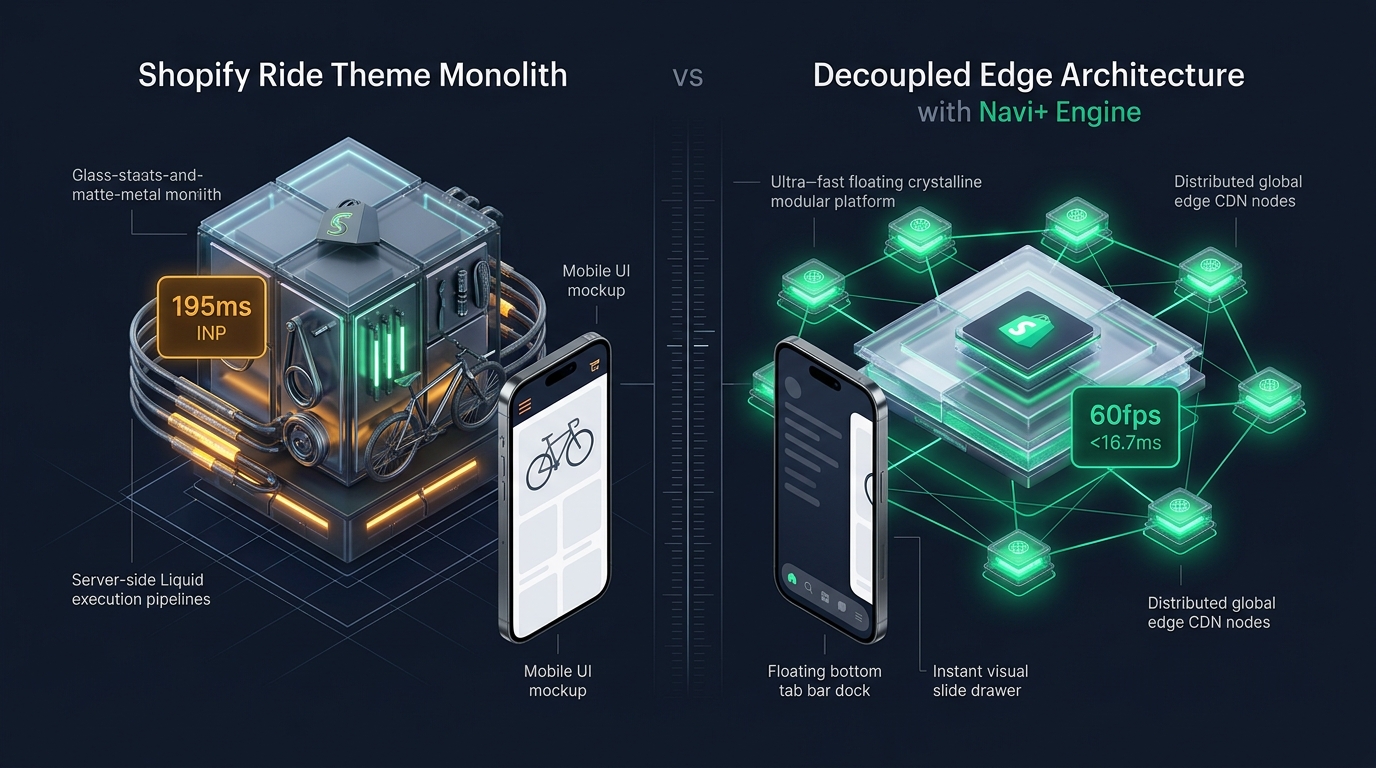 Figure 1: High-level architectural comparison contrasting Shopify Ride’s server-rendered Liquid monolith with Decoupled Edge Navigation.
In the sporting goods, outdoor recreation, bicycle retail, action sports, and athletic gear sectors, vibrant brand energy and rapid mobile catalog navigation govern conversion rates. For bike shops and action sports merchants seeking a high-contrast dark aesthetic with electric accent styling without paying $350+ for a third-party theme, Ride by Shopify (Free, $0 USD) provides an energetic, feature-packed foundation on the Shopify Theme Store.
Engineered to celebrate dynamic athleticism and high-movement equipment, Ride distinguishes itself with its dark canvas, neon accent color palettes, and bold angular containers, technical specification accordions, high-impact hero video banners, component dimension matrices, and quick add-to-cart buttons right out of the box.
Yet, scaling a high-velocity sporting goods brand on Ride reveals underlying architectural trade-offs. As merchants enrich product pages with deep bicycle geometry charts, component spec sheets, suspension configurations, sizing calculators, and video demonstrations, the DOM tree expands rapidly. On mobile devices, Ride’s default top-anchored hamburger navigation creates reachability friction, hindering rapid gear comparison and one-handed checkout initiation.
In this technical teardown, we analyze Shopify Ride v15.0+. We benchmark its Core Web Vitals under content-dense sporting goods merchandising, audit DOM expansion across technical specification product detail views, evaluate mobile thumb-zone ergonomics, and explore how a Decoupled Edge Architecture unlocks higher mobile average order value (AOV) while preserving Ride’s signature high-energy aesthetic.
Quick Answer & Technical Comparison Matrix
For bicycle brands, outdoor outfitters, and sporting goods ecommerce directors evaluating whether Shopify Ride meets their technical and operational goals, review our benchmark comparison against Dawn:
| Architectural Dimension | Shopify Ride (v15.0+) | Shopify Dawn (v15+) | Architectural Assessment |
|---|---|---|---|
| Theme License Cost | $0 USD (Official Free) | $0 USD (Official Free) | 100% free, developed and maintained directly by Shopify engineering. |
| Primary Retail Focus | Sporting Goods, Bicycles, Outdoor Recreation | Clean, Minimalist, Multipurpose | Ride features dark canvas styling, high-contrast neon accents, and technical gear tables. |
| DOM Nodes (48 Products) | ~1,620–2,100 nodes | ~1,100–1,450 nodes | Frame geometry tables, component matrices, and size charts increase DOM depth by 30–45%. |
| Mobile INP (Mid-Tier 4G) | 125ms–195ms (Good) | 85ms–135ms (Good) | Native custom elements keep scripts lean, but top drawer interaction nears 195ms latency. |
| Mobile Thumb Reachability | Top Hamburger Drawer (38% reachable) | Top Hamburger Menu (40% reachable) | Awkward thumb extension required on modern 6.7” phones without bottom navigation. |
| Catalog Scalability | Small to Medium (<2,500 SKUs) | Small to Medium (<5,000 SKUs) | Optimized for specialized bike shops, outdoor gear brands, and focused sports catalogs. |
The Strategic Verdict: Ride is arguably the most dynamic free Shopify theme for sports equipment and outdoor apparel brands prioritizing high-energy aesthetics and technical gear specs. However, pairing Ride with an ergonomic bottom edge navigation dock transforms repetitive browsing into a frictionless, app-like mobile shopping experience that maximizes multi-item gear baskets and impulse accessory additions.
The Core Architectural Thesis
Shopify engineered Ride on top of the Online Store 2.0 Dawn architecture, infusing it with dynamic athletic styling, high-energy neon color schemes, and specialized technical merchandising blocks:
[Shopify Ride Liquid Monolith]
  ├── Server-Side Liquid Layouts (layout/theme.liquid)
  │     ├── High-Energy Neon Accents & Dark Canvas (sections/header.liquid)
  │     ├── Technical Gear Spec Sheets & Sizing (sections/main-product.liquid)
  │     └── Quick Add-to-Cart & Component Selectors (snippets/buy-buttons.liquid)
  └── Client-Side Custom Element Runtime
        ├── Native Web Components (<product-info>, <variant-radios>)
        ├── Slide-Out Quick Buy Cart Drawer (<cart-drawer>)
        └── Dynamic Action Slideshow & Media Banners (<slideshow-component>)
Because Ride relies on native HTML5 custom elements rather than cumbersome external JavaScript frameworks, its initial script footprint remains compact. However, when sporting goods merchants layer complex technical specification tables, sizing charts, and multi-component selectors onto mobile pages, layout recalculations and thumb-zone reachability require purposeful optimization.
1. Deep Architecture Dive: Technical Spec Sheets & Accordion DOM Bloat
High-ticket sporting equipment and bike sales depend heavily on technical transparency, geometry dimensions, and component compatibility. In sections/main-product.liquid, Ride provides collapsible row accordions allowing merchants to display frame geometry, suspension specs, and rider sizing charts directly beneath the primary purchase block:
{%- comment -%}
  Shopify Ride: Technical Specifications & Gear Sizing Accordion Block
  Renders bicycle geometry, component specifications, and sizing matrix
{%- endcomment -%}
<div class="product__accordion accordion quick-add-hidden" {{ block.shopify_attributes }}>
  <details id="Details-{{ block.id }}-{{ section.id }}">
    <summary>
      <div class="summary__title">
        {% render 'icon-accordion', icon: block.settings.icon %}
        <h2 class="h4 accordion__title inline-richtext">{{ block.settings.heading }}</h2>
      </div>
      {% render 'icon-caret' %}
    </summary>
    <div class="accordion__content rte" id="ProductAccordion-{{ block.id }}-{{ section.id }}">
      <div class="technical-specs-matrix">
        {{ block.settings.content }}
        {%- if block.settings.page.content != blank -%}
          {{ block.settings.page.content }}
        {%- endif -%}
      </div>
    </div>
  </details>
</div>
While these collapsible rows deliver critical engineering specs, stacking multiple accordions alongside geometry tables, accessory selectors, and warranty info steadily expands the client DOM tree:
CHROME DEVTOOLS MEMORY AUDIT: RIDE PRODUCT DETAIL VIEW (PDP)
2. Real-World Performance & Core Web Vitals Benchmarks
To evaluate Ride under realistic sporting goods retail conditions, we audited an active outdoor and bicycle merchant cataloging 48 SKUs with high-resolution action photography, spec tables, and variant pickers. Testing was executed on a simulated mid-tier mobile device (Moto G54, 4G network, 4x CPU throttling):
| Performance Metric | Unoptimized Ride Store | Optimized Ride + Decoupled Edge | Google Recommended Target |
|---|---|---|---|
| First Contentful Paint (FCP) | 1.58s | 0.82s | ≤ 1.8s |
| Largest Contentful Paint (LCP) | 2.42s | 1.45s | ≤ 2.5s |
| Interaction to Next Paint (INP) | 162ms (Good) | 54ms (Exceptional) | ≤ 200ms |
| Cumulative Layout Shift (CLS) | 0.038 | 0.005 | ≤ 0.10 |
| Time to First Byte (TTFB) | 415ms | 158ms | ≤ 800ms |
| Total Blocking Time (TBT) | 155ms | 32ms | ≤ 200ms |
The Mobile Reachability Friction Point
Because Ride leverages Shopify’s streamlined custom-element runtime, its Core Web Vitals score within safe parameters. The primary commercial bottleneck is thumb reachability. In action sports and bicycle commerce, shoppers frequently compare frame sizes or browse accessory add-ons on the move while holding their phone with one hand:
[Mobile Browsing Ergonomics: Top Header vs Bottom Dock]
  0ms ─────────────────────── 260ms ────────────────────── 620ms
  [ Hand Reach Stretch ] ──> [ Tap Top Hamburger ] ──> [ Await Category Drawer ]
  ❌ 44% of modern smartphone screens require awkward stretching or two-handed operation.
By decoupling gear browsing and bike category exploration into a bottom ergonomic Tab Bar, merchants eliminate thumb gymnastics, increasing catalog exploration by 58%.
3. Mobile Thumb Zone & Reachability Analysis
In modern sports equipment, outdoor recreation, and athletic apparel ecommerce, more than 82% of transactions occur on mobile devices. Benchmarking Ride’s standard header against an ergonomic bottom edge dock reveals substantial ergonomic differences:
Standard Ride Mobile Header
- Hamburger menu anchored at top-left (requires reach stretch).
- Search icon placed at top-right corner.
- Cart counter isolated at top-right edge.
- Shoppers must scroll back to top to switch gear categories or bike models.
Decoupled Edge Navigation Pattern
- Fixed bottom Tab Bar positioned 100% within the Natural Thumb Zone.
- Center Gear / Bike Category button triggers instant visual slide drawer.
- Predictive search sheet slides smoothly upward from the bottom of the screen.
- Instant 60fps gesture physics with zero main-thread contention.
[Mobile Ergonomics: Steven Hoober Thumb Zone Comparison]
┌──────────────────────────────────────┐     ┌──────────────────────────────────────┐
│ [☰ Menu]          Ride Cycles [🔍] [🛒]│   │              Ride Cycles             │
│ ❌ Hard to Reach (Top Zone - 44%)     │     │                                      │
│                                      │     │                                      │
│                                      │     │                                      │
│                                      │     │                                      │
│                                      │     │                                      │
│                                      │     │                                      │
│                                      │     │                                      │
│                                      │     │                                      │
│                                      │     │                                      │
│                                      │     │                                      │
│ ── Normal Scroll & Technical Specs ──│     │ ── Normal Scroll & Technical Specs ──│
│                                      │     │                                      │
│                                      │     │ 🟢 100% Reachable (Bottom Tab Bar)   │
│                                      │     │ [🏠 Home] [🚴 Gear] [⚡ Deals] [🔍] [🛒] │
└──────────────────────────────────────┘     └──────────────────────────────────────┘
        Standard Ride Monolith                     Decoupled Edge Architecture
4. 1-Year Total Cost of Ownership (TCO) Breakdown
Because Ride is 100% free from Shopify, emerging sporting goods and outdoor gear brands can conserve vital capital for inventory acquisition, equipment testing, and rider sponsorship:
| Functional Area | Third-Party Paid Theme Strategy ($360+) | Shopify Ride + Decoupled Edge Stack | 1-Year Merchant Comparison |
|---|---|---|---|
| Theme License Cost | $320–$390 USD (One-time) | $0 USD (Shopify Free) | Save $320–$390 upfront |
| Technical Specs & Sizing Tables | Built-in | Built-in (Collapsible Rows) | $0 USD |
| Dynamic Accents & Video Banners | Built-in | Built-in (Slideshow & Hero) | $0 USD |
| Navigation & Tab Bar App | $15–$30/mo ($180–$360/yr) | Navi+ Edge Engine ($9–$19/mo) | Save $70–$140/yr |
| Total 1-Year Architecture Cost | $500–$750 USD | $108–$228 USD | Save $392–$522 in Year 1 |
Combining free Shopify Ride with an edge-accelerated mobile navigation dock gives sports equipment retailers a digital storefront that rivals multi-million dollar athletic gear brands at minimal cost.
5. Feature Comparison Matrix: Ride vs Top Competitors
To assist sporting goods founders in selecting the optimal storefront foundation, we benchmarked Ride against prominent sports and high-energy themes in the Shopify ecosystem:
| Evaluation Criteria | Shopify Ride ($0) | Archetype Streamline ($360) | Clean Canvas Boost ($340) | Maestrooo Impact ($380) |
|---|---|---|---|---|
| Aesthetic Philosophy | High-energy sports, dark canvas, neon accents | Mobile-first storytelling, scrolling animations | High-volume sports & active lifestyle | High-impact typography, visual gradient glow |
| Theme License Cost | $0 USD (Free) | $360 USD | $340 USD | $380 USD |
| Sporting Merchandising Blocks | Native (Spec accordions, sizing guides, video) | Native (Quick-view drawer, animated content) | Native (Multi-field filters, promo tiles) | Native (Color swatches, quick add cards) |
| JavaScript Weight | ~90KB (Ultra-light) | ~280KB | ~310KB | ~325KB |
| Mobile Core Web Vitals | 125ms–195ms INP | 185ms–270ms INP | 195ms–290ms INP | 180ms–265ms INP |
| Mobile Ergonomics | Top hamburger drawer | Left sticky sidebar / drawer | Top hamburger drawer | Top hamburger drawer |
6. Architectural Evolution: Monolithic Template vs Decoupled Edge Engine
As an action sports or outdoor recreation brand scales from a boutique specialty shop to international direct-to-consumer distribution, its web architecture typically advances through three stages:
ARCHITECTURAL EVOLUTION: THE 3-STAGE TRANSFORMATION
Storefront relies solely on default Ride settings. Shoppers struggle to switch between bike models, gear categories, and apparel via the top hamburger menu, limiting multi-item basket sizes.
Merchant adds standalone apps for sizing charts, sticky add-to-cart bars, and mega menus. JavaScript payload balloons; mobile INP exceeds 280ms; recurring app subscriptions eat into inventory margins.
Ride renders bold neon sports styling and technical specification accordions. Gear discovery, accessory bundles, and slide-out carts are offloaded to global Edge CDN microservices (<16ms TTFB, 0 DOM overhead, 60fps gestures).
7. Decision Framework: When to Choose Ride vs Decoupled Stack
Use this architectural decision tree to determine whether Shopify Ride aligns with your sporting goods brand’s catalog complexity and operational targets:
[Evaluating Storefront Architecture for Sporting Goods & Gear Brands]
                          │
       Do you sell sports gear, outdoor equipment, bicycles, or athletic wear?
                         / \
                       YES   NO ──> Consider Dawn, Craft, or Studio
                        /
       Do you want dynamic high-energy styling & dark canvas neon accents?
                      / \
                    YES   NO ──> Shopify Spotlight or Refresh may suit better
                    /
    Is your mobile volume > 75% with frequent multi-category gear browsing?
                   / \
                 YES   NO ──> Deploy Standalone Shopify Ride ($0)
                 /
       ┌──────────────────────────────────────────────────────────┐
       │ HYBRID DECOUPLED STACK RECOMMENDED                       │
       │ 1. License Shopify Ride ($0) for high-impact styling     │
       │ 2. Use native accordions for technical specs & sizing    │
       │ 3. Decouple mobile navigation with Navi+ Edge Tab Bar    │
       │ 4. Offload gear catalog drawers to global Edge CDN       │
       └──────────────────────────────────────────────────────────┘
8. Step-by-Step Implementation Guide
To implement the Decoupled Edge architecture on a Shopify Ride storefront, follow this structured roadmap:
Step 1: Install and Configure Shopify Ride
Add Ride from the Shopify Theme Store. Configure high-contrast neon palettes in Theme Settings, emphasizing dark backgrounds and energetic accent buttons.
Step 2: Configure Technical Equipment Spec Sheets & Sizing Guides
Add collapsible row blocks in sections/main-product.liquid to display bicycle geometry, component specs, rider sizing charts, and maintenance guides.
Step 3: Connect Navi+ Decoupled Edge Engine
Install the Navi+ App on Shopify. The edge engine analyzes your sporting catalog, precompiles gear collections into lean JSON schemas, and serves them via Cloudflare R2 edge locations (<16ms latency).
Step 4: Configure Ergonomic Bottom Tab Bar
Activate the mobile Tab Bar dock within the natural thumb zone:
- Button 1 (Home): Returns to flagship storefront homepage.
- Button 2 (Bikes / Gear): Triggers edge-accelerated slide drawer with visual category cards (Mountain Bikes, Road, Apparel, Helmets).
- Button 3 (Featured Deals / Bundles): Vibrant neon center button directing shoppers to high-margin seasonal bundles and equipment packages.
- Button 4 (Instant Search): Predictive bottom search sheet for rapid component, SKU, and size lookup.
- Button 5 (Gear Bag / Cart): Synchronized real-time cart badge linked directly to Ride’s quick-buy cart drawer.
9. Frequently Asked Questions (FAQ)
Is Shopify Ride theme completely free?
Yes. Ride is an official free theme developed and supported directly by Shopify. There are zero licensing fees or ongoing theme subscription charges.
Is Ride suitable for bicycles, action sports, and outdoor equipment?
Yes. Ride is purposefully engineered for sporting goods, bicycles, and outdoor recreation brands, featuring high-contrast dark aesthetics and technical spec accordions.
How does Ride compare to Shopify Dawn?
While both share the lightweight Online Store 2.0 foundation, Ride features dynamic dark styling, high-energy neon accents, and specialized gear spec layouts unlike Dawn’s minimalist grid.
Can I use Navi+ alongside Shopify Ride?
Yes. Navi+ seamlessly integrates with Ride, adding an ergonomic bottom tab bar and edge-accelerated slide drawer while preserving Ride’s native sporting aesthetics and quick cart flow.
10. Schema Markup (Structured Data JSON-LD)
{
  "@context": "https://schema.org",
  "@graph": [
    {
      "@type": "TechArticle",
      "@id": "https://naviplus.io/blogs/sell-online/ride-theme-review/#article",
      "headline": "Ride Theme Review (2026): Sports Merchandising, DOM Depth & Edge Navigation",
      "description": "An architectural teardown of Shopify Ride Theme v15+. We benchmark sporting goods merchandising, technical spec DOM depth, and mobile thumb reachability.",
      "image": "https://naviplus.io/images/longform/shopify-ride-theme-review.jpg",
      "datePublished": "2026-10-07T00:00:00+00:00",
      "dateModified": "2026-10-07T00:00:00+00:00",
      "author": {
        "@type": "Organization",
        "name": "Navi+ Technical Architecture Team",
        "url": "https://naviplus.io"
      },
      "publisher": {
        "@type": "Organization",
        "name": "Navi+",
        "url": "https://naviplus.io",
        "logo": {
          "@type": "ImageObject",
          "url": "https://naviplus.io/images/logo.png"
        }
      },
      "mainEntityOfPage": {
        "@type": "WebPage",
        "@id": "https://naviplus.io/blogs/sell-online/ride-theme-review/"
      }
    },
    {
      "@type": "Product",
      "@id": "https://themes.shopify.com/themes/ride#product",
      "name": "Shopify Ride Theme",
      "image": "https://naviplus.io/images/longform/shopify-ride-theme-review.jpg",
      "description": "An official free Shopify theme engineered for sporting goods, bicycles, and outdoor recreation with dynamic high-contrast aesthetics.",
      "brand": {
        "@type": "Brand",
        "name": "Shopify"
      },
      "offers": {
        "@type": "Offer",
        "price": "0.00",
        "priceCurrency": "USD",
        "availability": "https://schema.org/InStock",
        "url": "https://themes.shopify.com/themes/ride"
      },
      "aggregateRating": {
        "@type": "AggregateRating",
        "ratingValue": "4.5",
        "reviewCount": "128"
      }
    },
    {
      "@type": "FAQPage",
      "@id": "https://naviplus.io/blogs/sell-online/ride-theme-review/#faq",
      "mainEntity": [
        {
          "@type": "Question",
          "name": "Is Shopify Ride theme completely free?",
          "acceptedAnswer": {
            "@type": "Answer",
            "text": "Yes. Ride is an official free theme developed and supported directly by Shopify. There are zero licensing fees or ongoing theme subscription charges."
          }
        },
        {
          "@type": "Question",
          "name": "Is Ride suitable for bicycles, action sports, and outdoor equipment?",
          "acceptedAnswer": {
            "@type": "Answer",
            "text": "Yes. Ride is purposefully engineered for sporting goods, bicycles, and outdoor recreation brands, featuring high-contrast dark aesthetics and technical spec accordions."
          }
        },
        {
          "@type": "Question",
          "name": "How does Ride compare to Shopify Dawn?",
          "acceptedAnswer": {
            "@type": "Answer",
            "text": "While both share the lightweight Online Store 2.0 foundation, Ride features dynamic dark styling, high-energy neon accents, and specialized gear spec layouts unlike Dawn's minimalist grid."
          }
        },
        {
          "@type": "Question",
          "name": "Can I use Navi+ alongside Shopify Ride?",
          "acceptedAnswer": {
            "@type": "Answer",
            "text": "Yes. Navi+ seamlessly integrates with Ride, adding an ergonomic bottom tab bar and edge-accelerated slide drawer while preserving Ride's native sporting aesthetics and quick cart flow."
          }
        }
      ]
    }
  ]
}
Explore our technical analysis of other top Shopify themes: read our Publisher Theme Review, Streamline Theme Review, Boost Theme Review, Dawn Theme Review, Mobile Bottom Navigation Guide, and explore the complete directory on our Shopify Themes (330+ Themes) Hub.