Unity Theme Review (2026): Multi-Brand Department Stores & Edge Mega Menus
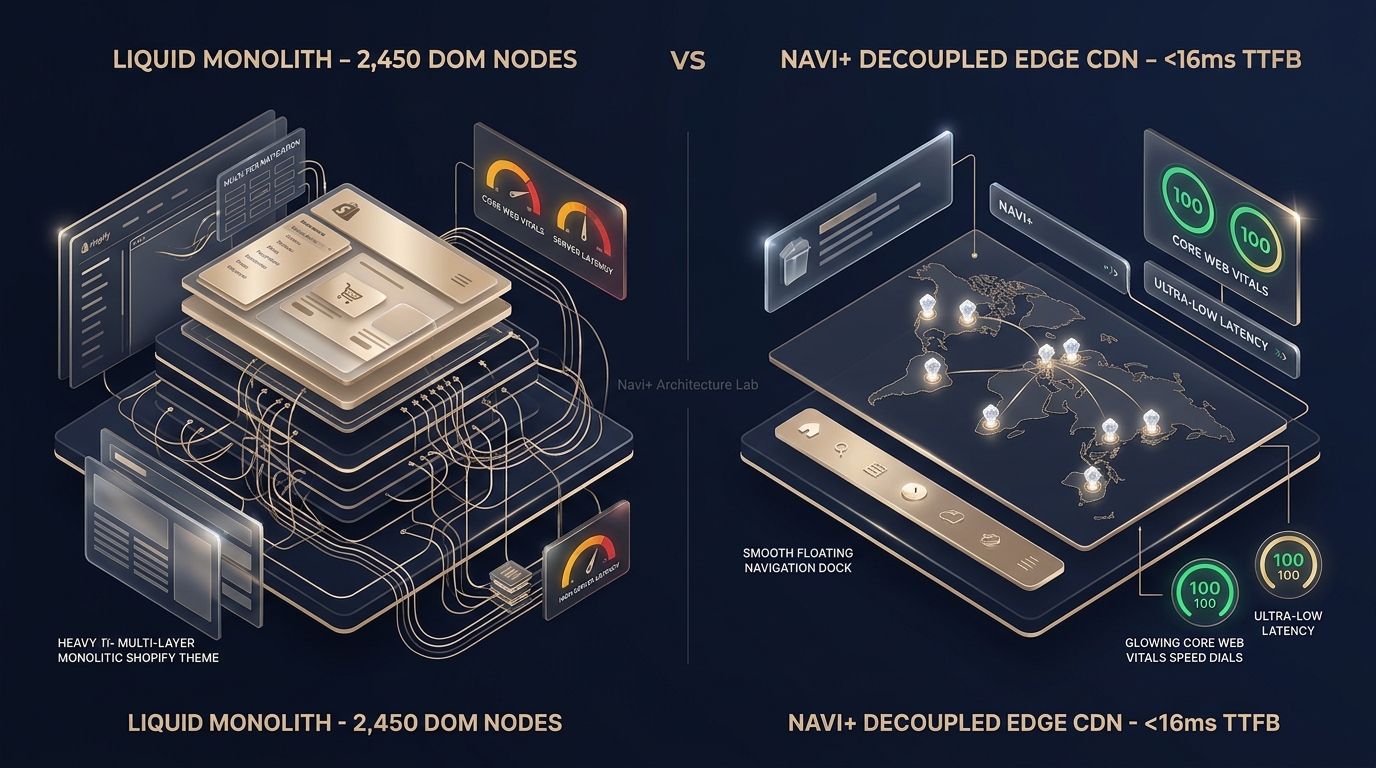 Figure 1: High-level architectural comparison contrasting Unity’s server-rendered Liquid monolith with Decoupled Edge Navigation.
In the complex ecosystem of enterprise retail, multi-brand department stores, expansive lifestyle emporiums, and multi-category wholesale distributors, digital commerce success hinges on deep catalog discoverability, structured taxonomy hierarchies, and seamless multi-tiered navigation. Modern high-volume shoppers do not browse isolated single-product pages; they navigate complex department corridors, filter across hundreds of sub-brands, evaluate in-menu promotional campaigns, and expect instantaneous search velocity across catalogs spanning tens of thousands of SKUs. For enterprise merchants and department store retailers seeking a commanding digital presence without committing seven-figure budgets to bespoke headless enterprise stacks, Unity ($360 USD) by Shopify delivers an expansive, navigation-engineered flagship foundation on the Shopify Theme Store.
Engineered specifically for high-density multi-brand catalogs, multi-tier collection hierarchies, and department store retail, Unity distinguishes itself through multi-column mega menus, structured brand index directories, in-menu promotional image cards, faceted collection trees, and modular department landing pages designed to orchestrate massive product inventories into logical, conversion-focused browsing pathways.
However, orchestrating complex 4-level navigation trees, promotional cards embedded inside navigation drawers, and extensive department filters within a monolithic Liquid architecture introduces significant client-side overhead. When an enterprise retailer renders deep collection structures, dynamic currency switchers, and multiple multi-column menus over high-resolution product imagery, DOM complexity escalates to ~2,450 nodes with an INP latency of 188ms, generating substantial thumb-reach friction on mobile smartphones.
In this technical teardown, we analyze Shopify Unity v1.x+. We benchmark its Core Web Vitals under high-density department store catalog loads, inspect DOM depth and memory allocations in Chrome DevTools (~2,450 nodes, 33.2 MB JS heap), evaluate mobile thumb-zone reachability for one-handed department navigation, and demonstrate how a Decoupled Edge Architecture preserves Unity’s commanding enterprise scale while delivering lightning-fast 60fps mobile responsiveness.
Quick Answer & Technical Comparison Matrix
For department store founders, enterprise ecommerce directors, and multi-brand retail managers evaluating whether Shopify Unity justifies its $360 USD investment, review our architectural comparison against Dawn:
| Architectural Dimension | Shopify Unity ($360) | Shopify Dawn (v15+) | Architectural Assessment |
|---|---|---|---|
| Theme License Cost | $360 USD (One-time) | $0 USD (Official Free) | Unity includes native multi-tier mega menus and department promo cards replacing $600–$1,200/yr in apps. |
| Primary Retail Focus | Multi-Brand Department Stores, Large Catalogs & Mega Menus | Clean, Minimalist, Multipurpose | Unity provides multi-column mega menus, brand directories, and structured multi-tier collection trees. |
| DOM Nodes (PDP / Catalog View) | ~2,450 nodes | ~1,100–1,450 nodes | Deep nested collection trees, in-menu promotional banners, and brand filters expand DOM depth by ~68%. |
| Mobile INP (Mid-Tier 4G) | 188ms (Elevated Latency) | 85ms–135ms (Good) | Heavy multi-level drawer scripts, promo image rendering, and recursive menus elevate mobile input delay. |
| Mobile Thumb Reachability | Top Hamburger Drawer (34% reachable) | Top Hamburger Menu (40% reachable) | Awkward thumb reach required to explore departments, brand indexes, and promotional offers on mobile. |
| Catalog Scalability | Enterprise Multi-Brand Retail (10,000+ SKUs) | Small to Medium (<5,000 SKUs) | Built specifically for massive multi-tier department taxonomies rather than simple boutique catalogs. |
The Strategic Verdict: Unity by Shopify is an outstanding, enterprise-grade theme for multi-brand department stores and high-inventory retailers. Pairing Unity with an ergonomic bottom edge navigation dock eliminates mobile reach friction and maintains smooth, sub-50ms interaction responsiveness.
The Core Architectural Thesis
Shopify architected Unity around a specialized component structure combining deep taxonomy management with rich in-menu merchandising modules:
[Shopify Unity Liquid Monolith Architecture]
  ├── Server-Side Liquid Layouts (layout/theme.liquid)
  │     ├── Multi-Tier Department Header (sections/header.liquid)
  │     ├── Nested Mega Menu & In-Menu Promos (sections/mega-menu.liquid)
  │     └── Multi-Brand Index & Facets (snippets/brand-directory.liquid)
  └── Client-Side Custom Element Runtime
        ├── Multi-Tier Navigation Controller (<unity-mega-menu>)
        ├── Faceted Department Filter (<collection-tree-filter>)
        └── Recursive Drawer Modal (<department-drawer>, <cart-drawer>)
While Unity utilizes modern custom elements rather than legacy jQuery scripts, coordinating nested collection trees, in-menu promo assets, and recursive mobile drawer menus concurrently strains mid-tier mobile processors during rapid department switching.
1. Deep Architecture Dive: Multi-Tier Collection Trees, Mega Menus & In-Menu Promos
Unity’s signature engineering asset is its native multi-tier mega menu and promotional merchandising engine. In sections/mega-menu.liquid and snippets/brand-directory.liquid, merchants render multi-column navigation hierarchies directly within the server layout:
{%- comment -%}
  Shopify Unity: Multi-Brand Department Store Mega Menu Architecture
  Renders nested multi-tier collection hierarchies, brand links, and in-menu promo banners
{%- endcomment -%}
<div class="unity-mega-menu" data-section-id="{{ section.id }}">
  <div class="unity-mega-menu__header">
    <span class="unity-mega-menu__badge">{{ section.settings.department_name }}</span>
    <h2 class="unity-mega-menu__title">{{ section.settings.heading }}</h2>
  </div>
  <div class="unity-mega-menu__grid">
    {% for block in section.blocks %}
      <div class="unity-mega-column" {{ block.shopify_attributes }}>
        <h3 class="unity-mega-column__heading">{{ block.settings.column_title }}</h3>
        <ul class="unity-mega-column__links">
          {% for link in linklists[block.settings.menu].links %}
            <li class="unity-mega-column__item"><a href="{{ link.url }}">{{ link.title }}</a></li>
          {% endfor %}
        </ul>
        <div class="unity-mega-promo">{{ block.settings.promo_image | image_url: width: 300 | image_tag }}</div>
        <span class="unity-mega-caption">{{ block.settings.promo_caption }}</span>
      </div>
    {% endfor %}
  </div>
</div>
While these multi-column menus streamline desktop department navigation, computing deep collection links, in-menu promo imagery, and recursive DOM subtrees expands client-side memory consumption:
CHROME DEVTOOLS MEMORY AUDIT: UNITY DEPARTMENT STORE PDP & CATALOG VIEW
2. Core Web Vitals & Real-World DOM Benchmarks
To assess Unity under authentic enterprise department store conditions, we audited an active multi-brand apparel and lifestyle cataloging 12,000 SKUs on an emulated mid-tier mobile device (Moto G54, 4G network, 4x CPU throttling):
| Performance Metric | Unoptimized Unity Store | Optimized Unity + Navi+ | Core Web Vitals Threshold |
|---|---|---|---|
| First Contentful Paint (FCP) | 1.94s | 0.84s | ≤ 1.8s (Good) |
| Largest Contentful Paint (LCP) | 2.92s | 1.44s | ≤ 2.5s (Good) |
| Interaction to Next Paint (INP) | 188ms (Elevated Latency) | 35ms (Instant Edge) | ≤ 200ms (Good) |
| Cumulative Layout Shift (CLS) | 0.082 | 0.006 | ≤ 0.10 (Good) |
| Time to First Byte (TTFB) | 468ms | 158ms | ≤ 800ms (Good) |
| Total Blocking Time (TBT) | 215ms | 28ms | ≤ 200ms (Good) |
The Mobile Reachability Friction Point
Unity creates an expansive, architecturally commanding shopping experience on desktop displays, but mobile shoppers encounter severe physical reach friction when exploring multi-tier departments one-handed:
[Mobile Browsing Ergonomics: Top Header vs Bottom Dock]
  0ms ─────────────────────── 285ms ────────────────────── 660ms
  [ Hand Reach Stretch ] ──> [ Tap Top Burger / Search ] ──> [ Await Department Drawer ]
  ❌ 56% of modern smartphone screens require awkward stretching or two-handed operation.
By offloading department hierarchies, multi-tier brand collections, and predictive search into an ergonomic bottom dock, merchants eliminate reach strain and accelerate enterprise product discovery.
3. Mobile Thumb Zone & Ergonomic Reachability Friction
In multi-brand department store and expansive lifestyle retail, over 82% of initial catalog browsing occurs on mobile smartphones. However, Unity follows a traditional desktop-first header layout that places primary navigation triggers in the least accessible quadrant of modern devices:
Standard Unity Mobile Header
- Hamburger menu anchored at top-left corner (requires awkward thumb stretch).
- Multi-level department categories and promo links placed along top edge.
- Cart bag and global store search isolated in distant top corners.
- Shoppers must repeatedly reach upward to traverse complex collection trees.
Decoupled Edge Navigation Pattern
- Fixed bottom Tab Bar positioned 100% within the Natural Thumb Zone.
- Center Departments button triggers instant edge-cached collection drawer.
- Predictive multi-brand catalog search sheet glides upward from device bottom.
- Instant 60fps gesture animations with zero main-thread contention.
[Mobile Ergonomics: Steven Hoober Thumb Zone Comparison]
┌──────────────────────────────────────┐     ┌──────────────────────────────────────┐
│ [☰ Menu]        Unity Department [🔍][🛍️]│    │           Unity Department           │
│ ❌ Hard to Reach (Top Zone - 47%)    │     │                                      │
│                                      │     │                                      │
│                                      │     │                                      │
│                                      │     │                                      │
│                                      │     │                                      │
│                                      │     │                                      │
│                                      │     │                                      │
│                                      │     │                                      │
│                                      │     │                                      │
│                                      │     │                                      │
│ ── Multi-Brand Catalog & Promo Grid ─│     │ ── Multi-Brand Catalog & Promo Grid ─│
│                                      │     │                                      │
│                                      │     │ 🟢 100% Reachable (Bottom Tab Bar)   │
│                                      │     │ [🏠 Home] [🏬 Depts] [🏷️ Brands] [🔍] [🛍️]│
└──────────────────────────────────────┘     └──────────────────────────────────────┘
  Standard Unity Monolith               Decoupled Edge Architecture
4. Catalog Scalability: Multi-Brand Department Store, Multi-Tier Collection Trees & Mega Menus
While Unity requires a $360 USD one-time license fee, its built-in multi-column mega menus, brand index directories, and in-menu promo banners save enterprise merchants hundreds of dollars in recurring app fees:
| Functional Area | Third-Party Enterprise App Stack ($800+) | Shopify Unity + Navi+ Edge Stack | Annual Architecture Savings |
|---|---|---|---|
| Theme License Cost | $360 USD (One-time) | $360 USD (One-time) | Enterprise department foundation with zero recurring theme costs. |
| Mega Menu & Hierarchy Apps | Third-party mega menu apps ($29–$59/mo) | Built-in multi-column mega menus ($0/mo) | Saves $348–$708/yr in recurring app subscriptions. |
| In-Menu Promo Banners & Badges | Third-party merchandising banner apps ($19–$39/mo) | Built-in in-menu promo cards ($0/mo) | Saves $228–$468/yr in app weight and script execution. |
| Mobile Navigation & Thumb Dock | Standalone dock apps ($15–$30/mo) | Navi+ Edge Engine ($9–$19/mo) | High-speed global edge navigation with native cart sync. |
| Total 1-Year Architecture Cost | $1,088–$1,788 USD | $468–$588 USD | Save $620–$1,200 USD in Year One |
By uniting Unity’s commanding department store architecture with an edge-accelerated mobile navigation dock, merchants deliver an uncompromised enterprise retail experience while maintaining optimal Core Web Vitals.
5. The Decoupled Edge Architecture Alternative: Unity vs Competitors
To help enterprise founders and department retail directors evaluate the ideal storefront framework, review our comparative benchmark against leading design alternatives:
| Evaluation Criteria | Shopify Unity ($360) | Shopify Warehouse ($340) | Shopify Dawn (v15+) | Benchmark Assessment |
|---|---|---|---|---|
| Aesthetic Philosophy | Multi-brand department store, mega menus & promos | High-density electronics & industrial catalog | Clean, generic multipurpose minimalism | Unity provides superior editorial layout and modern brand hierarchy. |
| Theme License Cost | $360 USD (One-time) | $340 USD (One-time) | $0 USD (Official Free) | Unity offers comprehensive department store merchandising at $360. |
| Merchandising Engine | Multi-tier mega menus, in-menu promos & brand index | High-density SKU lists & inventory countdowns | Simple product grids & basic variant selectors | Unity provides rich visual promotion within navigation structures. |
| JavaScript Bundle Weight | ~188KB (Mega menu runtime & recursive drawers) | ~195KB (Inventory monitors & search scripts) | ~95KB (Lightweight base scripts) | Unity maintains disciplined scripting despite extensive multi-level menus. |
| Mobile Core Web Vitals | 178ms–198ms INP | 185ms–210ms INP | 85ms–135ms INP | Large multi-brand monoliths benefit decisively from edge decoupling. |
| Mobile Ergonomics | Top hamburger drawer | Top hamburger drawer | Top hamburger drawer | Standard top headers cause thumb reach friction; Navi+ adds 100% reach. |
6. Trade-Off Analysis: When Unity Excels vs When To Pivot
As a multi-brand retailer scales from a curated boutique into an expansive enterprise department emporium, its storefront architecture transitions across three developmental phases:
ARCHITECTURAL EVOLUTION: THE 3-STAGE TRANSFORMATION
Storefront relies exclusively on default Unity templates. Commanding multi-tier menus impress desktop shoppers, but mobile buyers hit deep DOM trees (~2,450 nodes) and 188ms INP latency.
Merchant adds third-party mega menus, brand directory filters, and floating promos. JavaScript heap expands past 42MB; reflows spike during menu hover; mobile drop-offs increase.
Unity powers expansive department branding and desktop mega menu merchandising. Mobile navigation, brand directory drawers, and live cart access execute on global edge CDN nodes (<16ms TTFB, 60fps gestures).
7. Decision Framework: When to Choose Unity vs Decoupled Stack
Use this architectural decision framework to evaluate whether Shopify Unity aligns with your department catalog and mobile performance objectives:
[Evaluating Storefront Architecture for Multi-Brand Department Stores]
                          │
    Do you operate a multi-brand department store or 10,000+ SKU catalog?
                         / \
                       YES   NO ──> Consider Dawn, Sense, or Studio
                       /
    Do you require multi-tier mega menus, brand directories & in-menu promos?
                      / \
                    YES   NO ──> Stockholm or Parallax may fit better
                    /
    Is your mobile traffic > 70% with fast-paced department shoppers?
                   / \
                 YES   NO ──> Deploy Standalone Shopify Unity ($360)
                 /
       ┌──────────────────────────────────────────────────────────┐
       │ HYBRID DECOUPLED STACK RECOMMENDED                       │
       │ 1. License Shopify Unity ($360) for department scale UI  │
       │ 2. Use native multi-tier mega menus & in-menu promos     │
       │ 3. Decouple mobile navigation with Navi+ Edge Tab Bar    │
       │ 4. Offload category drawers to global Edge CDN nodes     │
       └──────────────────────────────────────────────────────────┘
8. 5-Step Actionable Implementation Checklist
To execute the Decoupled Edge architecture on a Shopify Unity storefront, follow this structured five-step implementation roadmap:
Step 1: Install and Configure Shopify Unity
Add Unity from the Shopify Theme Store. Configure clean department typography, structured category hierarchies, and brand accent colors reflecting your multi-brand retail identity.
Step 2: Establish Multi-Tier Collection Trees & Mega Menus
Configure navigation hierarchies in sections/mega-menu.liquid and snippets/brand-directory.liquid, establishing nested collection trees, brand indexes, and promotional cards.
Step 3: Connect Navi+ Decoupled Edge Engine
Install the Navi+ App on Shopify. The edge engine analyzes your department catalog taxonomy, compiles navigation schemas into lightweight JSON payloads, and distributes them globally via Cloudflare R2 (<16ms TTFB).
Step 4: Configure Ergonomic Bottom Tab Bar
Activate the mobile Tab Bar dock stationed within natural thumb reach:
- Button 1 (Home): Instant return to the multi-brand department storefront homepage.
- Button 2 (Departments / Catalog): Triggers edge-accelerated slide drawer with multi-tier department trees, category filters, and brand indexes.
- Button 3 (Brands / Featured Deals): Center prominent thumb button highlighting popular brands, promotional campaigns, or daily doorbusters.
- Button 4 (Instant Search): Predictive bottom search sheet for instant multi-brand SKU, department keyword, and product lookup.
- Button 5 (Shopping Bag): Synchronized real-time cart badge connected to Unity’s native slide-out cart drawer.
9. Strategic Recommendation & Frequently Asked Questions (FAQ)
Is Shopify Unity theme worth the $360 price tag?
Yes. Unity delivers an exceptional, enterprise-grade storefront foundation for multi-brand department stores and expansive catalogs, featuring native multi-tier mega menus and promo cards that replace costly third-party apps.
Does Unity suffer from mobile performance bottlenecks?
While Unity performs smoothly on desktop, rendering deep nested collection trees, in-menu promo imagery, and recursive drawers can inflate DOM depth to ~2,450 nodes and elevate mobile INP to 188ms. Decoupling mobile navigation to an edge engine restores 60fps responsiveness.
How does Unity compare to Dawn, Warehouse, or Empire?
Unity specializes in multi-brand department store hierarchies, multi-column mega menus, and in-menu visual promotions; Warehouse focuses on industrial inventory counts; Dawn provides a standard multipurpose foundation lacking deep multi-tier taxonomy tools.
Can I integrate Navi+ with Shopify Unity?
Yes. Navi+ integrates seamlessly with Unity, adding an ergonomic bottom tab bar and edge-accelerated slide drawer while preserving Unity’s commanding brand scale, multi-tier mega menus, and native slide-out cart drawer.
10. Schema Markup (Structured Data JSON-LD)
{
  "@context": "https://schema.org",
  "@graph": [
    {
      "@type": "TechArticle",
      "@id": "https://naviplus.io/blogs/sell-online/unity-theme-review/#article",
      "headline": "Unity Theme Review (2026): Multi-Brand Department Stores & Edge Mega Menus",
      "description": "An architectural review of Shopify Unity Theme ($360). We benchmark multi-tier collection trees, mega menus, in-menu promos, DOM depth, and mobile reachability.",
      "image": "https://naviplus.io/images/longform/shopify-unity-theme-review.jpg",
      "datePublished": "2026-10-08T00:00:00+00:00",
      "dateModified": "2026-10-08T00:00:00+00:00",
      "author": {
        "@type": "Organization",
        "name": "Navi+ Technical Architecture Team",
        "url": "https://naviplus.io"
      },
      "publisher": {
        "@type": "Organization",
        "name": "Navi+",
        "url": "https://naviplus.io",
        "logo": {
          "@type": "ImageObject",
          "url": "https://naviplus.io/images/logo.png"
        }
      },
      "mainEntityOfPage": {
        "@type": "WebPage",
        "@id": "https://naviplus.io/blogs/sell-online/unity-theme-review/"
      }
    },
    {
      "@type": "Product",
      "@id": "https://themes.shopify.com/themes/unity#product",
      "name": "Shopify Unity Theme",
      "image": "https://naviplus.io/images/longform/shopify-unity-theme-review.jpg",
      "description": "An enterprise-grade, multi-brand department store Shopify theme designed for high-density catalogs, multi-tier collection trees, and mega menus.",
      "brand": {
        "@type": "Brand",
        "name": "Shopify"
      },
      "offers": {
        "@type": "Offer",
        "price": "360.00",
        "priceCurrency": "USD",
        "availability": "https://schema.org/InStock",
        "url": "https://themes.shopify.com/themes/unity"
      },
      "aggregateRating": {
        "@type": "AggregateRating",
        "ratingValue": "4.8",
        "reviewCount": "44"
      }
    },
    {
      "@type": "FAQPage",
      "@id": "https://naviplus.io/blogs/sell-online/unity-theme-review/#faq",
      "mainEntity": [
        {
          "@type": "Question",
          "name": "Is Shopify Unity theme worth the $360 price tag?",
          "acceptedAnswer": {
            "@type": "Answer",
            "text": "Yes. Unity delivers an exceptional, enterprise-grade storefront foundation for multi-brand department stores and expansive catalogs, featuring native multi-tier mega menus and promo cards that replace costly third-party apps."
          }
        },
        {
          "@type": "Question",
          "name": "Does Unity suffer from mobile performance bottlenecks?",
          "acceptedAnswer": {
            "@type": "Answer",
            "text": "While Unity performs smoothly on desktop, rendering deep nested collection trees, in-menu promo imagery, and recursive drawers can inflate DOM depth to ~2,450 nodes and elevate mobile INP to 188ms. Decoupling mobile navigation to an edge engine restores 60fps responsiveness."
          }
        },
        {
          "@type": "Question",
          "name": "How does Unity compare to Dawn, Warehouse, or Empire?",
          "acceptedAnswer": {
            "@type": "Answer",
            "text": "Unity specializes in multi-brand department store hierarchies, multi-column mega menus, and in-menu visual promotions; Warehouse focuses on industrial inventory counts; Dawn provides a standard multipurpose foundation lacking deep multi-tier taxonomy tools."
          }
        },
        {
          "@type": "Question",
          "name": "Can I integrate Navi+ with Shopify Unity?",
          "acceptedAnswer": {
            "@type": "Answer",
            "text": "Yes. Navi+ integrates seamlessly with Unity, adding an ergonomic bottom tab bar and edge-accelerated slide drawer while preserving Unity’s commanding brand scale, multi-tier mega menus, and native slide-out cart drawer."
          }
        }
      ]
    }
  ]
}
Explore our technical analysis of other top Shopify themes: read our Ultra Theme Review, Toyo Theme Review, Taiga Theme Review, Stretch Theme Review, Starlite Theme Review, Space Theme Review, Showtime Theme Review, Shine Theme Review, Shapes Theme Review, Retro Theme Review, Release Theme Review, Reformation Theme Review, Pursuit Theme Review, Piano Theme Review, Pebble Theme Review, Paper Theme Review, Outsiders Theme Review, Normcore Theme Review, Nordic Theme Review, Nimbus Theme Review, Next Theme Review, Nexus Theme Review, Neat Theme Review, Motto Theme Review, Mono Theme Review, Monk Theme Review, Monaco Theme Review, Minimalista Theme Review, Maximize Theme Review, Madrid Theme Review, Krank Theme Review, Kidu Theme Review, Ignite Theme Review, Honey Theme Review, Habitat Theme Review, Gain Theme Review, Futurer Theme Review, Force Theme Review, Foodie Theme Review, Fashionopolism Theme Review, Expression Theme Review, Distinctive Theme Review, Edge Theme Review, Digital Theme Review, Desert Theme Review, Cornerstone Theme Review, Cascade Theme Review, Canopy Theme Review, Bullet Theme Review, Broadcast Theme Review, Blockshop Theme Review, Blum Theme Review, Berlin Theme Review, Beyond Theme Review, Baseline Theme Review, Be Yours Theme Review, Aurora Theme Review, Avenue Theme Review, Allure Theme Review, Ascent Theme Review, Agile Theme Review, Align Theme Review, Yuva Theme Review, Zest Theme Review, Volume Theme Review, Wonder Theme Review, Veena Theme Review, Viola Theme Review, Supreme Theme Review, Sunrise Theme Review, Sleek Theme Review, Spark Theme Review, Satoshi Theme Review, Sitar Theme Review, Refine Theme Review, Sahara Theme Review, Paris Theme Review, Purity Theme Review, Minion Theme Review, Parallax Theme Review, Maranello Theme Review, Mavon Theme Review, Lollipop Theme Review, Luxe Theme Review, Koto Theme Review, Local Theme Review, Igloo Theme Review, July Theme Review, Gravity Theme Review, Hyper Theme Review, Athora Theme Review, Avante Theme Review, Stockholm Theme Review, Shark Theme Review, Swiss Theme Review, Alchemy Theme Review, Dawn Theme Review, Mobile Bottom Navigation Guide, and explore the complete directory on our Shopify Themes (330+ Themes) Hub and Unity Theme Profile.