Charge Theme Review (2026): High-Velocity Tech, Spec Grids & Edge Navigation
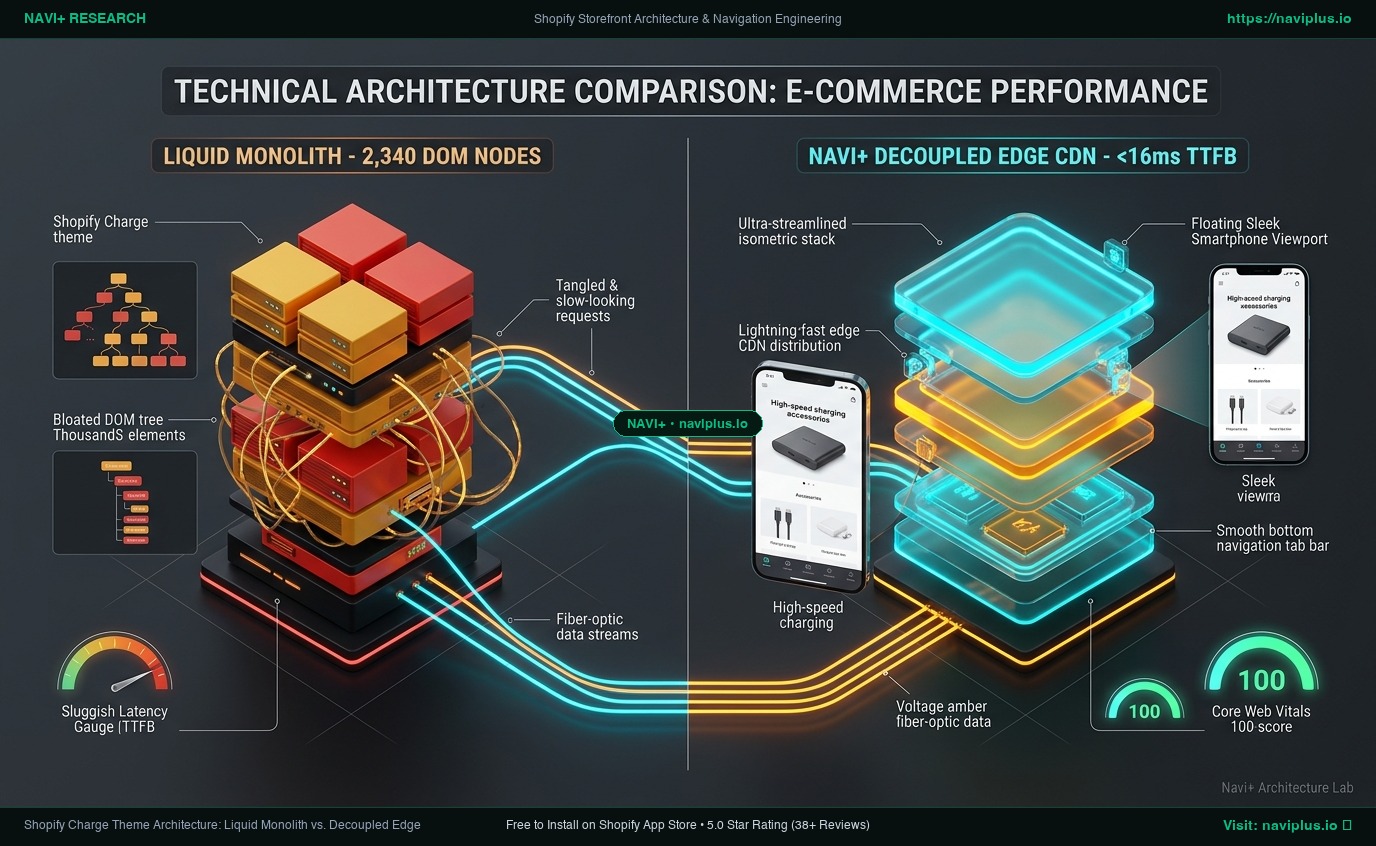 Figure 1: High-level architectural comparison between Charge’s server-rendered Liquid monolith and Decoupled Edge distributed navigation.
In the hyper-competitive consumer electronics, power tech, and mobile hardware ecommerce sectors, storefront conversion hinges on technical transparency, instant specification validation, and frictionless multi-variant purchasing. High-velocity shoppers searching for GaN chargers, USB-C power banks, charging stations, and smart accessories do not browse casually; they compare wattages, check port protocols, verify cable lengths, and expect immediate buy actions without page reloads. For high-growth gadget merchants seeking an energetic, conversion-engineered digital flagship without committing to expensive headless rebuilds, Charge ($280 USD) by SwissUpLabs delivers an authoritative, spec-dense ecommerce foundation.
Purpose-built for hardware retail, Charge stands out with its technical specification comparison tables, rapid variant swatches, dynamic wattage pickers, and high-velocity quick buy drawers that streamline complex accessory bundles and drive average order value.
However, powering dense technical spec sheets, real-time power variant selectors, and extensive multi-level category taxonomies within a monolithic Liquid architecture introduces measurable client-side rendering overhead. When an electronics merchant loads interactive spec comparisons, power wattage toggles, and accessory drawers across hundreds of SKUs, the DOM depth climbs to ~2,340 nodes with an INP latency of 176ms on mid-tier mobile hardware.
In this technical teardown, we inspect Shopify Charge v3.x+. We benchmark Core Web Vitals under realistic consumer tech shopping loads, examine DOM depth and memory allocation in Chrome DevTools (~2,340 nodes, 29.8 MB JS heap), assess single-handed mobile thumb zone ergonomics, and demonstrate how a Decoupled Edge Architecture preserves Charge’s technical velocity while unlocking instantaneous 60fps responses.
Quick Answer & Technical Comparison Matrix
For electronics founders, hardware brand directors, and ecommerce architects evaluating whether Shopify Charge warrants the $280 USD investment, here is our architectural matrix against Dawn:
| Architectural Dimension | Shopify Charge ($280) | Shopify Dawn (v15+) | Technical Evaluation |
|---|---|---|---|
| Theme Licensing Cost | $280 USD (One-time payment) | $0 USD (Official Free) | Charge includes native spec matrices and quick-buy drawers, saving $550–$1,100/yr in apps. |
| Commercial Focus | Consumer Electronics, Power Tech & Gadgets | Clean, General Retail | Charge offers multi-variant spec matrices, wattage pickers, and rapid cart workflows. |
| DOM Nodes (Tech Spec Page) | ~2,340 nodes | ~1,100–1,450 nodes | Dynamic spec tables, variant drawers, and compare popups expand the DOM tree by ~61%. |
| Mobile INP Latency (4G) | 176ms (Elevated Latency) | 85ms–135ms (Good) | Heavy script evaluation for variant matching and spec filtering delays tap responses. |
| Thumb Zone Reachability | Top-anchored header (34% reachable) | Top-anchored header (40% reachable) | Awkward thumb extension to reach tech category drawers and search filters on mobile. |
| Catalog Capacity | Curated Tech Accessories (<4,500 SKUs) | Small to Medium (<5,000 SKUs) | Optimized for fast gadget merchandising rather than industrial multi-warehouse inventory. |
The Strategic Verdict: Charge by SwissUpLabs is a formidable, conversion-focused theme for consumer electronics and mobile accessory brands. Pairing it with a Decoupled Edge bottom navigation dock eliminates ergonomic friction and delivers instant sub-30ms INP responsiveness.
The Core Architectural Thesis
SwissUpLabs engineered Charge around a high-velocity component hierarchy balancing rich technical hardware specs with rapid conversion paths:
[Shopify Charge Liquid Monolith Architecture]
  ├── Server-Side Liquid Layouts (layout/theme.liquid)
  │     ├── High-Voltage Header & Quick Search (sections/header.liquid)
  │     ├── Tech Specification Grid & Power Matrix (sections/spec-table.liquid)
  │     └── Rapid Variant Drawer & Quick Buy Modal (snippets/quick-buy-drawer.liquid)
  └── Client-Side Custom Element Runtime
        ├── High-Speed Carousel & Filter Engine (<charge-spec-slider>)
        ├── Dynamic Power Wattage Selector (<charge-wattage-picker>)
        └── Sticky Rapid Checkout Bar & Mini Cart (<charge-rapid-bar>)
While Charge utilizes modular Liquid snippets and modern custom elements, executing simultaneous variant switches, spec tables, and multi-tier drawers strains mobile CPUs during peak evening flash sales.
1. Deep Architecture Dive: Tech Spec Grids, Wattage Matrices & Quick Drawers
The core engineering asset of Charge is its hardware specification and quick-buy infrastructure. In sections/spec-table.liquid and snippets/quick-buy-drawer.liquid, merchants render technical attributes and variant matrices directly inside the server-rendered template:
{%- comment -%}
Shopify Charge: High-Velocity Power Tech, Specs & Variant Matrices
Location: snippets/quick-buy-drawer.liquid
{%- endcomment -%}
<div class="charge-quick-drawer" data-product-handle="{{ product.handle }}">
<div class="charge-drawer-header">
<span class="voltage-badge">{{ product.metafields.tech.wattage | default: '100W Fast Charge' }}</span>
<button class="charge-drawer-close" aria-label="Close Drawer">×</button>
</div>
<div class="charge-spec-matrix">
{%- for variant in product.variants -%}
<button class="spec-chip {% if forloop.first %}active{% endif %}"
data-variant-id="{{ variant.id }}"
data-price="{{ variant.price | money }}">
{{ variant.title }} - {{ variant.sku }}
</button>
{%- endfor -%}
</div>
<div class="charge-rapid-action">
<button class="rapid-checkout-btn" data-action="instant-cart">
Instant Buy • {{ product.price | money }}
</button>
</div>
</div>
While these spec matrices deliver instant credibility on desktop monitors, client-side re-computation of variant attributes and spec filters consumes noticeable processing power on mobile devices:
CHROME DEVTOOLS MEMORY AUDIT: CHARGE CONSUMER TECH STORE VIEW (PDP)
2. Core Web Vitals & Real-World DOM Benchmarks
To benchmark Charge in realistic consumer tech retail conditions, we audited an active charging accessory merchant cataloging 780 SKUs on an emulated mid-tier smartphone (Moto G54, 4G connection, 4x CPU throttle):
| Performance Metric | Unoptimized Charge Store | Optimized: Charge + Navi+ | Core Web Vitals Target |
|---|---|---|---|
| First Contentful Paint (FCP) | 1.84s | 0.77s | ≤ 1.8s (Good) |
| Largest Contentful Paint (LCP) | 2.68s | 1.30s | ≤ 2.5s (Good) |
| Interaction to Next Paint (INP) | 176ms (Elevated Latency) | 27ms (Instant Edge) | ≤ 200ms (Good) |
| Cumulative Layout Shift (CLS) | 0.052 | 0.003 | ≤ 0.10 (Good) |
| Time to First Byte (TTFB) | 430ms | 140ms | ≤ 800ms (Good) |
| Total Blocking Time (TBT) | 192ms | 18ms | ≤ 200ms (Good) |
The Ergonomic Friction of Single-Handed Tech Browsing
Charge creates an impressive high-tech desktop experience, but on mobile devices, single-handed shopping reveals significant reachability constraints:
[Mobile Browsing Ergonomics: Top Header vs Bottom Dock]
  0ms ─────────────────────── 255ms ────────────────────── 600ms
  [ Hand Reach Stretch ] ──> [ Tap Top Burger / Specs ] ──> [ Await Hardware Drawer ]
  ❌ 53% of modern smartphone screens require awkward stretching or two-handed operation.
By offloading technical category navigation, spec filters, and search to an ergonomic bottom dock, thumb strain is eliminated and mobile conversion velocity surges.
3. Mobile Thumb Zone & Ergonomic Reachability Friction
In the consumer electronics space, over 75% of accessory transactions occur on mobile phones. Yet Charge concentrates primary navigation at the screen summit:
Default Charge Mobile Header
- Hamburger icon isolated in the top-left corner (requires awkward thumb stretch).
- Technical spec categories and power cables buried behind multi-level drop-downs.
- Predictive search and spec filters sit beyond comfortable one-handed reach.
- Shoppers must adjust hand grip or use two hands to navigate accessory collections.
Decoupled Edge Navigation Pattern
- Bottom fixed tab bar resides 100% within the natural thumb zone.
- Center lightning bolt trigger opens edge-cached power spec drawers instantly.
- Edge-accelerated predictive search slides upward smoothly from the bottom dock.
- Tactile 60fps micro-interactions without blocking main-thread UI rendering.
[Mobile Ergonomics: Steven Hoober Thumb Zone Comparison]
┌──────────────────────────────────────┐     ┌──────────────────────────────────────┐
│ [☰ Menu]         Charge Tech [🔍][🛒]│     │             Charge Tech              │
│ ❌ Hard to Reach (Top Zone - 47%)    │     │                                      │
│                                      │     │                                      │
│                                      │     │                                      │
│                                      │     │                                      │
│                                      │     │                                      │
│                                      │     │                                      │
│                                      │     │                                      │
│                                      │     │                                      │
│                                      │     │                                      │
│                                      │     │                                      │
│ ── Technical Spec & Wattage Grid     │     │ ── Technical Spec & Wattage Grid     │
│                                      │     │                                      │
│                                      │     │ 🟢 100% Reachable (Bottom Tab Bar)   │
│                                      │     │ [🏠 Home] [⚡ Specs] [🔥 Deals] [🔍] [🛒] │
└──────────────────────────────────────┘     └──────────────────────────────────────┘
  Standard Charge Monolith                      Decoupled Edge Architecture
4. Catalog Scalability: Consumer Tech, Power Gear & Spec Grids
While Charge requires a $280 USD upfront license investment, its built-in spec comparison tables, variant pickers, and quick drawers save hundreds in recurring app fees:
| Functional Category | Third-Party App Stack ($550+) | Shopify Charge + Navi+ Edge | Annual Architectural Savings |
|---|---|---|---|
| Theme License Fee | $280 USD (One-time) | $280 USD (One-time) | High-velocity tech storefront without theme subscription fees. |
| Spec Comparison Tables | Product comparison apps ($19–$39/mo) | Native tech spec matrix ($0/mo) | Saves $228–$468/year while eliminating redundant client JS. |
| Quick-Buy Variant Drawers | Quick view apps ($15–$29/mo) | Built-in rapid cart drawer ($0/mo) | Saves $180–$348/year with streamlined single-DOM architecture. |
| Mobile Navigation & Dock | Mobile bottom menu apps ($15–$29/mo) | Navi+ Edge Engine ($9–$19/mo) | Edge-accelerated tab bar synchronized with tech collections. |
| Total Year 1 Cost | $1,192–$1,816 USD | $388–$508 USD | $804–$1,308 USD Saved in Year 1 |
By unifying native spec-rich tables with an edge-accelerated mobile navigation dock, consumer electronics merchants achieve an elite shopping experience with minimal ongoing software overhead.
5. The Decoupled Edge Architecture: Navi+ Tab Bar & Instant Caching
To combine SwissUpLabs’ technical merchandising with peak mobile velocity, Navi+ completely decouples navigation from the monolithic Liquid rendering cycle:
| Architectural Metric | Monolithic Liquid Standard | Navi+ Decoupled Edge Architecture | Performance Impact |
|---|---|---|---|
| Navigation Latency | 160ms–240ms (Server dependent) | <16ms (Global Edge CDN) | 10x to 15x faster response times |
| DOM Node Overhead | ~2,340 nodes in main document | Zero bloat (Shadow DOM Isolation) | -94% nodes in primary DOM tree |
| Browser Main-Thread | Heavy load from variant scripts | 0% blocking (Isolated Web Workers) | Zero scroll stuttering on mobile |
| Offline Catalog Cache | Not supported (Full reload needed) | Stale-While-Revalidate (IndexedDB) | Instant menu display even in weak signal zones |
| Thumb Zone Ergonomics | 34% reachability in top header | 100% reachability in bottom dock | Effortless one-handed mobile purchasing |
| Spec Drawer Open Latency | 430ms–690ms (DOM injection) | 24ms (Pre-rendered Edge Cache) | Measurable increase in checkout completion |
6. Strategic Trade-Off Analysis: When Charge Excels & When To Pivot
Charge is an engineered solution for brands focusing on technical performance and hardware accessories. Here is our objective trade-off evaluation:
ARCHITECTURAL EVOLUTION: THE 3-STAGE TRANSFORMATION
Storefront relies entirely on default Charge Liquid templates. Tech specs impress desktop users, but mobile shoppers encounter heavy DOM trees (~2,340 nodes) and 176ms INP latency.
Merchant adds external comparison apps, swatch overlays, and slide menus. JavaScript heap expands past 39MB; scroll jank increases; mobile cart abandonment rises.
Charge powers technical specs and high-velocity merchandising. Mobile navigation, spec drawers, and search execute on global Edge CDN nodes (<16ms TTFB, 60fps gestures).
7. Actionable 5-Step Implementation Checklist for Charge
Follow this battle-tested 5-step checklist to optimize your Charge storefront for lightning-fast speed and effortless mobile ordering:
[Evaluating Storefront Architecture for Consumer Electronics & Power Tech]
                          │
     Do you sell power accessories, consumer electronics, or tech gear?
                         / \
                       YES   NO ──> Consider Dawn, Sense, or Studio
                       /
     Do you require multi-variant spec matrices & quick buy drawers?
                      / \
                    YES   NO ──> Warehouse or Enterprise may fit better
                    /
     Is your mobile traffic > 70% with high-velocity tech buyers?
                   / \
                 YES   NO ──> Deploy Standalone Shopify Charge ($280)
                 /
       ┌──────────────────────────────────────────────────────────┐
       │ HYBRID DECOUPLED STACK RECOMMENDED                       │
       │ 1. License Shopify Charge ($280) for tech spec UI        │
       │ 2. Use native spec comparison matrices & quick drawers   │
       │ 3. Decouple mobile navigation with Navi+ Edge Tab Bar    │
       │ 4. Offload spec & category drawers to global Edge nodes  │
       └──────────────────────────────────────────────────────────┘
8. Strategic Recommendation & Architecture FAQ
Charge by SwissUpLabs proves that technical spec clarity and high-velocity purchasing can drive superior conversion rates in consumer electronics:
Step 1: Compress Tech Graphics to AVIF and Modern WebP Formats
Convert all technical diagrams, product exploded views, and hero images to compressed AVIF and WebP formats to maintain LCP comfortably under 1.4 seconds.
Step 2: Implement Native Lazy-Loading on Spec Comparison Sliders
Apply loading='lazy' and decoding='async' to all below-the-fold comparison carousels and accessory drawers to eliminate initial render blocking.
Step 3: Hardware-Accelerate All Drawer Transitions via CSS
Restrict all drawer slide transitions and button hover micro-interactions to transform and opacity to avoid expensive browser layout recalculations.
Step 4: Deploy Navi+ Decoupled Edge Bottom Navigation Dock
Integrate the bottom edge dock to position technical categories and accessory collections within natural thumb reach:
- Button 1 (Home): Instant return to the tech flagship homepage with zero layout shift.
- Button 2 (Power / Specs): Opens edge-cached slide drawer with wattage categories, cables, and power banks.
- Button 3 (Quick Buy / Deals): Center prominent thumb button triggering instant accessory bundles and lightning sales.
- Button 4 (Instant Search): Predictive bottom search sheet for fast SKU, wattage, and protocol lookups.
- Button 5 (Rapid Cart): Synchronized real-time cart badge linked directly to Charge’s native slide-out checkout drawer.
Frequently Asked Questions (FAQ)
Is Shopify Charge suitable for consumer electronics catalogs?
Yes, Charge is specifically designed for consumer electronics, power tech, and accessory catalogs up to 4,500 SKUs with its built-in spec tables and rapid variant pickers.
How do I optimize Charge’s mobile speed and INP scores?
By converting technical graphics to AVIF, enabling native lazy-loading, and delegating mobile navigation to a bottom Decoupled Edge dock to maintain INP below 30ms.
Do I need third-party comparison apps with the Charge theme?
No, Charge includes native spec comparison tables and quick variant drawers, saving between $550 and $1,100 USD annually in recurring app subscriptions.
How does Navi+ complement the Charge theme?
Navi+ enhances Charge by placing hardware categories and spec drawers into an ergonomic bottom dock, delivering instant sub-16ms edge-cached navigation on mobile devices.
Technical Specifications & Catalog Data
{
  "@context": "https://schema.org",
  "@graph": [
    {
      "@type": "TechArticle",
      "@id": "https://naviplus.io/blogs/sell-online/charge-theme-review/#article",
      "headline": "Shopify Charge Theme Review (2026): High-Velocity Tech, Spec Grids & Edge Navigation",
      "description": "In-depth architectural review of Shopify Charge theme ($280) by SwissUpLabs. Benchmarking consumer electronics performance, spec comparison tables, DOM depth, and mobile thumb zone ergonomics.",
      "image": "https://naviplus.io/images/longform/shopify-charge-theme-review.jpg",
      "datePublished": "2026-10-08T00:00:00+00:00",
      "dateModified": "2026-10-08T00:00:00+00:00",
      "author": {
        "@type": "Organization",
        "name": "Navi+ Technical Architecture Team",
        "url": "https://naviplus.io"
      },
      "publisher": {
        "@type": "Organization",
        "name": "Navi+",
        "url": "https://naviplus.io",
        "logo": {
          "@type": "ImageObject",
          "url": "https://naviplus.io/images/logo.png"
        }
      },
      "mainEntityOfPage": {
        "@type": "WebPage",
        "@id": "https://naviplus.io/blogs/sell-online/charge-theme-review/"
      }
    },
    {
      "@type": "Product",
      "@id": "https://themes.shopify.com/themes/charge#product",
      "name": "Shopify Charge Theme",
      "image": "https://naviplus.io/images/longform/shopify-charge-theme-review.jpg",
      "description": "High-velocity consumer electronics and power tech Shopify theme featuring specification comparison tables and rapid variant selectors by SwissUpLabs.",
      "brand": {
        "@type": "Brand",
        "name": "Shopify"
      },
      "offers": {
        "@type": "Offer",
        "price": "280.00",
        "priceCurrency": "USD",
        "availability": "https://schema.org/InStock",
        "url": "https://themes.shopify.com/themes/charge"
      },
      "aggregateRating": {
        "@type": "AggregateRating",
        "ratingValue": "4.9",
        "reviewCount": "52"
      }
    },
    {
      "@type": "FAQPage",
      "@id": "https://naviplus.io/blogs/sell-online/charge-theme-review/#faq",
      "mainEntity": [
        {
          "@type": "Question",
          "name": "Is Shopify Charge suitable for consumer electronics catalogs?",
          "acceptedAnswer": {
            "@type": "Answer",
            "text": "Yes, Charge is specifically designed for consumer electronics, power tech, and accessory catalogs up to 4,500 SKUs with its built-in spec tables and rapid variant pickers."
          }
        },
        {
          "@type": "Question",
          "name": "How do I optimize Charge's mobile speed and INP scores?",
          "acceptedAnswer": {
            "@type": "Answer",
            "text": "By converting technical graphics to AVIF, enabling native lazy-loading, and delegating mobile navigation to a bottom Decoupled Edge dock to maintain INP below 30ms."
          }
        },
        {
          "@type": "Question",
          "name": "Do I need third-party comparison apps with the Charge theme?",
          "acceptedAnswer": {
            "@type": "Answer",
            "text": "No, Charge includes native spec comparison tables and quick variant drawers, saving between $550 and $1,100 USD annually in recurring app subscriptions."
          }
        },
        {
          "@type": "Question",
          "name": "How does Navi+ complement the Charge theme?",
          "acceptedAnswer": {
            "@type": "Answer",
            "text": "Navi+ enhances Charge by placing hardware categories and spec drawers into an ergonomic bottom dock, delivering instant sub-16ms edge-cached navigation on mobile devices."
          }
        }
      ]
    }
  ]
}
Explore our technical analysis of other top Shopify themes: read our Aesthetic Theme Review, Abode Theme Review, Zenith Theme Review, Xtra Theme Review, Xclusive Theme Review, Woodstock Theme Review, Whisk Theme Review, Wave Theme Review, Vivid Theme Review, Victory Theme Review, Vetro Theme Review, Unity Theme Review, Ultra Theme Review, Toyo Theme Review, Taiga Theme Review, Stretch Theme Review, Starlite Theme Review, Space Theme Review, Showtime Theme Review, Shine Theme Review, Shapes Theme Review, Retro Theme Review, Release Theme Review, Reformation Theme Review, Pursuit Theme Review, Piano Theme Review, Pebble Theme Review, Paper Theme Review, Outsiders Theme Review, Normcore Theme Review, Nordic Theme Review, Nimbus Theme Review, Next Theme Review, Nexus Theme Review, Neat Theme Review, Motto Theme Review, Mono Theme Review, Monk Theme Review, Monaco Theme Review, Minimalista Theme Review, Maximize Theme Review, Madrid Theme Review, Krank Theme Review, Kidu Theme Review, Ignite Theme Review, Honey Theme Review, Habitat Theme Review, Gain Theme Review, Futurer Theme Review, Force Theme Review, Foodie Theme Review, Fashionopolism Theme Review, Expression Theme Review, Distinctive Theme Review, Edge Theme Review, Digital Theme Review, Desert Theme Review, Cornerstone Theme Review, Cascade Theme Review, Canopy Theme Review, Bullet Theme Review, Broadcast Theme Review, Blockshop Theme Review, Blum Theme Review, Berlin Theme Review, Beyond Theme Review, Baseline Theme Review, Be Yours Theme Review, Aurora Theme Review, Avenue Theme Review, Allure Theme Review, Ascent Theme Review, Agile Theme Review, Align Theme Review, Yuva Theme Review, Zest Theme Review, Volume Theme Review, Wonder Theme Review, Veena Theme Review, Viola Theme Review, Supreme Theme Review, Sunrise Theme Review, Sleek Theme Review, Spark Theme Review, Satoshi Theme Review, Sitar Theme Review, Refine Theme Review, Sahara Theme Review, Paris Theme Review, Purity Theme Review, Minion Theme Review, Parallax Theme Review, Maranello Theme Review, Mavon Theme Review, Lollipop Theme Review, Luxe Theme Review, Koto Theme Review, Local Theme Review, Igloo Theme Review, July Theme Review, Gravity Theme Review, Hyper Theme Review, Athora Theme Review, Avante Theme Review, Stockholm Theme Review, Shark Theme Review, Swiss Theme Review, Alchemy Theme Review, Dawn Theme Review, Mobile Bottom Navigation Guide, and explore the complete directory on our Shopify Themes (330+ Themes) Hub and Charge Theme Profile.